Not Just a Bulkhead Ornament
Barometer Basics
 When the glass falls low,
Prepare for a blow;
When it slowly rises high,
lofty canvas you may fly
One of the oldest and most basic pieces of equipment mariners have - or ought to have - on board is a barometer to measure the pressure a column of the atmosphere exerts on the surface of the earth. We all know that it is the geographical difference in atmospheric pressure that creates wind and weather. Our passage through high and low pressures - or their passage by us - can be monitored by a barometer.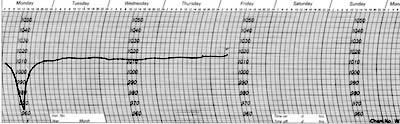 In past issues we have looked at state-of-the art weather-gathering equipment, such as weather fax, and even devices to illustrate real-time weather on our laptops. But we haven't talked about the simple barometer which, sadly, is often not even on board many boats these days. If it is, it is considered more of a bulkhead decoration, rather than a simple and reliable instrument to gather the most basic and vital weather indicators.
Barometer basics
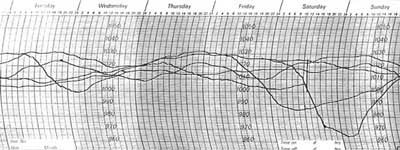
Clearly, a falling barometer indicates an approaching low-pressure system and its associated stormy, rainy weather. A rising barometer indicates an approaching high-pressure dome, which generally creates fair weather and light winds. Since most of our voyaging is done with relatively small vessels, our speed is much slower than that of an approaching weather system, so the weather will track over or by us. By monitoring the change in pressure and the change in wind direction, we can further analyze what is occurring in the big weather picture. A few years back we were delivering a yacht from St. Martin to Newport, R.I. and had a recording barometer, or barograph, on board. As we approached the Gulf Stream, forecasts indicated an approaching frontal system. We were enjoying a fair southerly, and as the front passed, we experienced a rapid increase in velocity and shift through east to the northwest. Maximum wind speed was about 45 knots. Figure 1 shows exactly the passage of the front and the steepness of the pressure gradient.
Figure 2 is an actual plot of Hurricane Bob as it passed directly over Newport, R.I. in 1991. Note the extremely steep pressure gradient, which generated winds of hurricane force. Another important point is that the gradient is steepest on the backside after the center had passed. It is not uncommon to experience the heaviest winds on the clearing side of a low center.
Long foretold, long past,
Short notice, soon past,
Quick rise after low,
Sure sign of stronger blow.
The good news is that things will improve. The rate at which pressure rises or drops is more important to the mariner than the exact reading of the pressure. A very rapid drop in pressure (or steep pressure gradient) will create strong winds, as will a steep rise in pressure. The rate of change is relative to the speed of the approaching system or how close together a high and low are. It is not uncommon to have stationary features with high-pressure gradients between. Or the lows can zoom by, creating the same rate of change. Imagine the steepness of pressure gradients as the steepness of a hill with a ball rolling from the top. On a gentle hill the ball will roll slowly; on a steep hill, the ball will roll a lot faster. It is no different with particles of air, although the wind does not flow directly into the lows but rather spirals towards the low due to the Coriolis Force (see "Buys Ballot's Law: As the World Turns" on page 19). Generally speaking, in the Northern Hemisphere, if the pressure is dropping and the wind is backing through the southeast, the low center will pass to your south. Conversely, if the wind clocks from southeast to southwest, the low will pass to the north.
Another occurrence, which is often overlooked, is the daily change in pressure - with a maximum at about 1000 and 2400 (10 a.m. and p.m.) and the minimum at about 0400 and 1600 (4 a.m. and p.m.). This daily variation can be as much as 0.05 inches of mercury. Since barometric pressure does not change rapidly (you can't watch it fall), barometer readings are usually logged into the logbook at regular intervals to keep track of trends. A better method is to graph pressure readings manually, with the horizontal scale covering four or five days.
Barometer types Mercury barometer: With the exception of the shark's oil weather glass, the oldest form of barometer is a tube of mercury, closed at the top, and with a vacuum at the top. The bottom is immersed in an open container of mercury. The atmospheric pressure on the surface of the mercury will keep the column of mercury "up" at a height of about 30 inches - hence the "inches" scale we are accustomed reading. As the pressure varies, the column of mercury will rise and fall. However, weather maps are graduated in millibars, so most barometers are graduated with both scales.
Aneroid barometer: While very simple and accurate, the mercury barometer is not practical on a rolling, pitching boat. The aneroid barometer was developed to allow mariners to take a measuring device to sea. It works on exactly the same principle as the mercury barometer, but the inner workings can be oriented in any direction and there are no liquids to spill.
Essentially, there is a very thin-walled metal diaphragm, which is partially evacuated - or has a partial vacuum - and expands and contracts with variations in atmospheric pressure. Through a series of levers and gears, this deflection is mechanically translated into a rotary motion and is displayed on a circular face that we are accustomed to seeing.
Clearly, temperature will have a bearing on the expansion and contraction of the diaphragm too. This is dealt with by using bi-metal construction, which reduces thermal effects. A reference hand is manually aligned with the reading hand to help the user better detect changes. Graduations are usually in both millibars and inches of mercury.
A typical aneroid barometer has a scale covering four inches (27.5 to 31.5). Most of the action is at mid-scale, and the extremes are rarely touched. Also, with a large range, very small changes are not readily apparent. The diameters vary, but it is obvious that the larger the diameter, then the larger the graduations and the easier it will be to read. I have a quality instrument that has only two inches total scale, and I find this very easy to read and very accurate.
These instruments are very rugged, and accurate, with precision of +/- 1.0 millibars (0.03 inches). Usually sold with matching clocks and housed in brass cases, they are handsome additions to any vessel. Prices vary a bit, from $350 to under $100, and the more expensive will have temperature compensation and a heavy solid brass case. Less expensive models may have the same innards, but a cheaper stamped-brass or even plastic case. Robert E. White of Boston, Chelsea, and Seth Thomas are all reputable manufactures of these precision instruments.
Barograph: My preference in barometers is a recording barometer, or barograph. It is essentially the same in operation as an aneroid barometer, with metal diaphragm, levers and gears to mechanically translate the movement to a pointer. However, the pointer contains a small ink pen with its writing surface a drum turning on a vertical axis. A chart is attached to the drum, which typically turns at a rate of 1 revolution per week. As the drum turns, an ink trail is left creating a continuous record of barometric pressure (see figures 1 and 2).
I find that this feature of having a permanent record useful for analyzing what is going on or, at the end of a passage, comparing it to weather charts. I suppose it is the same mind set that keeps me plotting with chart and pencil, even though the vessels I sail are frequently equipped with computers and charting devices.
It used to be that the drum was driven by a wound spring and required periodic winding, just like the old ship's clocks. However, newer models have a battery-driven quartz movement, which is more accurate and will last up to nine months. Figures 1 and 2 are examples of the what a week's chart looks like. The most popular model and the one I have used the most is a beauty made by Weems & Plath (of sextant fame) housed in a glass and mahogany case. It is pricey, though, with a sticker of $1,450. However, it is not only a precision instrument, but also a handsome showpiece. A smaller circular model is priced at $600.
Electronic barometer: On to modern technology. Our world has turned to solid state, so why not barometers? For quite a long time, commercial and industrial applications have used solid-state and digital instrumentation for various manufacturing processes. This technology has trickled down to the marine industry, and several electronic barometers are made specifically for yachts.
One of the beauties of the new electronics is their size, and electronic barometers are no exception. But how to get over the clunky metal diaphragm that senses the changes in pressure. Vaisala, a European manufacturer of fine electronic devices, uses their Barocap to sense even the most minute changes in pressure. Rather than use a metal diaphragm, they have developed a silicone diaphragm that is stable, has excellent thermal properties, and has perfect elasticity. In essence, as the silicone diaphragm deflects, the capacitance of the sensor changes. This variation is measured electrically and converted into a pressure reading. This information can be displayed in virtually any manner - as a digital numeric display, graph or barograph.
The Baroscope, offered by Robert E. White and Vetus Den Ouden, presents the pressure reading in a graph format with the horizontal scale capturing 24 hours. The vertical scale (pressure) is greatly exaggerated, so slight variations can easily be seen. The current time and pressure is always on the right edge of the screen with the past 24 hours trailing off to the left. This device runs on either AA cells or a 12VDC power source. An additional feature is an audible "gale warning," which will sound if the rate of change exceeds a preset value. This unit is prices at $795.
Both Robert White and Prosser Industries (UK) offer a simple single-line digital readout of barometric pressure with the added feature of storing data for up to 35 days, which can be recalled for analysis. White's Nimbus also has a standards RS232 output to satisfy the computer buffs. Prosser's Weathertrend will also keep track of trends and indicates significant trends. Both are battery-powered to avoid power outages and improve reliability. Prices on these units start at $375.00.
Speedtech Instruments has marketed their popular Weathermate recording barometer for some time and it is an attractive package. Battery-driven, its display is a vertical barograph with a 24-hour history. Units are select able, and humidity and temperature are also displayed. Icons are also displayed (clouds, sun, rain), depending on the trends the instrument senses. Of all of the digital units we have seen, this is the most affordable at $94.95. It can be wall mounted or has its own base for table applications.
Wrist barometers: The gadget nuts among us will be relieved that barometers are now available as part of a wristwatch. With technology allowing everything to become smaller and smaller, it is only logical. Both Casio and Suunto (a large Finnish manufacturer of compasses) offer watches that include barometers. I suppose that the silicone diaphragm has been reduced in size to fit the case and the internal processor programmed to do the rest. Suunto's Vector even has a trend feature with history to four days, and it also displays temperature. What next? The only down side I see to these watches is that only the wearer can read them, which makes it awkward for non-wearers to make log entries. Prices start at $199 (Vector).
The BWS conclusion
Clearly there are traditional barometers to give us the basic information of weather-generating forces around us, and technology has introduced sophisticated new products to do the same. All are sensitive instruments, built to take the rigors of a voyaging vessel. With the exception of the wrist mounts, take care where you mount your barometer. Barometers are sensitive, and if mounted near a companionway, will pick up variances caused by even gusts of wind, if exposed.
Keep them dry, and they should last a lifetime. Have them calibrated periodically, and you'll trust them implicitly. Call your local airport or port authority Met office for their current reading, and make the adjustment with the setscrew on the barometer's back. Often, you'll hear weather Samaritan Herb Hilgenberg (Southbound II) tell boats that their barometers are not calibrated properly, and then offer the correct barometric pressure, which nearby boats listening in can note.
Aneroid: At BWS, we feel that a barograph is the best device going. On the traditional side, we would have the Weems & Plath barograph on board. Good looking and functional, it's a great piece of equipment, albeit expensive.
Electronic: For cost-effectiveness, the Weathermate from Speedtech is a great value, and will give you all the information you need. While the barographs don't have the resolution we like, the numeric display takes care of that. If you have a few more dollars to spend, the Baroscope from Vetus Den Ouden and Robert E. White looks good with its easily read graph. In the end, any barometer is better than none. And nobody should be out there without one.
At sea with low and falling glass
Soundly sleeps a careless ass,
Only when it's high and rising,
Truly rests a careless wise one.
- a seaman's rhyme