Caribbean Storm-book review
Excerpt from A Mile Down: The True Story of a Disastrous Career at Sea
 In the last light of day, my wife Nancy and I saw an enormous wave. Our bow went up and still the wave rose and then it was breaking above us. Our bow went so high, so straight up into the air for so long, we could feel our entire 90 foot yacht-all 200,000 pounds of it-actually hanging, ready to fall backward off the wave, and still the wave rose higher and the part that had broken was blown over our pilothouse at highway speed, thousands of gallons of water turned into smoke.
We hung and the boat fell to the side, everything crashing. I could hear our wedding gifts, which had been stored in cupboards in the galley, hitting the cabinet doors so hard they broke open and everything fell twenty feet across the main salon to the port side. Other heavy thuds and bangs throughout the boat, things breaking. And then our bow plowed into the next wave with such force that our teak platform on the steel bowsprit was blown off its bolts. Our bow went deep into solid water, and that wave turned us 90 degrees. We tipped left in the trough, broadside now to the waves, and the next wave hit the side of our hull so hard we were picked up out of the water and dropped again. Everything from the main salon crashed back into the galley.
I gunned the engines and brought us around to port, spinning the spoked wooden helm a full 11 turns, so that we took the next wave on the bow, though I was worried about the integrity of the bow. What was left of the heavy teak platform and its stainless steel railing was loose and banging. I was afraid the force of that wood flying up would catch the underside of our roller furler and the impact would break our headstay. If that happened, our heavy wooden masts could come down backward right on top of us.
These were the worst seas I had ever been in. It was likely we would lose our lives. No help available, and the conditions so bad we wouldn't be able to get into our life raft.
Nancy remained calm. She helped assess the damage. "Everything from under the stern platform is out on deck. Both dinghies still attached. Galley, everything has opened and fallen. Do you want me to check more below?"
A lot of hard objects were flying back and forth across the main salon, but our Inmarsat station was down there and we needed weather information. "We have to find out what we're in. It could be a hurricane, but I don't think it is, because it couldn't have formed so fast and it feels too cold. I think it has to be a cold storm from north of us that collided with a tropical system."
Nancy went below to the chart table.
"Tell them we have more than 60 knots of wind," I yelled. The storm and engines were very loud. "Seas over 30 feet, with some bigger waves mixed in, and no report for this area. Tell them please send a report. And be careful. Hold on."
It was dark now. I couldn't see the bowsprit anymore, but I could see the steaming light halfway up our mainmast lighting the headstay, which was swinging wildly back and forth, several feet to either side. I was afraid it would go. After each concussion, I looked up to check.
I couldn't see the waves now, couldn't see what was coming. I focused on the compass, keeping us on a heading between 0 and 30 degrees, using more throttle on the engines whenever we threatened to fall off course. The wind was so loud I kept thinking I was hearing things: other boats, whistling in our engines, Nancy's voice, songs as if a radio were playing, though I had turned off the Walkman. Nancy said she thought she could hear songs, too, now and then.
There was no predicting when the hardest hits would come. But it was never more than five or ten seconds before another wave would stop our bow and the shock would reverberate through the boat. Then solid water would crash over the foredeck, the windows underwater, then clear except for spray that pelted them in flurries.
I was beyond caring about the wedding gifts and equipment and other things that were being destroyed. We had worked hard to prepare for our charter, and the boat had looked beautiful only the day before, when we had left Trinidad for the British Virgin Islands, and this damage would set us back, but all I wanted was for us to survive. For that to happen, the headstay needed to remain attached, the rudder and steering had to hold, and the engines needed to keep running. And I had to keep us from getting rolled over and buried.
The experience felt similar, in its grimness, to the time I had steered with only the engines and no rudder for 10 hours in a storm off the Moroccan coast. But these seas were far worse. Even with a working rudder, these were more dangerous because they were so sharp and irregular. They were straight walls, some of them, with water breaking down onto us, and each one hit us from a different angle. I steered into them for hours, not able to see but trying to guess where they were. Everything done by feel and by the compass. Nancy stopped trying to go below or to tie anything down, and we just braced ourselves and waited. I found myself saying, "Please, please," over and over in my head, though I'm not religious and don't pray. It's impossible not to beg for help, even if you have no one to beg.
I wanted it to end, but it went on for a long time, about six hours. Living second by second in darkness and fear makes six hours an exquisitely long time.
But the wind and waves did finally die down, to 40 knots and 15 feet, then 30-35 knots and 10 or 12 feet, and finally 25 knots and 10 or 12 feet, which was manageable. It was near midnight when I asked Nancy to take the helm for an hour so I could inspect the boat and take a nap.
In the engine room, I found water and sediment in the diesel filters. Water is deadly to a diesel engine. If the water filled these and the other filters and made it to the injectors, the engines would stop.
The steel walls between the diesel and waste water tanks must have ruptured from the force of the waves. This was unheard of, but it must have happened to both tanks because they were isolated from each other by valves and yet both had taken in water and sediment. We had been hit hard.
I turned off the port engine, bled water and sediment from its tank and then its filter, and restarted it, then repeated for the other engine. I was drenched in sweat and dizzy from all the diesel fumes, naked except for my shorts, with diesel on my hands and feet. I climbed back up to the helm and turned on the starboard engine. It raced and fell a bit but held.
"There's so much crap in them right now," I told Nancy. "So much that must be getting through those dirty filters. Especially the starboard engine, since I did it last. I should probably bleed it underway, to try to blow some of the crap out of the injectors."
I went below again and stood over the starboard diesel loosening then retightening the caps on each injector, one at a time. The engine could run temporarily on just five cylinders instead of its full six. When uncovered, the injectors spat out diesel mist at high pressure, covering me head to toe, but they also spat out some bubbles, which were air, and I saw round clear drops of water slide down the side of the engine like fat.
The only thing I wanted now was sleep. We had been underway for almost two days, just the two of us alternating at the helm, ninety minutes each, and then I had taken the helm for six hours in the storm. But there were more problems before I could rest. In the aft bilge, water was rushing from side to side like a river as we rolled in the waves, hitting the underside of the aft stateroom floors with such force it was coming up along the walls, in every small carpenter's gap. The mahogany was swollen and was going to warp.
I opened the small hatch for the bilge. The water ran unchecked now, over both varnished floors, back and forth from one room to the other as we rolled. I grabbed a small plastic bucket, opened a porthole, and started bailing.
On one bailing trip, as I took the few steps from the bilge toward the porthole with my full bucket, we hit a large wave and I slipped on the wet varnished floor and went straight up. I was about five feet off the floor, horizontal in the air, holding the bucket of water. Then gravity kicked in and I was dropped on my back onto the wood and the bucket.
I couldn't move, couldn't breathe. The boat was still rocking and bucking, the water running back and forth, hitting the underside of the floor hard and sloshing me from above, and I was sliding around, my head hitting against the foot of the bed.
Then I took a breath, which hurt. My back was stunned. I managed to sit up and breathe again, fell sideways, then sat up and held on. I waited a few minutes, thinking that if I had cracked my head open and were bleeding and unconscious, Nancy wouldn't even know, and in these conditions, without an autopilot, she wouldn't be able to leave the helm. We were taking such stupid risks. What the hell was I doing, bailing at night on a varnished floor in big seas when I was dizzy, exhausted, and nearly naked?
When I was able, I made my way slowly down the hall and up to the pilothouse to tell Nancy what had happened. She looked at my back. "You took off some of the skin by your scar," she said. "And it's red. You hit the entire muscle on your right side."
I lay down on the pilothouse cushions, our bed for the past two days, and tried to breathe. My back was so tight, it wasn't easy.
"This boat isn't worth it," I said. "It's not worth dying or even getting hurt out here."
"I don't want to do this ever again," Nancy said. "Next time we have to stop at Rodney Bay so we're always close to islands, instead of a hundred miles from land."
"I agree," I said. She had managed to stay calm through all of it, which was pretty impressive. And she was still willing to do these delivery trips, just closer to land.
By daybreak, the conditions had died down to 20 knots and 10 feet, but the seas looked cold, as if we were much farther north, the seas I knew from Alaska and off the Washington and Oregon coasts. Maybe it was the clouds everywhere in the distance, and the sky that was hazy and white, so that water, clouds, and sky all shared the same color, all seemed part of the same body. I remembered this same seascape on a morning on my first boat, Grendel, leaving Victoria; I remembered it outside of Ketchikan with my father; I remembered it on a purse seiner in the Cook Inlet. But it was strange for the Caribbean.
Out of the milky white came a large container ship, the Tropic Sun. It passed us to starboard, heading southeast. I hailed the captain on the VHF, asking for weather information.
"We didn't have any warning," he said. "We had about the same conditions as you, though much father north. Nothing on any forecast or report."
I asked what we could expect ahead, on our way to the Virgin Islands.
"All conditions diminishing, it seems. Though there's still no report."
"Have you ever seen the reporting stations fail like this?" I asked.
"No," he said.
I thanked him and continued on toward a far line of thick clouds, hoping we weren't heading straight into another storm. The strange weather was everywhere, land was far away, and there were no reports, so there was nothing to do but just continue on and hope for the best.
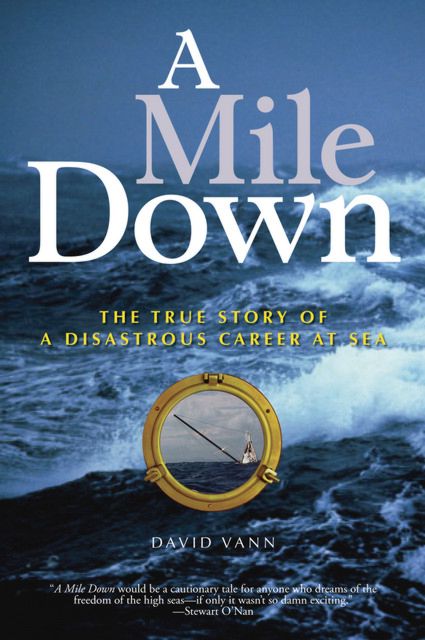
David Vann's new sailing memoir, A Mile Down: The True Story of A Disastrous Career at Sea, is exciting stuff. It's the true story of building a yacht in Turkey and losing it twice, first after the war in Kosovo and the second time to a storm in the Caribbean which sinks it a mile down. It's also about the legacy of his father's dreams and failures at sea and eventual suicide.
David has been published in The Atlantic Monthly, has taught at Stanford and Cornell, and currently teaches Travel and Adventure Writing for Oxford, Stanford, and Yale. He also has the sailing credentials, with a 200-ton license, 40,000 miles offshore, and experience running charters in a dozen countries. His most recent project was to design and build a 90-foot aluminum charter catamaran. Excerpts of his book will be published on boats.com and in Sailing Magazine.
David will be on the west coast in June and August, the east coast in July and September as part of a book tour which so far includes 21 cities. To check tour dates and locations see www.davidvann.com
To schedule a book reading at your yacht club or bookstore, email David at [email protected]
To order the book through Amazon.com click HERE.