Counting Sheep
In spring, look for sheepshead on artificial reefs
June 27, 2001

Georgia DNR researcher Jeff Mericle prepares to tag a sheepshead caught offshore on an artificial reef.
The 4-ounce sinker bounced lightly on the wreck 40 feet below. In my mind, I pictured the two dropper loops waving in the slight current, moving every time the fiddler crab baits got nervous.
I could feel every twitch of the line.
Suddenly, the rod tip vibrated. That's all. It vibrated. Just as if the first tiny tremors of an earthquake had rocked the graphite. I waited for the pull, fingers on the reel handle.
Nothing.
I reeled the bait up. Nothing. No fish. No bait.
"What the heck am I supposed to do when the fish just breathes on the bait?" I asked my fishing buddies, two Georgia Department of Natural Resources researchers.
"Just set it when you THINK he's there," one said.
This isn't fishing, this is mind-reading.
That's what I get for tangling with sheepshead. Convict fish. Their reputation as bait stealers is legendary.
Of course, researchers Spud Woodward and Jeff Mericle kept horsing in the fish. After years and hundreds of sheepshead caught, they have the timing it takes to foil even the larger fish. The ones who — in my vivid imagination — use mental telepathy to shake the fiddler loose from the hook.
Fish in Need?
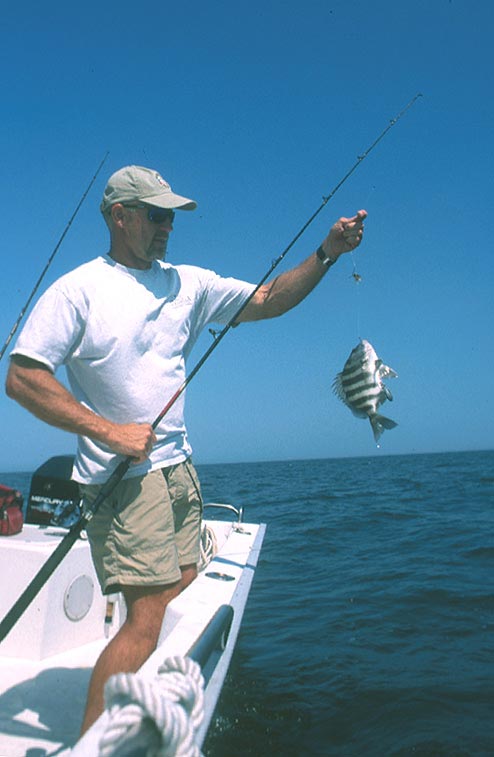
Georgia DNR researcher Spud Woodward catches another sheepshead during an April offshore trip.
The Georgia DNR has been tagging sheepshead since 1997 on wrecks such as the submerged landing craft we fished in mid-April about 7 miles off St. Simons Island. Using tag returns and captured fish for research, the DNR is setting the groundwork for understanding the fishery.
Sheepshead may seem unloved and unwanted now: Top sportfishing magazines rarely feature sheepshead among their colorful gamefish how-tos. But the Georgia DNR is concerned that dwindling supplies of its cousin — the red porgy — and tighter rules on snapper and grouper may cause recreational and commercial fishermen to focus more heavily on sheepshead.
The scientists are practicing a little preventive medicine.
But prevention is a balancing act. The question scientists are trying to answer is: At what point does protection become overreaction?
Mature sheepshead swarm on artificial reefs off the Georgia coast — and through much of the southeastern United States — from January through May. Subsequent scuba dives I made with the DNR in April showed huge schools of sometimes 10-plus-pound sheepshead mulling about the submerged structure.
Scientists believe the fish are there to spawn. Spawning peaks in April, and by May, some of the fish wander back to the marshes and estuaries to haunt bridge pilings, docks and other structure; some stay offshore yearround.
When the fish congregate on artificial reefs, they are vulnerable; just as snook become easy targets in Florida when they arrive en masse to the inlets each summer.

Georgia DNR researcher Spud Woodward displays a tagged sheepshead.
Sheepshead become mature and able to reproduce when they reach about 12 inches in length, or about 3 to 4 years in age, according to a Georgia DNR research paper by Woodward and co-worker Paul Medders presented in February at an American Fisheries Society Southern Division meeting. However, most of the state's surveys show smaller, immature fish — about 8 inches long — are the dominant catch.
Georgia enforces an 8-inch minimum size limit on sheepshead with a 25-fish bag limit. In South Atlantic federal waters, sheepshead are part of the snapper/grouper aggregate; possession is limited to 20 fish and there is no minimum size. Other southern states range in their limits; Florida allows a 15-fish daily take with a 12-inch minimum.
Currently, there is little commercial effort directed on the fishery off of Georgia. The minimal sheepshead landings are classified as bycatch. But that may change.
"The percent of the harvest that is mature is 38 percent (in Georgia). Commercial landings are increasing. Will there be a shift to sheepshead?" Medders asked fellow scientists in his February presentation.
The Georgia scientists will recommend that rulemakers increase the minimum size limit to 10 inches fork length and lower the take to a 15-fish-per-day bag/possession limit. Their research, which is paid for by Federal Aid in Sport Fish Restoration, could influence neighboring state and federal rules.
The proposal first goes to the state's Board of Natural Resources in May. Once approved or modified, it will go to the public for comment in June then back to the board for potential rulemaking.
Redefining Gamefish
Recreationally and commercially, sheepshead are taken by hook-and-line. That relatively inefficient fishing method, the fish's wiles and its preferred crustacean diet are factors that may have protected sheepshead until now.
But anglers are getting more proficient. We have super-sensitive and super-strong braided lines, and we're finding ways to target sheepshead on tidal flats and at other locations where they've been historically safe from human predation.
On the landing craft wreck off Georgia earlier this month, we released every sheepshead we caught after the biologists tagged them and recorded their size. And while it was the first time I had actively targeted sheepshead, I was struck by the many similarities between bottom-fishing for sheepshead and hauling in smaller snapper or grouper species.
Sure, they're not very glamorous. In fact, they're downright ugly. Their protruding buck teeth give them a goofy expression and their broad black stripes and silver coloring fail to inspire the kind of homage paid to beautiful, bronze redfish.
But feeling the take of a 5-pound sheepshead on a 12-pound conventional rod, then beating the fish to the bite and bowing the rod as it bounces toward the bottom, is challenging. These fish are not pushovers.
A Simple Process
Doing battle with sheepshead begins with collecting bait, which itself may be painful. Fiddler crabs can be found at low-tide on marsh flats. Pick the crabs as they race toward their holes and collect them in a bucket.
Males have an extended pinching claw while females do not. Try grabbing the males so that you pin the claw to their body.
When you head offshore, it's best to have done your homework. You will need some specific coordinates for artificial reefs. Sheepshead have been found as far offshore as 20 miles, but will be most abundant in depths from 40 to about 70 feet off Georgia.
On the DNR trip, we used a grapple to snag the wreck. But it wasn't easy. We marked the wreck, then drifted over it multiple times before successfully hooking the structure.
The fish will be directly above and in the wreck. And they won't move off to find your bait. So be on target.
Rigs are simple. Tie a snap swivel to your line and fashion a leader from about 18 inches of 40-pound-test monofilament. Tie a loop knot at the top and bottom of the leader. One end attaches to the snap swivel; the other is looped through the eye of a bank sinker and over the lead. Use enough lead to hold bottom, usually 3-5 ounces depending on the current.
Tie two dropper loops about 4-6 inches apart that extend from the leader several inches. Thread each loop through and over an Eagle Claw 084 ring-eye hook (No. 2 to 1/0 in size).
Some anglers have had success using modified circle hooks, which apparently hook the sheepshead through the lip, Woodward said. Either way, you need a strong enough shank so the fish's teeth don't bite through the metal.
Pick two hefty crabs from your bucket and push the hooks through the carapace beginning near one of the hind legs.
Drop the baits down to the structure, re-weighting if the rig doesn't hold bottom. Some anglers like to take a few quick cranks on the reel to lift the bait slightly up off the bottom. I found more hits — or at least felt more hits — when I let the sinker ride on the wreck.
The rest is practice. First dumb luck finds you, and you hoist in one or two fish. Then you start getting the feel for the strike... maybe.
And maybe not. Maybe the fish will be its own best ally, and you'll go home empty-handed. Conned by a convict.