
Their First Marlin
Brothers may share their blood, but they won’t share their billfish.
When a rare and glorious species starts attacking, my 14 year old twin boys would normally race to the fishing rods—quite possibly elbowing me out of the way—to see who could be the first to catch one. But on this day, even bigeye tuna proved to be a mere distraction.
Yes, it's true that bigeye are a rare catch, and somehow we’d located a massive school of the species off the mid-Atlantic coast. These fish commonly range from 100 to 300 pounds and make it feel like there’s a Mack truck gulping nitrous oxide on the end of your line. And neither of the boys had ever seen a bigeye before, much less landed one.
But on this day, their brute strength, speed, and fighting ability failed to impress either Max or David. Nor did it impress the adults onboard, several of whom had spent countless hours in search of bigeye. Because the tunas that attacked our spreader bars and ballyhoo baits had about as much brute strength as yellow perch—the largest was barely 10 inches long, and unable to bend the fishing rod much less budge the reel’s drag. Catching them was an oddity, for sure, but it was hardly a spectacular event. That would come later.

A teeny, tiny tuna. An interesting catch, for sure, but not exactly thrilling.
While shucking baby bigeye off the hooks Max remained upright, watching the lures being briskly pulled across the surface of the cobalt-blue waters in Norfolk Canyon. He was watching for a bite from our actual target fish, the white marlin, another fish most anglers spend their whole lives going after.
Meanwhile David had succumbed to the weariness of endless hours of trolling. The hypnotic thrum-thrum-thrum of diesel inboards combined with a 4:00 AM wake-up is the perfect recipe for a nap.
The result was both predictable and, in Max’s case, the perfect setup: when one of the lightly-set drags finally gave a click, he easily beat his brother to the rod.
Game On
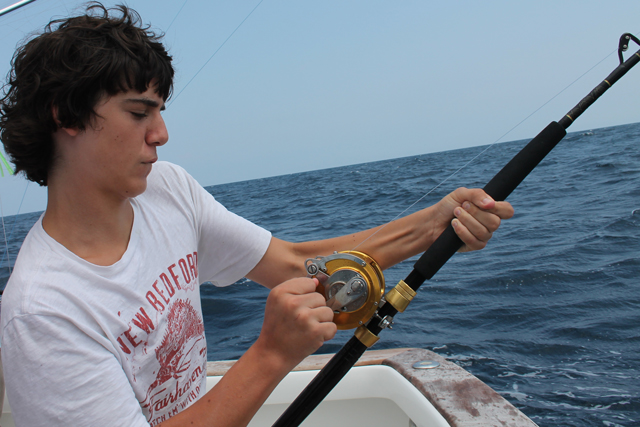
We heard Captain Dale shout from the bridge, “Billfish attacking the spreader bar,” and instant cockpit chaos broke out. There was a mad scramble to man the other rods, as Max followed the routine we’d been practicing for several years: take the rod in-hand, point the tip at the fish, turn off the clicker, and open the drag. Allow line to spill off the reel as fast as possible, to feed the marlin the bait and allow him to eat it without feeling resistance.
There was just one snafu, and it was a big one—you can’t “feed” a billfish a spreader bar, which has a metal bar the size of a straightened coat-hanger, multiple hook-less “teaser” lures, weighs several pounds, and sinks in a patently un-lifelike manner when not being dragged across the water’s surface under tension. Instead, you send back a ballyhoo from a nearby rod to attempt to lure the fish away from the bar, and onto the bait.
Max was feeding back the spreader bar.
Commands flowed smoothly from above. “Put down the spreader bar rod, Max. Grab a rod with a ballyhoo. Stop feeding back the spreader bar. PUT DOWN THAT ROD!”
Max was either too focused on the job at hand to hear, or too focused to comply. And in one of those minor miracles that proves there’s no “right” or “wrong” in fishing—there’s just what works sometimes and what doesn’t work other times—the marlin turned around and ate the one lure on the spreader bar with a hook. Max slammed the drag home, leaned back, then was yanked forward two steps as six feet of white marlin turned on the turbocharger.

Max is hooked up - his first white marlin is on the line, and a big smile is on his face.
The cockpit chaos continued, along with the calm but firm directives from above. Keep tension on the line. Get a fighting belt on him. Then a harness. Someone keep a firm grip on the back of the harness, just in case. Crank, crank, crank and crank faster. None of it phased Max, who’d gone toe-to-toe with other pelagics of similar size. But this was the first marlin. Somehow that made it more important—more desperate—that he beat the fish. That he see it up close and personal, next to the boat. That he turn it free only after a complete victory.
The marlin turned sideways to the boat, dug in, and gave a steady tug-of-war style fight that made the battle anti-climatic. There was no jumping, no gray-hounding across the surface, no blistering-fast run. But when Max got his first glimpse of the fish, he couldn’t resist letting out a hoot. And when the mate reached over and grabbed the fish’s bill, the hoot became a holler.

Victory! Note the multiple lures hanging from the spreader bar, at right. It may not be the ideal way to hook a white marlin, but this time it worked.
Many pictures were taken, and the fish was sent back on its way unharmed. Captain Dale came down from the bridge, grabbed Max by the shoulders, and gave him a celebratory shake. “Good job,” he said. “We caught the fish, and that means you did everything right. Everything. Congratulations. Now, never feed a marlin a spreader bar again.”
Game Over?
I looked back over my shoulder and saw a mix of envy, awe, and regret on David’s face. It’s rare to hook up a marlin, and he knew it could be years before he’d get his first shot. He also knew that would mean years of ribbing from his brother.
The captain turned the boat, the crew set the lines back out again, and the diesels went back to their thrumming. This time, David stayed awake.
As all serious anglers know, trying to predict what will happen during any given moment of fishing is hopeless. The course of a day can turn radically at any moment; it can go from uninteresting to epic in a heart-beat, or vise-versa. You can do everything right, but succumb to simple bad luck. You can do everything wrong, and come home a hero.
Against all odds, before the adrenaline of Max’s marlin had completely dissipated I heard the click of an outrigger clip popping open, followed by the “woosh” of monofilament cutting through air. The proverbial screaming drag came next—and David launched out of his seat as if his pants were on fire.
There would be no feeding this marlin. It had attacked one of our rigged ballyhoo without hesitation, setting the hook on itself as it streaked away from the boat. David got the rod out of the holder and held tight, as the crew came back to life. Three grown men fussed about him like bridesmaids primping a bride, adjusting the fighting belt and clipping on the harness. Someone yelled “holy s***” and all heads swiveled aft to get a glimpse of the six-foot predator leaping clear of the water, thrashing its head back and forth.
Grunt, crank, grunt - David's first white provided a completely different fight.
Without the encumbrance of the heavy spreader bar, it was a completely different battle. David’s fish jumped, thrashed, and changed direction every few seconds. Cradling my camera, watching as one of the other adults onboard kept a firm grip on the back of the harness, I could see David’s shoulders bulge out a bit every time the marlin ran. Sweat began dripping down his face. Grunts of determination slid past his lips. And he didn’t let up on the fish for one second.
This time, as the mate reached for the bill the fish went ballistic. It tail-walked five feet away, making eye contact with us as it grew to our height, then sank back down into the water. The mate got the bill, another crewmember pitched in, and suddenly the beast was in the boat.

Victory - again. The second billfish hook-up of the day proved a spectacular success.
I took 132 pictures, in three minutes.
Bridge to the Future
They say that the apple doesn’t fall too far from the tree, and as parents, we hope there’s some truth to that. Sure, we want our kids to be true to themselves. But we also hope, maybe secretly, that they aren’t so different from us that they don’t understand where we’re coming from. We want to have some things in common, be it hobbies, profession, or personality. We need bridges, to help span the communication gap that often appears between generations. And in my family, fishing is that bridge.
I got the punch in the arm. That rare, elusive “thanks, dad,” in the tone of voice that told me they really meant it. I saw the contented grins. I heard the brothers congratulate each other. And that was how my boys caught their first marlin.

The brothers bask in their glory at the end of the day. If they look a bit damp, it's because they just climbed out of the water - fishing tradition dictates that after catching his first marlin, an angler gets shoved over the side of the boat back at the marina. When they weren't looking, I gleefully maintained this tradition with one double-handed shove.


