George Linder’s Legacy: Shaping High-Performance Boating
George Linder’s 21-foot Challenger hull, launched in 1976, set a new standard in offshore racing with its innovative non-constant vee design for superior speed and handling.
In the high-octane world of offshore powerboat racing, few names carry the weight of George Linder. A racer-turned-designer, Linder’s innovative hulls defined an era, blending speed, stability, and craftsmanship.
A Racer’s Roots
George Linder’s love for powerboats began in the 1960s, behind the wheel of wooden V-bottoms in races like the Havasu World Outboard Championships and the Around Long Island Marathon. Driving boats like the 18-foot Eltro, he learned what made a hull sing—or sink—in rough water. His first ride, a 1966 Carlson Challenger tunnel hull, was a lesson in what not to do, with its poor handling in choppy seas. These experiences shaped Linder’s vision: build boats that were fast, tough, and reliable.
By the mid-1970s, Linder hung up his racing helmet to focus on design. In 1976, he launched Challenger Boats, crafting hulls that would become legends on the East Coast and beyond.

George Linder, Image by VÉHICULE
The Challenger and Shadow: Icons of Design
Linder’s signature creation was the 21-foot Challenger hull, a fiberglass marvel that hit the water in 1976. With a non-constant vee bottom—deep forward for wave-cutting, flatter aft for planing—it delivered speeds over 70 mph while handling like a dream in rough conditions. The hull’s lifting pads and strakes gave it unmatched cornering and efficiency, outpacing rivals like the Donzi 22 with less power. Only about 200 were built, each with premium touches like stainless steel hardware and teak accents, making them collector’s gems today.
In 1980, Linder teamed up with Rich Alter to evolve the design into the Shadow 21, pushing speeds to 85 mph with a refined bottom and deck. These hulls inspired countless knockoffs—Superboat 21, Apache 21, and more—proving Linder’s influence. His work with Mercury Racing on drives like the No. 6 sterndrive further cemented his reputation as a performance pioneer.

George Linder's famous 21-foot Challenger, Image by VÉHICULE
The Jesse James Collaboration: A Tribute to Mark Lavin
In November 1986, throttleman Mark Lavin died in a horrific crash during the Key West World Cup Championships. Racing the 35-foot Jesse James catamaran, a wooden Conquest hull, Mark and driver Kenny Adams Sr. hit a wave, causing the boat to submarine. Despite early safety features, the impact was fatal for Mark, shaking the offshore racing world and his brother, Chris Lavin.
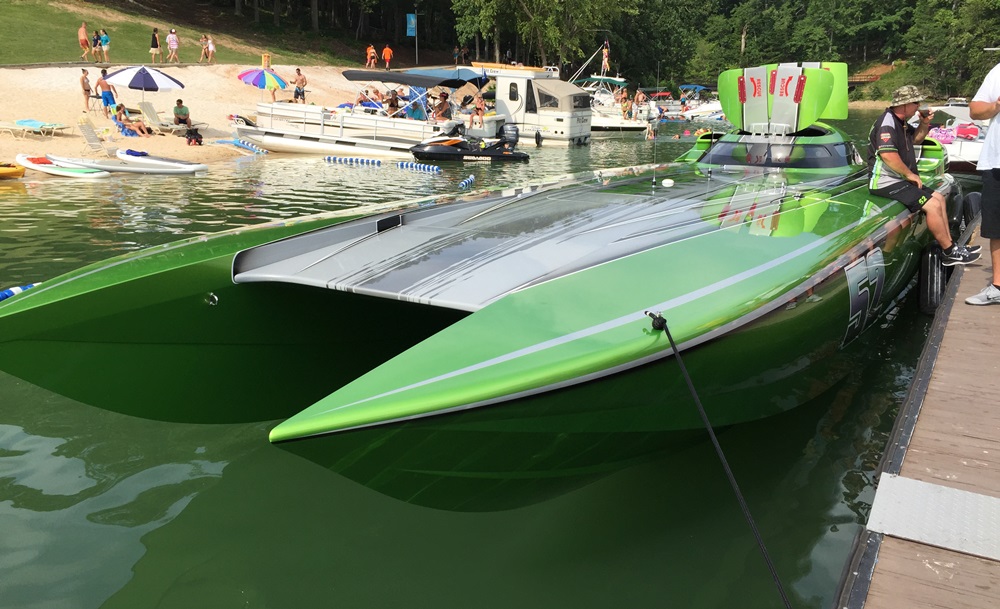
In 1987, Linder collaborated with Conquest Marine (Rich Luhrs) and Quest Racing (Kenny Adams Sr.) to design a revolutionary 48-foot catamaran. Built from 1987 to 1989, this wooden-fiberglass composite beast was a safety-first masterpiece. It featured:
- F-16-style canopies: Double-wide, impact-resistant Texstar canopies seating four, a first in offshore racing, inspired by Mark’s accident.
- Powertrain: Two four-valve big block Chevrolet engines, the most efficient of their time, paired with the strongest drive system ever built and the largest racing propellers to date.
- Safety innovations: Full-time air systems, reinforced cockpit capsules, and harnesses, setting new standards for UIM and APBA rules.
Costing over $1 million in R&D, the boat was a “compelled carry-on” for the Lavins. It raced briefly in 1989 under Chris Lavin, hitting speeds likely exceeding 100 mph, but the emotional weight of Mark’s loss led the family to step back from competition. The catamaran’s safety features, though, lived on, influencing modern offshore racing protocols through the Mark Lavin Memorial Offshore Medical and Safety Foundation.

George Linder's Design for the Jesse James 48ft Catamaran, Image by VÉHICULE
Linder’s Lasting Impact
George Linder’s designs, from the Challenger to the Jesse James catamaran, were about more than speed, they were about pushing boundaries. His hulls inspired brands like Tuff Marine, whose modern 24-footers owe a debt to his non-constant vee and pad designs. Collectors still chase his boats, and his safety innovations with the Jesse James team saved lives. Linder’s legacy is a testament to what passion and precision can achieve on the water.

George Linder's Jesse James 48ft Catamaran, Image by VÉHICULE
Have you spotted a Linder hull or heard tales of the Jesse James catamaran? Drop a comment below!