Sword Fight
Is swordfishing the ultimate angling adventure or a miserable, humbling experience? Yes.
Sleep deprivation, extreme boredom, an assortment of sharp implements, and water are all the ingredients needed for torture sessions (um... I mean "enhanced interrogation). They also happen to be just what you need for a swordfishing trip. Sometimes, both at the same time. But that’s why swordfishing is so rewarding. The bigger the mountain, the greater the satisfaction upon reaching its peak. And trying to catch a swordfish is one hell of a big mountain.

Swordfish fishing is no easy chore - but the rewards are nothing short of stellar.
At least, it is here in the Mid-Atlantic region. While Florida anglers have had strong populations of swordfish in their waters over the past decade (usually credited to the commercial sword-fishing long-line ban of 2000), anglers from the Carolinas to New York may spend two, three, or even more fruitless nights adrift on the open Atlantic before they get lucky enough to hook into Xiphias gladius. And then, they have to fight it. Again: one hell of a big mountain.
After a swordfish is hooked, depending on its size it can be expected to fight for anywhere from 15 minutes to two or three hours. Most fishermen use 50 or 80 pound class gear, which is set at 20 to 25 pounds of drag. That means that from the moment the fish eats your bait to the moment it’s gaffed, your body has to fight against 20 to 30 yanking, kicking, zig-zagging pounds of pressure. After an hour or so, this feels like—you guessed it—torture. And as a result, when you finally bring a sword over the gunwale the taste of victory is that much sweeter.
Setting the Scene
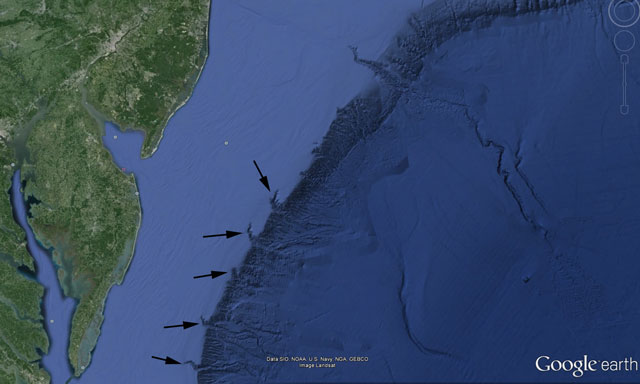
Canyons along the Continental Shelf are prime territory for anglers seeking swords.
Swords are found east of the Continental shelf, in deep, open waters. Experienced anglers target them in waters between 1,200 and 2,500 deep, usually in canyons or around underwater pinnacles which create unusual currents or up-wellings. Temperature breaks are also a leading factor when choosing a sword-fishing spot, because they tend to gather sea life of all varieties. But since swords commonly remain over 1,000 feet beneath the surface during daylight, then rise to within a hundred or two feet of our air-bound plane of existence in the dark, fishermen commonly target them at night. As you might expect, this brings an entirely unique set of challenges. You’ll need to make sure you have extra lights and the juice to power them, extra clothes to ward off the chill, twice the usual provisions, and for safety’s sake, waterproof strobes for every crewmember. You’ll also need to make sure someone stays awake and on watch at all times. And a word to the wise: if you feel a bit seasick from time to time when you go fishing, in the darkness, there’s a good chance you’ll be on your knees heaving into a bucket much of the night.

Squid are one of the more unusual critters spotted - and caught - during a night at the canyons.
On the flip side, you’ll be treated to sights few people ever encounter. The ocean is a very different place at night, and drifting through the darkness with 1,500 feet of water under the keel is like going to another planet. When you turn out the lights (except the nav lights, of course), the stars pop out of the inky darkness with far more intensity than they do on light-polluted land. And speaking of ink, you’re likely to see squid, a creature that’s rarely if ever spotted in broad daylight. Dozens, hundreds, or even thousands of them, darting through a green halo created by the sword-fishing lights hung over the side of the boat (more about that, later). Along with the squid you’re likely to see countless fish, wiggling copepods, crabs, and one after another what-the-heck-was-that’s. Then a 300 pound mako shark swims by. You get the picture—swordfish or no, the ocean is an awesome place to be at night.
Dressed for Success
By now you should be either tempted into or scared off from trying a sword-fishing trip of your own. Good. You need to be fully aware of both the challenges and rewards you’re likely to experience. But if you want to get a taste of the greatest reward—successfully landing a swordfish—you’ll need to know a few basics about how to get one on the line.
Most anglers use either rigged squid or live fish for bait. Squid should be rigged with a 200-pound-test leader entering the tip of the mantle, going through the body of the squid, and exiting where the mantle meets the tentacles. Here, crimp on a 10/0 to 12/0 circle hook. Savvy anglers use rigging thread to sew the tentacles to the mantle, preventing the swords from slashing the bait in two and eating half the squid without ever grabbing the hook. If live fish are the bait of choice, either tinker mackerel, goggle-eyes, or similar species in the half- to one-pound range are appropriate, bridled to the hook or simply skewered through the back, just aft of the dorsal fin.
About 10’ above the hook (usually where the leader meets the main line) attach a 10 to 16 ounce weight, and a cyalume glow stick. The glow stick helps attract swordfish to your baits, with green and pink usually being the best color choices.

Note the balloon hanging from the rod, at left; used as a bobber, it suspends your baits at the appropriate depths.
Once your lines are rigged, drop one to 300 feet, a second line to 200 feet, and a third to 100 feet. You can use a balloon as a float, or some anglers use a pool noodle secured to the line with a rubber-band. With the floats in place, allow the lines to drift out and away from the boat, with the deepest line the farthest away. Then, set a bait out with no float and just a couple ounces of weight, at the edge of your light-line.
Wait a sec—what’s your light-line? Remember the green-glowing sword-fishing light we mentioned earlier? These are two to four foot long cylindrical lights, which sword anglers hang over the side of their boat. They spread a halo of light out through the ocean around the boat, helping to attract baitfish, squid, and other assorted sea creatures. Predators, ranging from swordfish to tuna to mahi-mahi, often cruise along the perimeter of the halo, hunting the edge of the light-line. Accordingly, you’ll want to put a bait here.
Those lights can be found in green, blue, pink, and assorted other colors, yet you’ll notice that I’ve specified green. Why? Anglers argue over a lot of things, including which light color attracts the most fish. To put this argument to rest, I spent a season of swordfishing with different color lights over either side of the boat for two hours at a time, and constantly tracked the results. It was no contest—the green side of the boat always had more life swimming through it, regardless of which other color it was up against. Get yourself a greenie.
Life on the Line
Going from sword fishing to sword catching is quite a leap—especially if you haven’t joined in battle with one of these fish before. Expect strikes to range from slow takes to mind-bending screamers, and in either case, before picking up the rod set the hook by slowly advancing the lever drag. Circle hooks, even those big 12/0’s, are self-setting and grabbing the rod before advancing the lever drag inevitably leads to yanking and jerking that isn’t helpful.
When the sword runs, don’t try to stop it. You can’t, anyway. Advancing the drag beyond 25 or so pounds of pressure often leads to ripping the hook free, so just let that fish run and wear itself down. As with any fish, keep the pressure smooth and the line taunt. Eventually, you’ll wear him down.
“Eventually,” of course, can mean hours on end. You will sweat. You will curse. You will wonder why you ever put yourself into this situation. Grit your teeth, and keep your mind on the prize. It’s getting closer with every crank of the reel.
The end game is the dangerous part. Bringing any billfish aboard carries with it a certain amount of danger, and when you drag a gaffed sword over the side, you can expect it to go berserk. A bill whipping back and forth at a few hundred miles per hour, backed up by a few hundred pounds of very angry muscle, can do some serious damage. With small fish it’s possible to gain the upper hand by grabbing the sword’s bill in a pair of gloved hands, and putting all of your weight on it. Larger fish should be tail-roped while still in the water, then cleated off. The head can be controlled with a flying gaff, cleated to the other side of the boat. The most important thing to remember: if the fish gets out of control and thrashes around in the cockpit, the best thing you can do is make sure everyone gets out of its way. Don’t try to subdue it with a billy club (this is akin to whacking a grizzly bear in the noggin with a drum-stick) and while some anglers shoot swords with a gun, I strongly question this tactic as it can also lead to shooting a hole in your boat.
So, is doing battle with Xiphias gladius truly the ultimate angling experience? Quite possibly. If you want a bigger challenge with a greater reward than catching a sword can provide, you’d better head for Mount Killimanjaro.