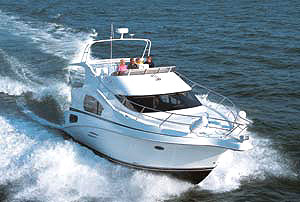
Bavaria BMB 380 — Looking Sharp.
BMB 380: Euro style meets German craftsmanship and engineering.
October 28, 2002
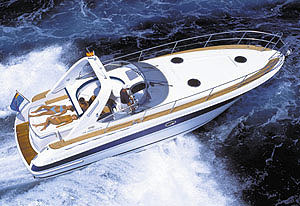
At 3,000 rpm, the 380 moved along at 22 knots, which would make an economical (but still quick) low cruise speed.
If you savor the performance capabilities of BMW automobiles, should you also consider purchasing a boat with a Bavarian pedigree — and a BMB nameplate?
Bavaria, a region of Germany best known for its luxury automobiles, is also home to Bavaria Motor Boats (BMB). The Bavaria company has long produced cruising sailboats, but it has recently applied its technologies to a new line of power boats.
In the past, manufacturers who tried to switch-hit from sail to power or power to sail have had mixed results. However, in the case of BMB, the effect is a fresh look at the concept of the power yacht: what it is, how we use it and where we use it.
Quality and More
Although the Bavaria company is noted for pricing its vessels attractively in the European market (the company made news when it sold 500 of its new 36 foot boats within two months of that design's launch), it is also known for its fine construction methods.
BMB hand lays the fiberglass for all of its hulls, and the company has rejected any suggestions to expedite the process with chopper guns. In BMB's power boats, the result is visibly high-quality glasswork on some rather tricky molds.
My first impression of the interior of the BMB 380, for example, was that its design was extrapolated from luxury sailboat interiors. Rich mahogany was used belowdecks to provide the kind of warmth you expect in a sailboat. But there, any comparison to sailboats ends.
The mahogany fits some complex molded surfaces, and the space is used in ways we expect aboard a modern power boat. In other words, it would be a mistake to think the 380 is merely an extension of Bavaria's sailboat technologies.
Up Top
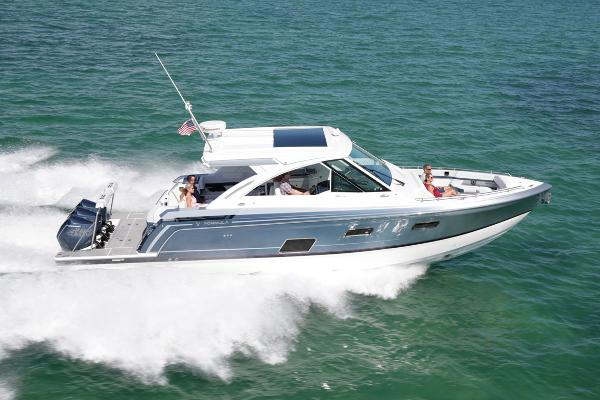
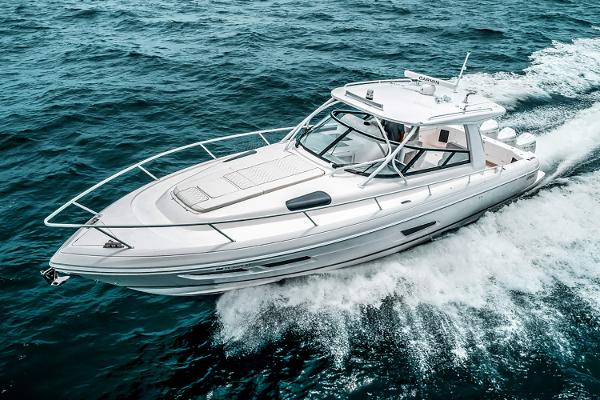
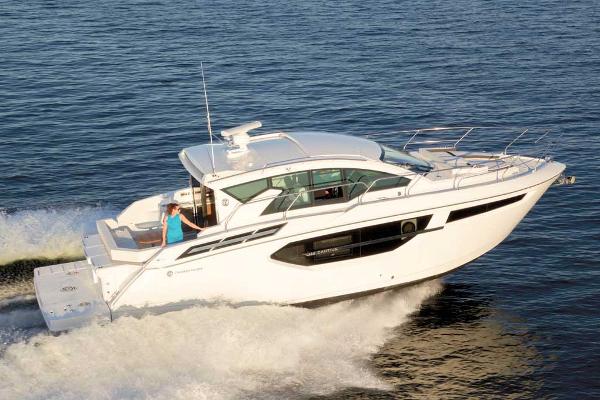
The decidedly European-influenced exterior lines and the design of the cockpit have absolutely no comparisons in sailboat design, and BMB's distinctive styling provides a fresh take on what we think of as a modern power boat.
I boarded our test boat in Vancouver, British Columbia at the Granville Island docks of Yacht Sales West. I was welcomed aboard by Brian Kirby, Bavaria's national sales manager, from Seattle.
We entered the boat from a large, stylish swim grid, with two access steps to the sunbridge port and starboard.
Between the steps, there's a large sunpad equipped with stainless steel grabrails. In addition to being a place where your guests can catch a few rays, this pad serves two additional purposes. The first thing Kirby did was actuate a hydraulic ram to lift the first cover and reveal a "dinghy garage" with space for a 9 foot inflatable.
A second hydraulic ram lifts the entire sunpad to reveal an easily accessible engine compartment with a pair of 260 hp Volvo Penta KAD 44P EDC/DP diesels (turning counter-rotating Duoprops). Five engine options are available, including one MerCruiser gasoline powerplant and four diesels, up to 375 hp.
The installation is clean and workable. All hoses and wiring are laid out for easy access, and the fuel tank is situated immediately forward of the engines. A deep bilge runs between the two, and there is ample working space.
The test boat has been in the water since last fall, and it has been kept outside the entire time. This bilge was dry and clean — no easy feat in Vancouver's "rain coast" climate.
Sunbridge
The sundeck and helm form the social nexus of this boat, with seating and a table for about six adults beneath a hardtop radar arch — which Bavaria calls a Sporttop. This dominant feature of the boat's exterior has a sliding sunroof, stereo speakers and exterior lighting built in. This top contributes to the boat's racy profile. Storage and a stern-to boarding ladder (a European-style option) are built into this area. Another version of the 380 — called the Sport model — offers the radar arch without the hardtop.
The exterior is mostly "wash-and-wear," with hose-down surfaces, easy-care vinyls and a teak and Thiacol sole. The wrap-around tinted windshield has a heavy-duty stainless steel grabrail.
The helm, to starboard, is equipped with a sports car-style wooden wheel, a bolster-style vinyl seat that allows the driver to stand for high-speed visibility and control or sit for socializing while running at slower speeds. All the analog instruments and Volvo Penta's electronic shift/throttle controls are close at hand while seated, though it's a bit of a stretch to reach everything while standing at the bolster.
Flush-mounted rocker switches are easily accessible at the edge of the console. There is room here to install radar, a depth sounder, a GPS receiver and other optional electronics.
Belowdecks
The 380's accommodations are accessible down three steps from the helm, through a sliding plexiglass and stainless steel companionway door. This door moves so smoothly and fits with tolerances that the crew of the Starship Enterprise might find acceptable.
The stringers, bulkheads and furnishings are built with computer-controlled rotary cutters to produce visibly tight joinery. Satin varnishes are applied to the wood by other robotic equipment, prior to the joinerwork's assembly in the boat.
A master stateroom is forward, with a queen-size berth. The cabin is surrounded by vinyl-covered bulkheads, with storage for small items available above the berth. A guest stateroom with two single berths and a hanging locker is situated to port. Just forward of the guest stateroom, to port, is a compact settee with a fold-out table. On the back side of the top are glass fiddles that can serve when the table is not being used.
The galley, on the starboard side, has a refrigerator/freezer and as many storage drawers and lockers as some larger boats. The breaker panel for the boat is located above the galley cabinets.
Despite all the storage and the galley's large Corian-topped counter, this is a convenience-oriented "dock-to-dock" galley — with a two-burner range and a microwave oven for rudimentary cooking chores. As with any dock-to-dock arrangement, the cook's chores are kept to a minimum. Of course, most boaters will want to make reservations at that charming little restaurant at the next port, anyway, rather than cook a big meal aboard.
The head, just abaft the master stateroom, is another easy-maintenance facility with a shower, a sink and a toilet. All its molded surfaces can be washed down with a hose.
Under Way
We took the 380 out for a spin on English Bay on a hot summer day, with a light westerly blowing and a flood tide. At a no-wake speed, heading out of False Creek at 600 rpm, the boat moved at about 4 knots.
At 2,900 rpm, the boat was clearly on plane, running at 19.6 knots with no tabs. At the 3,300 rpm high cruise speed, we moved at 25 knots — with a quarter load of fuel and a full water tank.
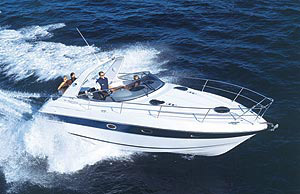
At 3,000 rpm, the 380 moved along at 22 knots, which would make an economical (but still quick) low cruise speed. The boat's top speed is 34 knots, at 4,000 rpm.
The 17-degree deep-V hull handled the chop, its wake and the wake of other vessels with a smooth, solid feel. The real proof of the smooth ride was the fact that a set of stainless steel canisters on a fiddled shelf above the stove never rattled, never teetered, and were still in position when we returned to the dock.
Dock maneuvering was a piece of cake, thanks to the boat's Sidepower bow thruster.
It's easy to see why BMB has already been so successful in Europe — and it's also easy to predict that the company's innovative new power boats will soon win many fans among North American boaters, too. An innovative, high-quality boat with a lot of good ideas built in, the BMB 380 is definitely a winner.
BMB 380 Sporttop Specifications
| Length | 39'1" |
| Beam | 12'2" |
| Draft (drive down | 3'1" |
| Weight | 16,843 pounds |
| Fuel capacity | 265 gallons |
| Water capacity | 80 gallons |
| Sleeps | 4 |
| Propellers | Counter-rotating Volvo Penta Duoprop |
| Base price with twin Volvo Penta GXI/DPS gasoline engines (delivered to Seattle) | $244,900 |
Performance
| Top speed | 34 knots |
| Miles per gallons at 22-knots cruising speed | 1.4 |
| Fuel cost for 100 miles | $107.14 |
| Range at 22-knots cruising speed | 371 miles |
| Sound level at 22-knots cruisel | 76 dB A |
(Estimated fuel cost based on a fuel price of $1.50 per gallon.)
Standard Features
Five-year warranty; skid-resistant sidedecks; electric anchor windlass with Delta anchor and 85 feet of chain; self-draining cockpit; folding radar arch; mahogany interior; microwave oven; Corian countertops; hot and cold pressurized water system; 40 amp battery charger; CD stereo system with indoor and outdoor speakers; black antifouling paint.
Construction
Hand-laid fiberglass hull.
For More Information
BMB Marine Imports
Seattle, WA
(800) 993-7245
www.bavaria-motorboats.com