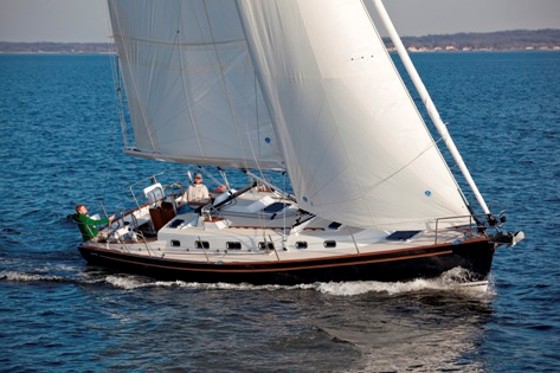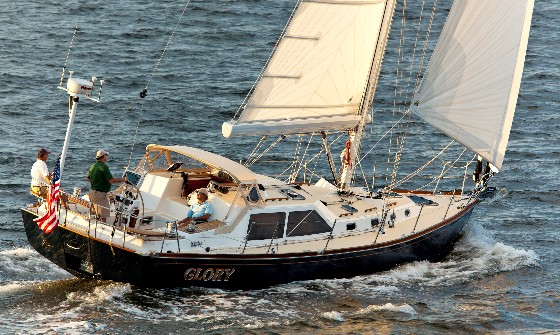
Tartan 40
Flexible, comfortable blue water cruiser
During an 11-day passage, this mid-1980s S&S racer/cruiser proves to be a basic blue water boat that really works in a variety of offshore conditions
For the first two days of our 1,500-mile passage from Tortola, in the British Virgin Islands, to Newport, Rhode Island, we had gentle east to southeast trade winds from 10 to 15 knots, and the sailing was mighty fine. Our crew of three was sailing Tartan 40 White Beagle, Hull No. 46, built at Tartan's Grand River, Ohio plant in 1988. She was a relatively barebones example of the breed: hank-on headsail, minimal electronics, and sail inventory consisting of mainsail, 135 percent genoa, yankee and a true high-cut handkerchief spitfire jib. However, halfway through the second day, we found ourselves ogling the seagoing accommodation, or looking down the wide, clean decks during a prolonged and sensuous beam reach, and musing, "What a nice little boat!"
Our crew was new to the Tartan 40, but within a few hours of departure felt we'd been aboard before. The reason for this sense of deja vu was that, though a stock production boat, the Tartan 40 was ergonomically ready to go to sea, thus most everything (there were, of course, exceptions) was where it should have been, and set up to take care of a crew over an extended passage.
Deck and Cockpit
The decks are wide, flat and relatively unencumbered. The coachroof is low, so scrambling amidships to the mast or boom is effortless. The molded non-skid pattern is industrial strength, which is a double-edged sword. Footing is terrific, but knees and elbows get torn up over time, but that's OK; we choose to live by that sword and stay aboard. Toe rails are stout. Handrails extend much of the length of the coachroof, and between them, jacklines, shrouds and lifelines, moving forward is simple and safe.
We're not advocates of running a lot of lines aft to the cockpit, so on White Beagle, we would clean up the mass of lines and turning blocks on the coachroof deck between the cockpit and the mast by retrofitting roller-reefing at the headstay. We'd then move main and jib halyards and winches to the mast and return the outhaul to the boom where it belongs. While passagemaking, the main will be up for days on end, as will the roller-reefing headsail, so why clutter the deck and cockpit with unnecessary lines, turning blocks, and jammers, three of which we just eliminated. We'd leave the main sheet jammer to port of the companionway and clutches for first and second reefs to starboard.
Most of our complaints about the Tartan 40 are in and around the cockpit, and we think that some of these shortcomings can be easily remedied. The large cockpit, with comfortable coamings, is ideal for dinner for the whole crew when at sea or for guests when at anchor. The forward part of the cockpit molding provides additional horizontal space under the dodger, at the same time creating headroom in the after sections of both the quarter-cabin and the nav-station.
Only one seat locker exists, to port, because the starboard seat is over the quarter-cabin. The single cockpit locker is, of necessity, deep and vertical in design, rather than the traditional shallow and fore and aft configuration. But this locker is voluminous and very dry, and it swallowed our four-man life raft, bosun's chair, fire extinguisher and docklines (coiled and hanging on pegs) with much room to spare. Our deflated dinghy almost fit in this locker. The stainless-steel hasp that restrains the port locker lid is perfectly positioned to bark the shins of anyone passing between the locker and the wheel and should be re-positioned or replaced.
The lazarettes are also deep, vertical, capacious and dry. The starboard laz contained our propane tanks; the port laz, jerry cans of diesel, boat hook, bucket and fenders. It's the design of their lids that caused a problem. They are hinged on their inboard ends and are curved to conform to the rounded after end of the cockpit. When you stand between the wheel and the lazarettes and lift up the lids, you are pushed away from the openings. Perversely, the more you open a laz, the farther away you are pushed by the scimitar-shaped lids. The design does not work, but perhaps the problem would be simply solved by hinging the lids on their outboard ends.
The grates over the scuppers in the after corners of the cockpit are a concern on two fronts. They are positioned where the helmsperson's feet will be placed while standing at the wheel in flat conditions (beveled teak foot rests provide comfortably support when the boat is heeling). Being grates, they are uncomfortable to stand on with bare feet for an entire watch. Being varnished, they are slippery for both bare and deck-shoed feet. Softening the grate edges and removing the varnish would help a lot. Additionally, should the cockpit fill with water, these wooden grates would float and could conceivably be washed overboard, leaving awkward holes where the helmsperson's feet should be. These grates should be screwed in place.
Another helm-station annoyance is the proximity of the backstay. Even crew under 5 feet tall cannot comfortably sit behind the wheel for long because their heads are restricted by the stay. When the autopilot worked (it went mad five days into the trip), the top of the engine housing/companionway stairs, wedged in the companionway, was a neat spot from which to check out the sails, shipping, approaching weather and constellations. With the dodger's center section removed, this was the best standing-room in the house.
To be fair, after the autopilot went down, we each hand-steered for many enjoyable hours, so the helm-station couldn't have been too bad.
One last cockpit and locker complaint: Access to the steering quadrant from the lockers and lazarettes is possible only for a disciple of Harry Houdini. We suggest creating access to the steering mechanism via the after bulkhead in the quarter-cabin, through which one could reach it in a comfortable prone position instead of standing on one's head. Now let's get back to what we liked about the Tartan 40, and there is a lot.
Accommodation
Three accommodation plans were available when the boat was introduced: Plan A, the Standard, White Beagle's arrangement; Plan B, with forward-facing nav-station to starboard, forward of the quarter-cabin and wet locker and additional stowage where our nav-station was to port; and Plan C, with two heads, the after head replacing the bureau and wet locker at the forward end of the quarter-cabin. We prefer the seamanlike standard layout.
Cabins and head: The interior layout shined for 1,500 miles. Designed by Tim Jackett in collaboration with S&S, it was obviously meant for blue water sailing, and we can imagine few more ergonomic setups. Rails are literally everywhere, and most everything within one's grasp doubles as a handhold. Teak cabinetry is solid and utilitarian, presenting strong and soft edges to fall into when the boat lurches or heels.
The Tartan 40 has three good seaberths: dinette settee to port and starboard settee in the saloon and double berth in the quarter cabin to starboard of the companionway. The settees were rigged with lee cloths, while the quarter-cabin offered back support on either tack with assistance from pillows or a sailbag. Our crew was comprised of two men and a woman who had not sailed with us before, and the quarter-cabin gave her privacy and an immediate comfort zone well before we set sail.
The dinette table drops on a single pedestal to create surface for a double berth. The single pedestal does not make for a very secure mount, and we'd consider permanently installing the table in the up position on a pair of pedestals that could sustain the impact of a crewperson being thrown into it by a sea. A plywood insert for the double berth could be stowed in one of the hanging lockers. Voluminous shelves and lockers above each berth accept lots of clothing and ship's supplies, and a seagoing bookshelf resides at the forward end of the starboard settee. With four opening ports, a Lewmar hatch and a fan, ventilation is excellent in the main cabin.
The single head with shower is just forward of the dinette to port, and while the W.C. was tightly wedged into the forward corner between the sink and the inboard bulkhead, providing a tight fit for even small-sized crew, overall this vital compartment worked. It was bright, cheerful, easy to keep clean, and surprisingly well ventilated, considering only one small Lewmar hatch in the overhead vented to the outside. Opposite the head is one of four real hanging lockers, with a fiddled shelf on top. Forward of this area is the forward cabin and V-berths, on which sail bags and unused cushions are stowed while on passage. This cabin, too, has a hanging locker, plus bone-dry lockers and drawers for personal clothing or spare parts. The forward cabin is extremely well ventilated by the forward hatch, a small Lewmar hatch and a fan.
The starboard settee is separated from the quarter-cabin by a wet locker, which is opposite the galley sinks. The quarter-cabin is a quart in a pint pot, and our lady mate thrived in it for 11 days. It, too, is well ventilated by three opening ports, one of which is set in the face of the cockpit well, and a fan. For double-handing, this would be an ideal berth for the off-watch, and the port into the cockpit would simplify communication with the on-watch. The fourth hanging locker is in this cabin, which also contains a five-drawer "bureau" with fiddled top, three drawers under the berth, and a comfortable cushioned seat nestled in the forward end of the bunk.
Galley: The galley is simple, yet well designed and practical. Being directly below the companionway, it has super ventilation, which is enhanced by two opening ports. It has a shallow U-shape formed by the sinks, counter with pots-and-pans bin set in, and gimbaled three-burner Hillerange. When cooking or washing up, wedging into the angle between the two sinks is effective in a seaway. The one flaw in this position is the solenoid switch which, at the very least, blacks and blues your hips and, at worst, shuts off without your knowledge when hips or bum hit it the right way. The switch should be moved. When working on the counter over the reefer, you can lean into the side of the engine housing/companionway stairs. Engine access, from beneath the companionway stairs, was good, if not great, and some contortion was required when bleeding one of the injectors.
One sink is deep, the other shallow, which simplifies meal preparation and cleanup. The pan bin is so deep that we never did find the bottom to it; on the other hand, we never had difficulty finding just the item we needed. A fiddle between the deep sink and the pan bin would keep sink water from dripping into the bin, as well as keep pans from sliding into the sink when on the port tack. Beneath the shallow sink in the inboard side of the U is a trash receptacle and stowage for cleaning materials. Louvered lockers and drawers hold a reasonable amount of food, tableware, galley tools and utensils.
The Hillerange stove and oven was one of the nicest appliances we've ever used offshore. It was simple to light, held a low flame for simmering, was easy to clean up, and the oven baked two home-quality loaves of bread, plus a panful of brownies. However, in this installation the crash bar was too close to the stove, and when lighting the burners when in a seaway, fingers got caught. The 7 cu. ft. refrigerator box under the port counter is the best, bar none, that we've used. An Adler-Barbour Cold Machine gave us fresh milk, bread and veggies all the way to Rhode Island, and we kept wahoo and dolphin filets from fish we'd caught five or six days earlier.
Nav-station: The nav-station is to port under the cockpit and faces aft. Being aft of the companionway and having a single opening port in the face of the cockpit well, ventilation is good but not stellar, and a fan is in order here. While the aft-facing layout is disturbing to some, chimping down the companionway and swinging into the nav-station seat really works, which is an asset when shorthanded with no simple means of dependable self-steering. The chart table with stowage under holds a full-width NOS or Admiralty chart, a logbook and navigation tools.
Above the table, aft and to port, there was plenty of room for radar, VHF, stereo, GPS and Loran. To port is a cabinet with two louvered doors that held manuals and reference books, but could be easily converted to space for an SSB or ham unit. The top of the cabinet was fiddled and held handheld electronics and other navigation tools. Again, a port that opens into the cockpit enhances communication between the nav-station and the helm.
Performance
The Tartan 40 performed in a manner we would expect from a design off the board of Sparkman & Stephens in the period between the early 1970s and the mid-1980s. This was a time when a team of young lions teamed with both Olin and Rod Stephens to create such classics as the Swan 431, Swan 47, She 36 and Tartan 37 and Tartan 40. On all points of sail, we were simply delighted, our experience consistent with the early racing record of the 40.
Off the wind: White Beagle reached and ran for 10 days in winds that averaged less than 10 knots; she was motor-sailed for 108 hours. In the light trades and flat seas, she bowled along at between seven and eight knots, often with the 135 wung out on a pole. In periods of calm, with five knots or less registering, we were able to keep the boat moving over the ground at three knots, give or take.
Even without light-air sails, the Tartan 40 kept moving. During several three-hour watches with no wind recorded in the log, but with a boost from the prevailing ocean current, we were able to eke out yet another seven miles, for which we were grateful, because on this light-air passage we had nearly run out of fresh water and diesel fuel. The 40's Sail Area/Displacement Ratio (SA/D) of 17.1 puts it in the category of cruiser/racer, which it is, and thus it is not surprising that this boat excelled in light air. In comparision, that classic voyager, the Valiant 40, with 5,000 more pounds of displacement, has an SA/D of 15.5, and a J/40 with 2,000 pounds less displacement has an SA/D of 20.2.
The Tartan 40's Displacement/length Ratio (D/L) of 250 puts it in the category of light cruising auxiliary. This means that while it has sufficient displacement to carry the gear and provisions necessary for passagemaking, its hull will still pass through the water with minimal disturbance and resistance. White Beagle's performance during our passage bore this out. The Valiant 40, a legendary passagemaker, has a D/L of 256 with a heavier displacement. Stated in other terms, in light air and with a lot of motor-sailing, we averaged about 140 mile per day over the rhumbline distance. Pure and simple, the Tartan 40 is a passagemaker that will, one way or another, get you efficiently from Point A to Point B, no matter the conditions.
On the wind: Only on the last day of the trip did we encounter head winds. This was during heavy thunderstorms that accompanied a frontal passage. The wind gusted to 40 knots, and with just the spitfire up, we clawed to windward, feathering the little sail to take the strain off it and the rig, so that we could bear off and reach in to port after the thunderstorms had passed. With the centerboard up, the boat was most weatherly and remarkably stiff. With the centerboard down, windward ability would have been inspired. While Ballast/Displacement Ratio (B/D) doesn't ever tell a complete story, the 40's B/D of 43 percent is consistent with those of boats of similar design. The J/40's B/D is 40 percent and the Erickson 38's B/D is 42 percent.
Rig/Construction
The keel-stepped, high-aspect, double-spreader mast is a handsome and well engineered extrusion, but for offshore work we'd recommend installing an inner forestay with runners to support the upper sections. The lower sections are well supported by lower shrouds and a babystay. The standing rigging is substantial for a production boat, and when approaching a line of violent thunderstorms with brief yet powerful bursts of wind, we had no worries about the rig. Peace of mind also derived from the hull's laminate schedule: Iso/Npg gelcoat, vinylester resin in the skin coat, balsa coring, and unidirectional fiberglass laminates. This construction creates a hull with high blister-resistance and weight and strength where it needs to be
Between 1984 and 1989, 72 Tartan 40s were built, so you'd think a number would be on the market at any given time. This does not seem to be the case, which indicates to us that Tartan 40 owners love their boats and hang on to them.
Prices of Tartan 40s are in the neighborhood of $150,000, depending upon condition of hull and interior, sails and gear included, and number of engine hours. During our 11-day passage, the Tartan 40 provided a comfortable and secure home for our crew of three, a fact of which we were well aware from the day of departure. What more can you ask for in a stock blue water cruiser?
Tartan 40
| LOA | 40'3" |
| LWL | 31'7" |
| Beam | 12'8" |
| Draft | Deep fin 7'6", Scheel Keel 5'1" |
| CB/U | 4'9" |
| CB/D | 8'5" |
| Displ. | CB 17,800 lbs., Fin 17,250 lbs., Ballast 7,600 lbs. |
| SA | 727 |
| SA/D | 17.1 |
| D/L | 252 |
| B/D | 43% |
| Aux. | Universal 44 |
| Fuel | 47 gals. |
| Water | 100 gals. |
| Designer | S&S |
Tartan Yachts, Inc.
1920 Fairport Nursery Road
P.O. Box 1135
Fairport Harbor, OH 44077
phone: (440) 354-3111