Powerquest 340 Vyper: Performance Test
Powerquest 340 Vyper: Rides on a new hull design and delivers impressive speed without losing its bite on the water.
December 3, 2001
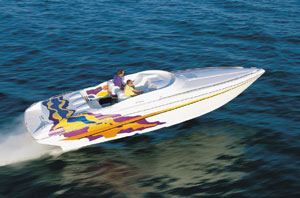
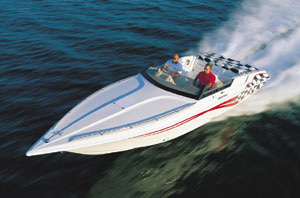
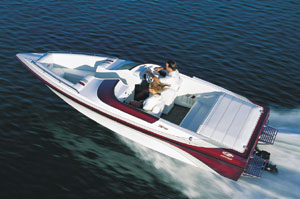
The Powerquest 340 Vyper reached 86.5 mph. (All photos by Tom Newby)
Holland, Mich., is a long way from any ocean, but if you look at a map you'll see that it's close to Lake Michigan. And Lake Michigan can get nasty. After spending some time aboard the new 340 Vyper, something tells us that Powerquest design engineers spent a lot of time on that body of water.
The 33'9"-long Vyper arrived at our Captiva Island, Fla., round of trials with a few options such as Mercury Racing's HP500EFI engines, the manufacturer's Level Two graphics package—applied in Dupont Chromo Base paint—and a porcelain head. More importantly, it came with the competition package, which included Gaffrig Red Line gauges and custom bezels, Corsa Quick & Quiet switchable exhaust, a stainless-steel rubrail insert, lay-in deck carpeting and a leather-wrapped steering wheel. All totaled, the 340 Vyper cost $211,255, barely above the $155,290 base. Given the performance and conveniences of those options, it would be money well spent.
Performance
The modified V-pad hull featured two equal-height steps. The first step was located about 15 feet forward of the transom. Four feet farther aft, the second step was vented slightly more forward than the first. The outer pair of the four strakes continued through both steps and stopped about 2 feet forward of the transom. The inner set terminated at the first step. At the edges, the flat chines measured about 6 inches wide. Behind the steps, Powerquest engineers angled the keel pads to about 10 degrees and built in a 6-inch notch that measured about 10 inches high.
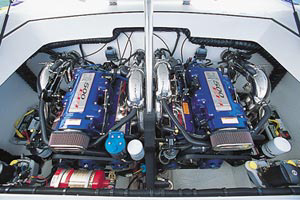
The 340 Vyper tapped twin Mercury Racing HP500EFI engines for power.
Performance hardware included 1.5:1 Bravo One XZ drives spinning lab-finished Bravo One 15 1/4" x 31" four-blade stainless-steel propellers. Latham Marine dual-ram hydraulic steering mounted between the drives handled directional changes and Mercury 280S K-planes stabilized the craft.
At first, testers thought 31"-pitch props might be too much for the HP500EFI engines, but they worked well enough to rocket the 340 Vyper to a top speed of 86.5 mph on the radar gun.
In acceleration drills, 15 seconds was all the boat needed to click 66 mph. Five more seconds with the throttles pinned produced 77 mph. During roll-on tests, the 340 took 4.5 seconds to go from 30 mph to 50 mph, and 40 to 60 took 5.2 seconds.
Handling-wise, our testers were pleased with the way the high-profile 340 performed slalom maneuvers. Our drivers actually were able to pitch the boat into a 100-yard-radius turn at full throttle. (Don't try that one at home.) Testers also found it best to leave it trimmed up a bit so it carried the nose through the turns. For a stepped-bottom boat, it tracked well in the turns and at all but the upper reaches of its speed range.
On the bottom end, the 340 stayed on plane down to 17 mph with the tabs engaged and came on plane in 5.2 seconds. It stuck the nose high in the air for most of that time, blocking forward vision some, but nothing objectionable or unsafe.
Workmanship
There was excellent mold work and a flawless rub rail installation. Hullsides were arrow-straight and provided a nice surface for the custom paint work. Powerquest used to do its graphics in the mold with gelcoat, but customer feedback about fading finishes led to this improvement.
Under the engine hatch, which opened with an electric screw jack stabilized with twin gas struts, sat the HP500EFI motors on aluminum L-angles through-bolted to the stringers. Our inspectors believed the hatch would be better if it opened farther, and they weren't crazy about the unfinished edges on the L-angles. Sanding and powder-painting them would have matched the attention to detail found throughout the boat.
On the firewall, Powerquest mounted the trim pumps for drives and tabs and supported the lines with galvanized cushion clamps. A Fireboy automatic extinguisher also was mounted on the firewall.
Inspectors also noted that it would be hard to get down into the bilge to clean it, but access to minor services was made easier due to the CMI headers. Rigging was sound and sanitary, with wiring wrapped in flexible plastic conduit.
Interior
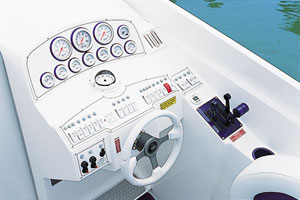
Instruments at the helm were laid out in two rows, and rocker switches activated the accessories.
Fabric and vinyls in the 340 were subtle and simple: black, gold and white. The forward V-berth felt spacious, though it was about the same size as any other boat this length. Powerquest cleverly added two cutouts to each side of the bulkheads between the berth and the midcabin, making the berth feel roomier.
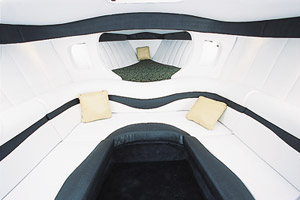
Stylishly upholstered facing lounges and a V-berth comprised the cabin accommodations.
The cabin also featured a suspended white vinyl headliner and U-shape facing lounges with storage underneath. Farther aft was a mini-galley with Corian countertops, tubular stainless-steel rails and a small refrigerator. To starboard, the 340 had a head—roomy enough to climb in and shut the door—with a flushing toilet.
Walk out the white acrylic cabin door to the cockpit and settle into the helm. This was one of the few offshore boats that accommodated people of all heights. The lower angled footrest was ideal for lanky drivers, and the upper suited people of average height. Either way, the controls were intelligently placed.
For example, the Gaffrig levers were within easy reach and all of the most important gauges—speedo, tachs, and trim were arranged so that the driver didn't have to divert attention from the water ahead.
Overall
Powerquest's new 340 Vyper could well be called a "gentleman's offshore boat." It has the top speed and handling to impress the poker-run crowd, and the good looks and amenities to make it appealing to luxury lovers.
Test Results
Hull and Propulsion Information
| Deadrise at transom | 24 degrees |
| Centerline | 33'9" |
| Beam | 8'6" |
| Hull weight | 7,500 pounds |
| Engines | Mercury Racing HP500EFI |
| Cylinder type | V-8 |
| Cubic-inch displacement/horsepower | 502/470 |
| Lower-unit gear ratio | 1.5:1 |
| Propellers | Mercury Bravo One 15 1/4" x 31" lab-finished |
Pricing
| Base retail | $155,290 |
| Price as tested | $211,255 |
Standard Equipment
Accessory switch panel with circuit breakers, Ritchie compass, Gaffrig gauges, Gaffrig drive/tab indicators, Sony AM/FM single CD with four speakers, 40-ounce cabin carpet, forward V-berth with storage underneath, hanging locker, sliding plexiglass cabin door with lock, ice box, portable head, bilge blower, two bilge pumps with auto float switches, Bomar deck hatch with screen.
Options on Test Boat
Upgrade to Mercury Racing HP500EFI engines ($44,220), Competition package comprised of: Quick and Quiet Select Exhaust, leather Momo steering wheel, stainless-steel rubrail insert, Gaffrig Red Line gauges, colored Gaffrig shifter, lay-in cockpit carpet, colored gauge bezels and cupholders ($4,585); Level Two Illusion graphics ($2,500), Mercury Racing HP500EFI Select Exhaust ($2,320), deck graphics ($1,395), porcelain head ($495), Gaffrig clock ($215), stainless-steel passenger footrest ($165), accent pillows ($70).
Acceleration
| 5 seconds | 25 mph |
| 10 seconds | 48 mph |
| 15 seconds | 66 mph |
| 20 seconds | 77 mph |
Midrange Acceleration
| 30-50 mph | 4.5 seconds |
| 40-60 mph | 5.2 seconds |
| 40-70 mph | 8.8 seconds |
Rpm vs. Mph
| 1000 | 8 mph |
| 1500 | 8 mph |
| 2000 | 16 mph |
| 2500 | 27 mph |
| 3000 | 41 mph |
| 3500 | 54 mph |
| 4000 | 66 mph |
| 4500 | 76 mph |
| 5000 | 80 mph |
Top Speed
| Speedometer | NA |
| Radar | 86.5 mph at 5000 rpm |
| Nordskog Performance Products GPS | 85.2 mph at 5000 rpm |
Planing
| Time to plane | 5.2 seconds |
| Minimum planing speed | 17 mph |
Fuel Economy
| At 45 mph | 1.5 mpg |
| At 65 mph | 1.3 mpg |
| At WOT | 1.0 mpg |
| Fuel capacity | 169 gallons |
Manufacturer
Powerquest Performance Boats
Dept. PB
2385 112th Ave.
Holland, MI 49424
(616) 772-9474
www.powerquestboats.com