Cruising Compass: October 19, 2001
Welcome to Cruising Compass. The newsletter has been designed with cruisers in mind and offers all who wish to participate a forum for new ideas, personal stories, comments and more. Your contributi
October 25, 2001
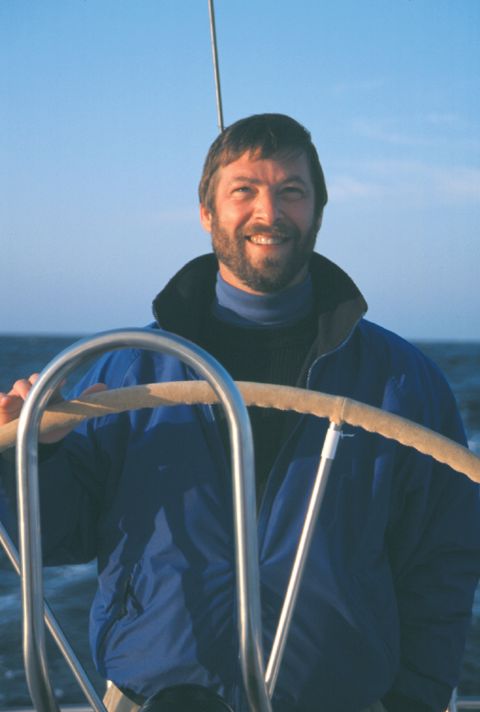
George Day
Welcome to Cruising Compass. The newsletter has been designed with cruisers in mind and offers all who wish to participate a forum for new ideas, personal stories, comments and more. Your contributions are welcome. Whether you sail across your local bay or around the world, Cruising Compass is for you.
----------------------------------------------------------
Send Cruising Compass to a friend!
If you enjoy Cruising Compass, why not e-mail a copy to a sailing friend. Even better, why not send a copy to your whole e-mail list so all your friends will know where to go to find the latest cruising news from around the world.
----------------------------------------------------------
Annapolis Sailboat Show Report - Part 2
A sampling of new gear found at the show
As we reported in the last issuer of CC, the sailboat show in Annapolis in early October attracted exhibitors and attendees from all over the world. In Part 1 we noted some of the new boats that were on display. Here we'll take a brief look at some of the new gear CC found that might be of interest to cruising sailors.
Gori Folding Prop - A&B marine, which distributes the Autoprop in North America, recently became the NA distributor for the Danish-built line of Gori propellers. Gori builds elegant two and three-bladed folding props that are machines to extremely fine tolerances. For cruising sailors, the three-bladed version has a lot going for it - offering both a lot of power in the water in both forward and reverse and very low drag while under sail. These are the props that were chosen by offshore marathon sailors like Can Lewis (team Adventure), Steve Fossett (Playstation) and Ellen MacArthur (kingfisher).
Simple Lightning Protection - Our friends at Everfair Marine, who sell the Four Winds wind generator and other useful products, introduced a new lightning protector for cruising boats at the show. The device is a copper tube, with chafe protection at each end that is hung from the shrouds into the water amidships while at anchor and off the stern while underway. Providing a large ground plane, the lightning protector will entice lightning that strikes the mast to exit safely overboard instead of blasting through the hull.
Schaefer In-boom Mainsail Furling - Although not entirely new, the final form of the new in-boom mainsail furler from Schafer Marine was on display in Annapolis. The new unit - reviewed in the September issue of Blue Water Sailing, with the other models on the market, has several features that make it attractive for cruisers. The boom is one of the simplest to retro-fit to existing masts, a job that the Schaefer expects say will take an eager amateur about a day. Also, Schaefer has included in the system an articulated mast slide and a unique luff guide, both of which make the system easy to and reliable to use.
Seafrost - Simple, low cost refer unit - Seafrost has long been known for manufacturing high quality cold-plate refrigeration ands freezer units that have been accepted worldwide by both the cruising fleet and many charter operations. To meet the demand in the market for a slightly lower end system, Seafrost has introduced (although not at the show) a new thin-plate system that is powered by the latest Danfoss conpressor. Boat owners who are looking for an 12-volt electric system to retrofit into an existing ice box at moderate cost should take a close look at the new unit.
Frigobot Refrigeration - This Italian made unit has earned high praise from European sailors for years and is now available in the US Coastal Clime Control. Using thin-plate technology and Danfoss compressors, the units' most unique feature is how heat extracted by the compressor (cold being the absence of heat) is dissipated through a below-the-water plate. If you have ever seen the heat exchangers on the bottom of a fishing boat equipped with freezers, you understand the concept. Even in tropical waters, an underwater heat exchanger is one of the most efficient ways to pull heat out of the system.
Phasor 12-Volt generator - The appeal of carrying a separate 12-volt DC diesel generator aboard a cruising boat has really caught on in the past few years. Several good models are available and the new unit from Phasor, which CC saw for the first time at the show, looks to be an excellent example of the type. With the capacity to produce 150 amps of DC current for battery charging while using only a cup or two of diesel per hour means that it is possible to keep all onboard systems running at very low cost. Moreover, by saving the main engine for true powering, you can save the big ,more expensive motor a lot of wear and tear. Nothing is worse for a auxiliary engine than running a low speeds and low loads while at anchor or at the dock.
Solomon Technology's Electric Propulsion motor - This new electric motor, designed to be a boats primary engine, first made an appearance at last year's show but was in prototype form. This year, after a year of beta testing, the motor was on display for real and for sale to the public. Driven by battery power which is turn comes from both a diesel generator and from the power supplied to the system when the motor is free wheeling under sail, this is a truly innovative hybrid device. For catamaran owners and those seeking the latest innovations in energy saving engines, this is something to take a close look at.
Jeantex Sailing Apparel - This line of foul weather gear and sailing clothing has been popular in Europe for thirty years but is new to the US market. Coming from Germany, the foul weather gear is based on T3000 breathable fabric that has many of the same qualities as Goretex - in other words, T3000 is waterproof and breathable. The foul weather gear comes in a rage of weights suitable for every type of sailing from day trips to voyages to the high latitudes. The company also offers a wide range of clothing and sailing gear, such as life harnesses, that are look of very top quality. Jeantex is imported from Europe by OHS marketing in Northridge, CA.
---------------------------------------------------------
The Log of Mahina Tiare - Hallberg-Rassy Open House
(John Neal and Amanda Swan-Neal run Mahina Expeditions aboard their Hallberg-Rassy 46 Mahina Tiare. Last summer they sailed with their expedition crews to Norway's Arctic island of Spitsbergen. We rejoin them as sail south from Sweden to Denmark and Germany. If you have an atlas handy, you can follow Mahina Tiare's voyage more easily.)
The Leg 5 Crew Arrives
The Leg 5 Gothenburg-Southampton crew arrived aboard Mahina Tiare yesterday at noon, and by 1600 we were motoring down the river for a quiet night and visit ashore with our friends Lars and Susanne in Hjuvik. This morning we set sail at 0600, planning to sail 60 miles to Anholt, a Danish island in the middle of the Kattegat. With beam winds of 18-22 knots and steady boat speeds of 7.5-8.3 knots, it became obvious that we could sail on, closer to the entrance of Germany's Kiel Canal, still making landfall before dark. Grenaa, a historic seafaring harbor was 24 miles further, and is now 8 miles ahead. This will be the first visit for most of us to Denmark, and we are excited about it.
DENMARK
Grenaa u Djursland Peninsula 31 56.24N -- 10.55E
We arrived in Grenaa around sunset and with strong winds, limited turning and dock space, and no bow thruster had our work cut out for us docking. In the marina we found a rack of free loaner bikes, with a map saying drop them off at any one of four locations. What a neat service of the town! In this historic ferry town we found wide boulevards, cobblestone streets and brick and timber houses, of a much different architectural style than we had seen in Norway or Sweden. Our time in Grenaa was short as we left at 0600 in order to make as many miles toward the Kiel Canal entrance as possible.
Korsor - West Sjalland
After leaving Grenaa we struck headwinds and had to motorsail awhile, but later the winds clocked to the NW and we had a great reach in 18 knots. We sailed under the Great Belt Bridge along with a whole string of ships, and then turned to port to moor in Korsor, on the south of a Naval basin. Once moored, Kurt Petersen, who sails his HR 36 Tessa with his wife Gitte came by and told us how much he had enjoyed our slide show at the HR Open House dinner. Korsor, 60 miles form Grenaa, is a quaint town with 19th-century church and interesting houses that we enjoyed viewing.
Here's our sturdy Leg 5 crew:
Meara Clark, 34 retired two years ago as a Bank of America's VP of Regional Government Affairs to become a Site Manager for Team Read tutoring program in
Seattle. She and her husband.
Brad Clark, 31 who is Liquidation Manager for Amazom.com just sold their Cal 34 which they sailed on Puget Sound because Brad has applied to Marine Corps Officer Candidate School.
Emil Finch, 57 is escaped from Yugoslavia at 19, eventually making his way to Kansas City where he became an orthopedic surgeon. Recently retired, he signed up for Legs 5 & 6 and is considering buying his own ocean cruising boat.
Chriss Mitchell, 50 and her husband Mark (who joins us on Leg 9) left the madness of Hollywood where she was a film producer for the mountains near Lake Tahoe, where they sail a Cal 34. They are excited about the Nov. 2002 delivery of a brand new Amel Super Maramu and introducing their daughter, Alex, age 11 to cruising in tropical climes.
John Holton, 50 is VP of Marketing for a food ingredients company and singlehands his Freedom 30 out of Chicago.
David Holton, 56 is John's brother and used to be in the insurance business. David sails his Mason 33 out of Connecticut.
----------------------------------------------------------
It's Boatshow Season
Take advantage of boat show specials this fall -- anLower interest rates have made financing for boats a lot more affordable; with the new boatsbank program, brought to you by our friends at boats.com, it's also gotten a lot easier. You can apply online, get multiple lenders to compete for your business, and get your loan approved FAST. There's a call center for help, a wide range of financing options, and very competitive rates. www.boatsbank.com
--------------------------------------------------------
Extreme Sailing -- Chasing a clipper ship record
Two Americans set our to beat the clipper ship record from New York to Melbourne, Australia
(Over the next several weeks CC will keep you posted on the progress of Great American II)
A New York-to-Australia clipper ship sailing record set nearly a century and a half ago is being challenged this fall by the 53-foot trimaran Great American II manned by two veteran American sailors, Rich Wilson and Bill Biewenga. The 14,000-mile voyage, which got underway on September 21, coincides with Australia's 150th anniversary observance of the Down Under discovery of gold in 1851
In 1855-56, the American clipper ship Mandarin completed the trip in a record 69 days, 14 hours, sailing from New York southward through the Atlantic, around the African continent's Cape of Good Hope, and on through the Indian Ocean to Melbourne, capital city of Australia's state of Victoria.
Back then Melbourne was the destination for thousands of eager fortune hunters from around the world. Those from America booked passage on American clipper ships, the speediest vessels then plying the seas. As had happened in California two years before, gold had been discovered in 1851 just a few miles west of Melbourne in a region that is now Ballarat, Victoria's largest inland city.
"This will be the second time, actually the third, that I've gone after a clipper ship sailing record set during a gold rush," said Wilson, a life-long sailor and founder of the global educational web site sitesALIVE!, based in Boston, Massachusetts.
In 1993, Wilson and his co-skipper Biewenga sailed Great American II from San Francisco around treacherous Cape Horn on the tip of South America and then north to Boston, in 69 days and 20 hours, breaking the venerable record set in 1853 for the 15,000-mile voyage by the clipper ship Northern Light.
An earlier attempt by Wilson and then co-skipper Steve Pettengill, in 1990, ended in disaster when the original Great American trimaran capsized and was lost in high seas off the west coast of South America, some 400 miles short of Cape Horn. In one of the great rescue stories of modern seafaring lore, the two men were plucked from their stricken vessel by the crew of the giant container ship New Zealand Pacific, which quickly responded to Great American's satellite distress signals. Ironically, the rescue took place on the holiday Americans traditionally give thanks for their good fortune, Thanksgiving Day.
"This 'gold rush' voyage coincides with the celebration in Victoria of the 150th anniversary of the discovery of gold in Ballarat. When we sail into Port Phillip Bay, Bill and I will be looking forward to joining the party," said Wilson, who lives with his wife, Lesley, in the seaport town of Rockport, north of Boston.
Maritime History Buffs corner - The Mandarin Story
The Australian Gold Rush starts a race
In 1851, a disappointed Englishman, Edward Hammond Hargraves, gave up gold prospecting in California and returned to Australia where he'd emigrated from Britain twenty years before. In two years, he'd had little success in the Sacramento goldfields, but he took back to Australia a vision and a thorough knowledge of how to search for alluvial gold deposits, a knowledge not then common outside of America.
During his fruitless search for the big strike in California, Hargraves had observed a marked similarity between the Sacramento terrain where other prospectors had hit pay dirt and a valley he used to roam back in his adopted homeland. It was a vision that was to change not only Hargraves' fortunes but the history of Australia itself.
Within days of arriving back in Australia, Hargraves set off for the region that had haunted him throughout his California sojourn. Camping along a tributary of the Maquarie River, he later wrote, "I felt myself surrounded by gold." In fact, he was, here and later at another site, Lewis Ponds Creek, where, at last, he made his first major strike. Within months the region was inundated with men who had abandoned their jobs and homes in the surrounding territory in hopes of striking it rich in the newly hatched gold fields. Later, they would be joined by thousands of others from abroad, including many Americans whose lust for gold had not been sated by their California experience.
The Australian gold rush was on! The exodus of Australians who left behind their jobs and families as they went in search of gold was especially acute in the newly established colony of Victoria, on Australia's southeast coast. Distressed that the fledgling colony's population was rapidly diminishing as thousands set off in search of gold, a citizens committee sought to alleviate the crisis by offering 200 pounds to the first person to discover gold in the region of Victoria's capital city of Melbourne.
In quick succession, starting in July 1851, gold was discovered in the surrounding communities of Clunes, Bendigo, Mount Alexander, and Ballarat, all within a hundred miles of Melbourne. By the end of 1851, more than 25,000 prospectors were scouring the Victoria goldfields, and tons of gold were being extracted. Soon, Victoria was the continent's greatest source for the precious metal. From the first few grains panned by Hargraves, gold production over the next century grew to a level that eventually placed Australia among the world's top gold producers.
As fortune hunters rushed in, the continent's stagnant population problem soon vanished. In 1852 alone, an estimated 100,000 emigrants entered the country. Within a decade of Hargraves' discovery of gold, the population of Australia as a whole is estimated to have grown from 500,000 to 1.5 million. This huge infusion of emigrants, free men with strong entrepreneurial spirit, radically changed the social dynamic of Australia, which had been founded chiefly as a penal colony.
Thousands of these emigrants journeyed to Australia aboard American clipper ships, the fastest vessels then afloat. In 1856, the clipper ship Mandarin set a New York-to-Melbourne sailing record of under 70 days for the 14,000-mile voyage, a record that has held to this day. This September, coinciding with Australia's 150th anniversary of the discovery of gold, two veteran American marathon sailors will challenge that record in a race against history aboard the trimaran Great American II.
Mandarin Captain John Parritt
John Parritt, Captain aboard Mandarin, joined the vessel in her third year, relieving Captain Stoddard, who had been with the ship since her launching in 1850.
During Captain Parritt's years of command, Mandarin made many memorable passages. While she sailed outward bound from New York to California by way of Cape Horn on three voyages, she sailed directly to China on six voyages. All of her homeward bound voyages were returning from China.
Captain Parritt sailed twice for Melbourne: first, from Norfolk, Virginia, in 1854, during which voyage, she sprung her mainmast early on so that she could not carry full sail, and arrived in the still respectable time of 106 days; and second, on her record passage from New York in 1855-6, arriving in 70 days.
Captain Parritt commanded Mandarin for 10 years until she was lost, homeward bound from China, when she struck an uncharted reef in the South China Sea. All passengers and crew were rescued by the steamer Ambon.
---------------------------------------------------------
GET TWO ISSUES OF BLUE WATER SAILING FREE
Are you ready to go cruising to the far ends of the earth or do you like cruising closer to home? Either way, Blue Water Sailing magazine is for you - if you love cruising. Every issue is filled with cruising stories, in-depth reviews of boats, gear and equipment. We offer sound advice on seamanship, navigation and the art and science of sailing a cruising boat. The magazine's regular contributors include circumnavigators Jimmy Cornell, Brian Hancock, Beth Leonard, and Bill Beiwenga - so you know they have the experience to tell it like it is. You can have TWO ISSUES of Blue Water Sailing ABSOLUTELY FREE by logging on to www.bwsailing.com. Look for the 2 FREE ISSUES button.
--------------------------------------------------------------------
Send submissions for Cruising Compass to [email protected]
For advertising inquiries contact David McCreary at [email protected]