J/90: First Impressions Last
J/90 has high performance without rating rules
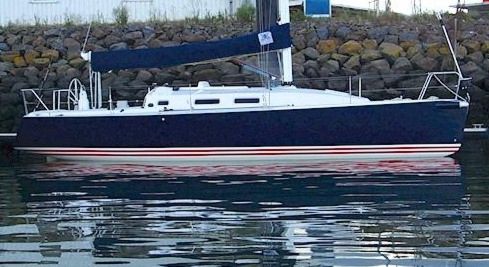
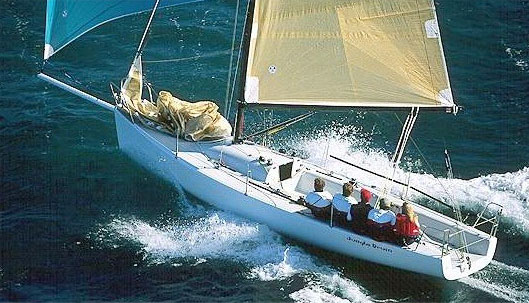 First impressions count for a lot. And the J/90 certainly impresses at first sight. Built unashamedly for speed, it immediately betrays its purpose in life: high-performance sailing with little regard given to the needs of rating rules or even design convention. Long and narrow with a disproportionately large cockpit and no real interior, this is a boat built almost without compromise.
Narrower hull forms with high ballast ratios had been out of fashion for some while, with a whole generation of boats designed to derive their righting moment from teams of football players stacked up along the rail. With performance sailing moving very much towards one-design racing, new options have been exposed and boats are getting narrower again. The J/90 epitomizes the new breed.
The key to the success of this new breed is reducing weight. The J/90 takes things very much to the limits with a lightweight hull in modern materials fitted with a substantial lead, bronze bulb keel and carbon rig. The result is an impressive 60% ballast ratio and a boat significantly stiffer than those we were sailing around in just ten years ago.
The boat feels incredibly stable in the dock. With a narrow beam, the crew exert little heeling force and the truly massive keel performs a good job of keeping the boat upright. Translated into sailing performance, it equates to an extremely stiff boat that will sail to windward quite happily with a crew of just three. Up wind and down, the narrow waterline beam makes for an easily-driven boat while careful design optimization and a little heel ensure the wetted surface has been kept down for excellent light-wind performance.
At the helm, the J/90 is one of the best. A beautifully-engineered steering system feeds every subtle sensation back to the helmsman without so much as a hint of friction, free-play or the other multitude of failures that seem to afflict the majority of production boats. Harken's new plastic rudder bearings no doubt play a substantial part, with excellent detailing of the rudder stock and tiller also contributing.
Even in the light and moderate winds, this was a boat to provide instant and positive feedback at every opportunity. With the sails adjusted just and a reasonable amount of heel, the J/90 is as easy to steer as any, with perfect trim it is among the very best. Tiny adjustments of sheet, traveler or kicker feed through into the tiller upwind or down, while even the smallest movement of crew weight exerts a noticeable effect on balance. What will happen when it's hard pressed in 25 knots remains to be seen but I'll bet it's nothing to be afraid of.
The J/90 sports a Carbon rig, built by Hall Spars. Set up quickly, the rig looked a fraction too straight for a perfect match with the X-Voile fore and aft sails and an adjustment of the forestay bottle screw seemed in order. With a narrow shroud base the J/90 looks though it should be able to point up high. With the flat cut, fine-entry genoa it certainly proves to be the case and even in light winds the tacking angle remained resolutely under 90 degrees. Why the bolt rope was effectively one size too big for the headstay remains unexplained. For stronger winds there is a 90 percent jib. Too full on the over-straight mast, the mainsail nonetheless looked nicely-made and well-shaped, quite unusually, it is fitted with five battens which should help longevity.
Though the class rules allow three spinnakers, we had to opportunity to look at two, both from North. The trimmer has to keep a hand on both the sheet and the tack line and the slightest hint of lost pressure requires a swift turn to windward to keep things going. Skilled crews will certainly make gains here.
Gains will undoubtedly also be made getting the sheer vastness of them all up into the air and back down again effectively. Trawling will definitely be slow with a net this big. The real fun comes at the drop when the whole cockpit seems to fill with voluminous green cloth. Getting it all down the hatch quickly is vital. The reacher is a much smaller and more easily-managed sail that on a light-air day at least looked pretty small. Inevitably with just two kites in place of an intended three, there appears to be something of a gap in the inventory. In light winds our test crew of just three proved perfectly adequate with plenty for everyone to do yet not so much as to be unmanageable. The deck layout counts for a lot here, with the Harken and Spinlock gear all well-laid-out and working perfectly. While providing plenty of space to work, big cockpits can all too easily offer a feeling of insecurity, especially with the boat well-heeled. Not so on the J/90. Though it may be long, the J/90 working area is also narrow and more significantly divided in two with a very substantial foot bar. Kept flat or heeled, the layout works excellently with never a false move on the highly efficient non-slip painted decks.
The hull itself is built using a pretty exotic collection of materials. Glass, epoxy and foam form the primary structure with carbon fiber extensively used as a structural reinforcement on the interior frames, stringers and bulkheads. The chain plates and other rigging anchorages are all cut from titanium. Light weight doesn't come without penalties and as with all thin-skinned foam sandwich boats, the J/90 is a bit more fragile than more heavily-built vessels. Our test boat was already showing the strain, with a small area of skin pushed in during transit. This kind of damage can occur just as easily with a hard landing on the pontoon or trailer though it is relatively easy to repair.
Although the structural detailing looks sound, the quality of finish, especially on the interior surfaces, leaves something to be desired. The secondary bonding in particular was (quite literally) rough around the edges. Not that anyone would want to spend much time down below. There are two pipe-type bunks but that's about it for accommodation. No toilet, no stove, no sink, not much of anything in fact except a giant sail storage area. Limited electronics have been attended to with a neatly-fitted battery and switch panel but that's about it.
Motorized power comes in the form of an outboard fitted to a very simple transom bracket. For racing, there is an engine stowage space under the cockpit.
JBoats
557 Thames Street
Newport, RI 02840
Phone: (401) 846-8410
Fax: (401) 846-4723
www.jboats.com