Herreshoff Heritage
Herreshoff's popular H-28 design spoke to a generation
March 29, 2001
The Herreshoff H-28 came off the drawing board of L. Francis Herreshoff one year after Pearl Harbor, and the original blueprints bear his carefully noted "Dec. 1942." The design, ironically enough, was finished just 30 years to the month before this great designer passed away. In those three decades, the H-28 went on to become one of the most popular designs from his fertile mind.
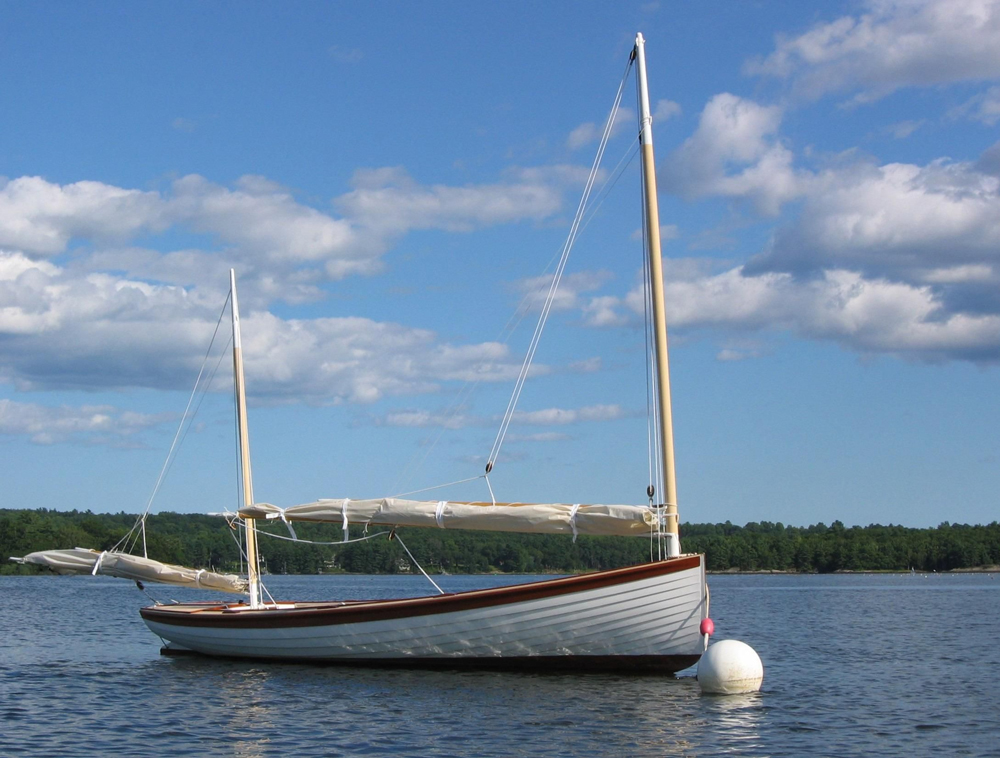
The Herreshoff H28 dates back to almost WWII.
When it was first published in Rudder magazine in 1943, who knows how many servicemen in Europe and the Pacific kept tattered copies in their duffels to pull out, study, and dream. Perhaps it was a symbol of peace and security, but the fact is that hundreds of H-28s were built shortly after the war ... in boatyards turning once again to pleasure craft and in backyards by home builders who hadn't yet heard the term "do-it-yourself."
It isn't hard to imagine the enthusiasm for a design that could be built up with visions of peaceful yachting, particularly when the nation was at war. Herreshoff had a way with words, and his first Rudder article on the H-28 set the style:
"But most of all to be considered is the joy of being noiselessly propelled over the ever-changing magic carpet of the sea and contemplation of the restful nights of relaxed slumber that follow an all-day sail. Like the Arabs, folding their tents and silently stealing away, the night clouds fold back before the golden dawn, lighting up the cockpit and streaming into the companionway; each drop of dew on rope and spar is a perfect pearl with all the colors of the rainbow, and the dawn has awakened all nature in our cove.
"Well, we are underway again, and have passed the harbor mouth. We have a long summer day ahead of us, for daylight starts at 4 a.m. now. Ye gods! What is that I smell subtly stealing from the companionway, now faint, now strong. Is it java or is it mocha?"
With a word picture like that, it's no wonder the little ketch had immediate admirers.
Why was the H-28 so popular? Not only was it a smooth sailing small yacht with good Herreshoff lines, a fine vessel for a new family, and economical to build and operate, it could also be taken anywhere with pride, unlike some of its ugly reverse sheer sisters that were to come. It could be described, in an almost unused word today, as being yar.
Herreshoff may have foreseen the boat's popularity, for his Rudder article that ran with the first plans started: "All designs are a compromise on the designer's attempt to combine certain desirable features without sacrificing too much safety, comfort, and cost. H-28 was designed for the man who has only a limited time to sail, but would like to go somewhere and back in that time. It was designed to be a boat that could be quickly gotten underway for a sail on a summer evening, a boat that could ghost along in light breezes as well as stand up to anything she might get caught out in. She is wider on deck than an ideal sea boat should be (particularly aft) but that is to secure maximum deck space and to make her dryer in a chop. Some of the principal objects of the design were to secure the maximum usable room for the cost without sacrificing looks and speed, and to make the boat as simple to build as is consistent with strength and long life."
And long life the H-28 has had. Tradewinds is owned by Donn Tatum Jr. of San Francisco, and was finished in 1946 as H-28 No. 5. One of three built in Panama, it varied slightly from the construction specs laid down by Herreshoff: oak frames with Honduras mahogany planking (fir was suggested for thrift) fastened with copper (the specs called for Tobin bronze) and decks covered with canvas. Tradewinds, aside from the planking, is an original H-28 in every way with two exceptions: the pipe berths in the cabin are missing and the cedar bucket with rope handle, lovingly drawn in the plans, has been replaced by a more modern marine toilet.
So it could be 1946, except that Tradewinds shows a bit more wear that it would have 46 years ago. But Herreshoff, who scorned "red pants, lapping jibs, claptraps and gigolo yacht jockies" probably would have hated a yachtsman who kept it in museum condition rather than actually enjoying the boat, and Tatum gets plenty of use from his H-28.
Getting back to its beginnings, the H-28 started as Design No. 80. Its parentage traces a history of the Herreshoff family itself, starting with the Wizard of Bristol, Herreshoff's father Nathaniel, who designed a popular 12 1/2-footer now called a Dough Dish. Years later, Llewellyn Howland (who was to commission the classic Concordia yawl also) asked L. Francis to design a slightly larger version which he called the Buzzards Bay 14. A quick glance at the lines of the 14 will show their similarity to the later H-28.
First public mention of the H-28 came in the December, 1942, issue of Rudder, when the editor outlined a series of upcoming articles titled "How To Build H-28," and showed a profile drawing of the yacht. The series ran, more or less steadily, for the following 14 months. Some months were largely Herreshoff articles while others were simply reproductions of spec sheets and blueprints. In the January, 1944, issue, the articles ended with the notation that reader interest had reached an all-time high for Rudder's How-To-Build series. A number of H-28s were already under construction "and we feel that if the demand for this series is any indication, a large number of these boats will be seen on our, as well as foreign, waters after victory."
The plans are a reflection of Herreshoff — carefully drawn and covered with neat notations on equipment and methods. These notes, in his own hand, have what might graciously be called atrocious spelling, but they do pass on gems of wisdom as seen by L. Francis, such as "Avoid all anchors which have moving parts."
The H-28 is Herreshoff throughout — from the long and almost straight forefoot to the under-tucked counter and wineglass transom that graced other yachting classics such as Ticonderoga and Nereia. The house is low, particularly when compared to modern yachts, but then, compared to modern yachts, the entire H-28 is low. The side decks are remarkably wide and you don't have to edge around the shrouds sideways when going forward. The cockpit is spacious, and the visibility is unhindered by anything forward, although the mizzen tends to divide captain from crew. One chiropractic complaint universal among H-28 owners is that the cockpit coamings are the wrong height for comfort. But all else is well laid out. The mizzen and mainsheets both trim to the mizzen mast, the working jib can easily be handled in a breeze, and singlehanding is effortless.
Discussing the cabin plan, Herreshoff wrote: "When yachting was yachting and people wore yachting clothes and lived in a sweet smelling spotless cabin with all the clothes neatly stowed high and dry, then, oh then, it was a joy to sit in the cabin under the soft glow of a kerosene lamp and study the chart for ever more snug and romantic coves than the one you were anchored in, and lay a course to regions even farther from the maddening crowds ... places where men are sailors or farmers and converse directly with the gods, and who could feel the pulse of nature and tell what the weather was going to be without benefit of radio or cinema. I can, or think I can, design a cabin plan for H-28 for those who want to go to where the water is clean, the pine trees green, the offshore breezes laden with ozone, and where breathing, living and sailing are joys."
The cabin can best be described as simple. A pair of built-in counters sit outboard of the companionway, with an alcohol stove called a Sea Cook to port. His Rudder article contained a largish segment devoted to one conclusion: he didn't like iceboxes and hadn't included one on the H-28. He did note that the starboard cupboard could be converted, since it was just shelves, and I would suspect that few H-28s were built without this "unapproved" conversion.
Forward of the two cabinets are a pair of settee berths drawn in for just that purpose: sitting. Pipe berths, which folded up to hold duffels out of the way and provide backrests, became berths at night or underway, with an infinite adjustment for any angle of heel. The cedar bucket was located just aft of the mainmast and the forepeak was floored in for storage or extra bunks if needed. Simple it was when compared to modern yachts replete with dinettes, wrap-around galleys and the like. But there is something very snug about the H-28 cabin that defies description ... it would be a pleasant cabin with rain pattering on the deck and a pot of tea perking on the stove.
The sail rig was current for the 1940s. The profile shows a low rig with short spars, long booms, and a small foretriangle. The spars were box section rectangles which Herreshoff had invented in the 1920s. Both masts had single spreaders and the booms raked upward in a way that might not work on vessels with less pleasing sheer lines.
For power, Herreshoff offered yet another dissertation:
"It is feared that most of the owners of H-28s will have to report to the office without fail on Monday morning and even telephone Mother or Aunt Susie on Saturday night, and so had best have a motor. Now, motors like women are not all bad, but it must be admitted there is a great difference among them. I prefer the simple, clean reliable ones, admire the economical ones, and almost love the quiet ones that are small and don't smell. But there again we must make a compromise, as all through a yacht's design; for whereas the small ones are economical, they are apt to be hot and smelly, while the big ones keep quiet and cool."
He went on to recommend a Gray Sea Scout with "magneto and impulse starter."
The prop shaft emerges under the port counter, which makes backing up a bit interesting, but Herreshoff felt reverse gears were noisy and left them out. Most modern H-28s, in the process of replacing 40-year-old engines, have added reverse, but you can always pick out an experienced H-28 owner because he never — ever — attempts to back to port.
The idea that a yacht designer in 1992 might offer advice on a lifestyle to go with his new vessel is absurd, but L. Francis had no such qualms. Perhaps he was paternal about his new creation, but the H-28 brought out discourses on a wide variety of subjects only vaguely related to the construction of the boat. While explaining his dislike of iceboxes, he suggested the foods that should be stocked in the cupboard, including prunes, hard tack, lentils, potatoes (to be eaten skin and all), and particularly hard black salami sausages. He advised that one should chew everything well.
Other sidetracks delved into guns and how to use them aboard, cameras with tips on lens settings, clothing for sailing, and a few paragraphs on companions (female) that might throw themselves upon H-28 owners (and how to protect oneself). He even recommended Hudson's Bay blankets for the pipe berths, and suggested a red one to port and a green one to starboard, perhaps so that one's female companions knew which bunk belonged to whom.
In his final words before delving into the construction details, Herreshoff offered some advice to potential builders:
"If her design is only slightly changed, the whole balance may be thrown out. If you equip her with deadeyes, build her with sawn frames, or fill her virgin bilge with ballast, the birds will no longer carol over her, nor will the odors arising from the cabin make poetry, and your soul will no longer be fortified against a world of warlords, politicians and fakers.
"For instance, two quite good violins might be made in distant countries and a century apart, and the procedure of each step of manufacture be quite different, but if each of the builders had exactly the same picture in mind of the finished article, in all probability the instruments would be very nearly alike. And if either of these instruments came into the hands of one who loved and cherished it and studied its peculiarities, even though the owner were a Canadian woodchopper or a Baltimore belle, he could finally make it respond to all his moods and draw from it delightful melodies even when playing in the dark. But if, dear reader, they listened to someone who could not design a violin or had changed it or mutilated it with parts belonging to some other type of music box (deadeyes or inside ballast) it could never be tuned again.
"So, too, with H-28. If you love and cherish her, you can learn to draw sweet melodies from her and she will carry you through all the scale (Beaufort scale) of gales and calms, for she is based on well-proven principles."
That is perhaps the best reason why hundreds of H-28s have been built in the 50 years since L. Francis Herreshoff put down his drafting pen on Design No. 80. And it also explains the loyalty of H-28 owners to their little yachts, and why backyard builders are still happily laboring over the set of blueprints that gave the H-28 life.
Editor's note: this article was updated in July of 2017.