Ideal 18: No Tweaking, Please
Ideal 18 is a Bruce Kirby one-design keelboat
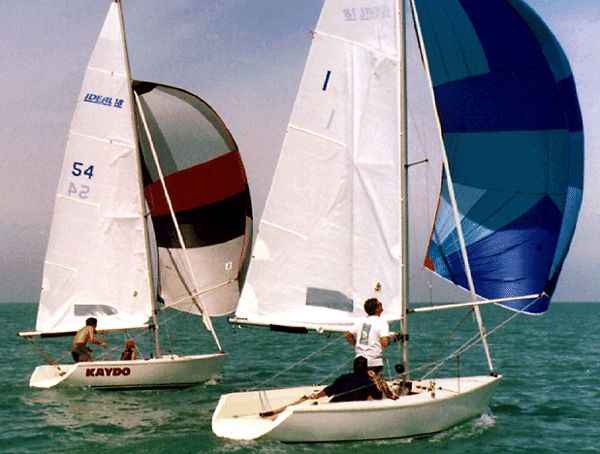
 Canada's Connecticut-based yacht designer Bruce Kirby has long been known for the singlehanded Laser. Of course, he has designed numerous boats in the three decades that have passed since the famous dinghy made its debut, and one is the Ideal 18. Although this design is a keelboat, with a crew of two, the basic philosophy behind it is true to the little boat that made Kirby a household name -- in nautical households.
Designers don't create boats in vacuum; more often than not a commission from a custom client or a production builder provokes the new craft and dictates its parameters. The trick is to pick the right designer for the job, and it is this case Kirby's track record of creating one-designs like the Laser (for builder Ian Bruce) or the Sonar (initially for a group of Long Island Club racers) made him a logical choice.
In the case of the Ideal 18, the provocation came from Frank and Skip Shumway of Rochester N.Y. They had long admired the Bullseye, a stable, full-keel little design by Nat Herreshoff first produced in 1934. They found it easy to sail because there was no hiking required, and its stability inspired confidence. But to make it exciting, it needed a little more speed.
Ontario Yachts 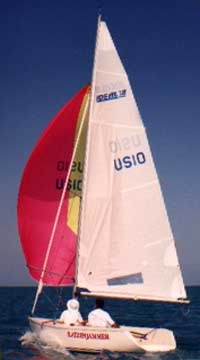 That's where Kirby entered the picture. All those involved felt the market was ready for a new fixed-keel sailboat with exceptional performance under strict one-design rules. After the preliminary design was complete, Ontario Yachts was brought in, not only to produce the boat, but to lend its years of small-boat experience building the Etchells-22, Kirby's Sonar, the Albacore and the International 14.
There is a strong emphasis on simplicity in this boat. It can be sailed by one or two people because of its self-furling and self-tacking jib. (It's so simple the second person might even get bored!) A Laser-style mainsheet with the bridle at the transom keeps the rigging cost low and maintenance to a minimum.
Design
Kirby has drawn a hull whose shape differs in philosophy from his Sonar and Laser. The form is much more that of a displacement hull, with less emphasis on planning. As Dirk Kneulman Jr. of Ontario Yachts explains, the curvature in the underwater profile just forward of the rudder is there "to eliminate those large differences in speed you see in other classes between crews of different weights." I can attest to that fact, having watched Laser sailors lighter (and younger) than me scoot past on the reaching legs as I struggle to get up on a plane. To promote its use for the "aging Laser sailor," this boat has been desensitized to allow sailors of different weights and athletic ability to sail at very similar boat speeds -- and that should make for great racing.
No tweaking allowed! 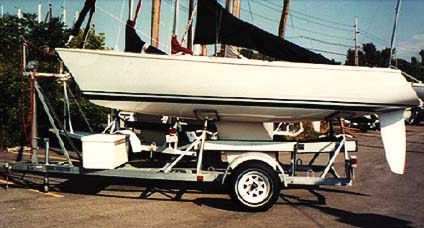 Kneulman is keen to eliminate much of the tweaking that is done to so-called one-designs to elicit some subtle speed advantage. To produce smooth, consistent keels, the lead casting is lowered into a second mold and encapsulated in pigmented resin. Thus, no fairing is required or allowed. To locate the keel on the hull, a small stub is molded on centerline that fits into a recess in the keel. The keel cannot and must not be moved fore or aft.
With such tight controls, competitive racing plainly is contemplated, but much of the market is hoped to be at the cottage. Although the boat can be launched from a trailer, I suspect most owners will leave it on a mooring and enjoy the fact that four minutes after you jump on board you can be sailing.
Specifications
| LOA | 17 ft. 10 in. |
| Beam | 6 ft. 2 in. |
| Draft | 3 ft. 3 in. |
| Weight | 1200 lbs. |
| Sail area | 167 sq. ft. |
Builder:
Ontario Yachts Company Limited
4160 Morris Drive
Burlington, Ontario L7L 6L5
Canada
(905) 639-8382
North American Distributor:
Ideal 18 Class Association
c/0 Shumway Marine
70 Pattonwood Drive
Rochester, NY 14617
USA
(585) 342-3030, (800) 433-2518
email: [email protected]