The Outboard Expert: Power Up your Steering
Economical power-steering system shows promise.
September 9, 2007
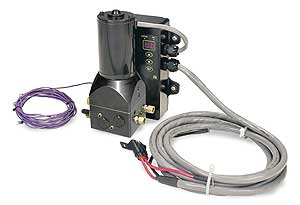
The components of the TeleFlex SeaStar Power Assist Pro power steering system can be mounted almost anywhere along the route of the hydraulic steering hoses within the boat.
A friend of mine in Florida scoffed at the idea of buying a new outboard with drive-by-wire controls and power steering, until he rigged his new center console boat with a Mercury Verado. After about a week he decided he wouldn't want to give up either feature, just because they made driving the boat so much easier. Trouble is, this nice technology comes on new outboards that are plenty expensive. It would be hard to justify replacing a perfectly good motor just to get a new Verado with power steering.
There is an alternative, however. Last year TeleFlex introduced its new SeaStar Power Assist Pro (www.teleflexmarine.com), a power steering system that can be installed on just about any boat that's already using TeleFlex SeaStar Pro manual hydraulic steering, by far the most-popular hydraulic system out there. I ran the SeaStar Power Assist Pro system on a Key West 268CC rigged with dual Suzuki DF150 outboards. We were running out of a public launch ramp in Largo, Fla., and had to negotiate a slalom-course channel to get out to the ICW. This proved to be a perfect test for the power steering system, as we were also testing the same Key West boat powered by a single Suzuki DF300 outboard that did not have power steering. Swinging that big motor almost lock-to-lock to make it through three tight turns at speeds took some muscle. With the power steering, guiding the boat with twin outboards was a finger-tip operation, like driving grandma's old Buick. Spend a day on the water, especially if you are trolling, backing down on fish, and maneuvering around docks, and the energy saved by power steering really adds up.
The SeaStar Power Assist Pro system is 10.5 inches high and about six inches deep, or about the size of a sterndrive trim pump, and consists of an electronic control unit and an electro-hydraulic pump. It is essentially a booster pump spliced into the hydraulic steering system, and can be located almost anywhere along the route of the hydraulic steering lines that there is room to mount the pump. On the Key West boat I tested, the pump was placed on the deck within the center console. It could also be placed within the inwales or bilge further aft, a typical location for bass and bay boats. It is compatible with any brand of outboard motor that uses hydraulic steering, and with autopilots. If the power assist system should stop working, it automatically reverts to manual hydraulic control.
The TeleFlex system differs from the Mercury Verado power steering system in that its electric pump only operates when it detects steering input from the helm - if you are simply idling or running a straight course, the electric pump does not operate. The Verado pump is always on, and in my experience it's also somewhat noisier than the TeleFlex pump. Even with the TeleFlex pump resting right at our feet, I never heard it running, even at trolling speeds. TeleFlex says the Power Assist Pro system draws just on average 3 amps (for single outboard installations), so it should not have an impact on battery capacity during long trolling runs.
According to TeleFlex tech representative Marc Adams, installing the SeaStar Power Assist Pro system is not a difficult job, except for the final step of bleeding air out of the system.
"It's basically a bolt-in job," said Adams. "but if you don't get the system purged correctly, it may not work. I'd suggest that if you do the installation yourself, you take the boat to a dealer with the TeleFlex Power Purge system and let them do that job."
With a suggested retail price of $1,720 (plus $150 to $200 for hydraulic lines), SeaStar Power Assist Pro is not inexpensive. But it's a lot cheaper than a new outboard. Watch for this system to be offered as an OEM option on more boats in 2008.
Keeping Customer Service In-House at Yamaha
If you call Yamaha customer service, the accent on the other end of the line is likely to be Southern. Two years ago, during a time when many industries were out-sourcing functions such as customer service, Yamaha Marine Group went against the trend and created an in-house customer relations department at its Kennesaw, Ga., headquarters. The program has paid off, as Yamaha Marine Group and its boat companies Century, Skeeter and G3, received an NMMA CSI Recognition Award for Excellence in Customer Satisfaction for 2007.
"We believe it's best to keep customer relations not only in the country, but also in the same building as the rest of the company," said Phil Dyskow, Yamaha Marine Group President. "When and if customers have a problem, they want a knowledgeable voice on the other end of the phone. "
Last year, through its Yamaha Marine University, the company trained 1,800 dealer service employees in technical service courses, 2,200 dealer staff in service updates and another 1,200 dealer sales professionals in product familiarity.
To monitor customer satisfaction and learn ways to improve it, Yamaha surveys every one of its retail customers twice in the first year of ownership. Customers receive a survey immediately after the purchase and approximately six months after the purchase.
Editor's Note: Charles Plueddeman is the editor at large for Boating, the nation's largest boating magazine.