Elite EC 278: Performance Report
Elite's EC 278 catamaran is worth every penny of its asking price.
December 7, 2003
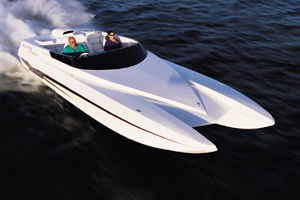
The EC 278 ran 83.8 mph with the engine turning 5,200 rpm. (Photo by Tom Newby)
No one, not even the most desperate or deluded salesman, will tell you performance boats are inexpensive. But there are bargains, relatively speaking, to be had, particularly from regional boatbuilders. The EC 278 catamaran from Elite Powerboats is a fine example.
Based in Highland, Ill., Elite has been building performance boats for 14 years. The company sells factory-direct, and almost all of its models go to buyers in the Midwest. Elite reportedly has a strong following, and after testing the EC 278, which was priced at less than $100,000, we can understand why.
Performance
The bottom of the EC 278 had two single-step sponsons with one continuous strake and a dual-step center pod. The catamaran was powered by a MerCruiser 496 Mag HO engine modified with a ProCharger centrifugal supercharger running 3 pounds of boost. In stock form, the 496 Mag HO is rated at 425 hp. The intercooled supercharger setup reportedly upped the engine's output to 580 hp.
The extra juice came in handy. The EC 278 ran 83.8 mph with the engine turning 5,200 rpm. Mazco Propeller reworked the boat's Bravo One four-blade prop to a 29"-pitch, and the wheel proved to be an ideal all-round choice for the 27-footer. Time to plane was 5 seconds—the same amount of time it took the cat to accelerate from 30 to 50 mph—and in 20 seconds the boat reached 70 mph. Running from 40 to 60 mph took only 7.05 seconds.
All the EC 278's numbers were strong, stronger still was its handling. The catamaran was responsive and crisp in all slalom and circle turns, yet forgiving and uncommonly easy to drive. Full hydraulic steering from IMCO surely helped. The boat also maintained a straight-line heading with zero input on the steering wheel and sliced easily through light river chop. Plus, unlike a lot of cats, it had no inevitable porpoise speed.
About the only downside of the EC 278 was the black soot on its transom after our test runs.
Workmanship
Elite hand-laid the EC 278, as it does on all its boats, with NPG ISO gelcoat, Reichold Hydrex 100 vinylester resin, 1 1/2-ounce mat, 1708 bidirectional fiberglass and 180 unidirectional fiberglass. The catamaran also was cored with half- and three-quarter-inch Baltek balsa.
Considering the EC 278 was a customer's boat that had seen a season of use, the shine of the boat's white gelcoat was healthy. There were a few dimples and waves in the cat's hullsides, but they were far from major. Through-bolted on the sides of the boat, the rubrail screwed in place at the transom, where it exhibited minimal gaps.
The builder went above the call, without going overboard, with the boat's hardware by equipping it with six Accon Pull-Up cleats in white powder-painted bezels. The boat also came with a pair of Eddie Marine billet swim steps on the stern.
With space to spare on both sides of the big-block motor, the engine compartment was accessible via a scoop-equipped hatch that lifted on a screw jack. A standard MerCruiser transom mount and L-angles through-bolted to the stringers secured the engine over the bilge, which was finished in smooth white gelcoat.
Rigging was clean and most of the wiring, all of which was supported by stainless-steel cushion clamps, was hidden. Also neatly hidden were the billet hinges for the engine hatch.
Interior
Conventional straight-back, single-cushion benches are old school and steadily disappearing from performance boats. They're being replaced by bucket- or bolster-style benches, such as the four-person bench in the EC 278, which have a comfortably snug place for each passenger. That's better than a conventional bench, as anyone who's sat on one at high speed or in rough water can attest.
Another much-appreciated feature of the catamaran's surprisingly spacious cockpit? Thick gunwale padding carried all the way ahead of the co-pilot's and driver's bucket seats. On the sole ahead of those buckets were molded angled footrests that were part of the cockpit liner. A grab handle and the boat's Pioneer stereo system were mounted in the co-pilot's dash to port.
Etched panels for the accessories contributed to the boat's custom feel at the helm station. The boat's white-rim Gaffrig by Livorsi gauges, included a 120-mph Monster GPS speedometer and a tachometer—both with recall—and were installed in teal bezels that matched the piping on the upholstery and the accents in the gelcoat.
Curiously, the Gaffrig by Livorsi throttle and shifter were installed in opposition, meaning the throttle-handle bend pointed forward and the shifter-handle bend pointed aft. A representative from Elite said the idea came from a customer. The crew at Elite found the setup comfortable and continued to install the Livorsi controls in that configuration. Our lead test driver didn't find it any more comfortable than the standard arrangement, but he also didn't find it uncomfortable.
Although the EC 278's cabin was little more than an 8-foot-long crawl space, the builder went to the trouble of carpeting it and installing a headliner on the ceiling. Elite also took the time to pad the cabin's bulkheads and embroider the forward-most bulkhead with its logo.
Overall
Because Elite is a regional builder with relatively low output, the company largely has stayed out of the performance-boating spotlight. That could change if the company keeps building strong performers—and strong values —such as the EC 278.
Hull and Propulsion Information
| Deadrise at transom | 13 degrees |
| Centerline | 27'8" |
| Beam | 8'6" |
| Hull weight | 4,000 pounds |
| Engine | MerCruiser 496 Mag HO with ProCharger |
| Cylinder type | V-8 |
| Cubic-inch displacement/horsepower | 496/580 (estimated) |
| Lower-unit gear ratio | 1.5:1 |
| Propeller | Modified Mercury Bravo One 15 1/4" x 29" |
Pricing
| Base retail | $81,000 |
| Price as tested | $98,750 |
Options on Test Boat
Three-pound ProCharger kit ($5,396), custom graphics ($4,500), IMCO full-power hydraulic steering ($4,000), stereo system ($2,000), hatch blower scoop ($650), cockpit cover ($625), Gaffrig by Livorsi mechanical trim indicator ($429) and drive shower ($150).
Test Conditions
| Site | Colorado River, Parker, Ariz. |
| Temperature | 90 degrees |
| Humidity | 23 percent |
| Wind speed | 10 mph |
| Water conditions | 1'-2' chop |
| Elevation | 450 feet |
Acceleration
| 5 seconds | 26 mph |
| 10 seconds | 48 mph |
| 15 seconds | 61 mph |
| 20 seconds | 70 mph |
Midrange Acceleration
| 30-50 mph | 5 seconds |
| 40-60 mph | 7 seconds |
| 40-70 mph | 12.6 seconds |
Rpm vs. Mph
| 1000 | 8 mph |
| 1500 | 13 mph |
| 2000 | 26 mph |
| 2500 | 33 mph |
| 3000 | 44 mph |
| 3500 | 53 mph |
| 4000 | 67 mph |
| 4500 | 77 mph |
| 5000 | 82 mph |
Top Speed
| Nordskog Performance Products GPS | 81.8 mph at 5200 rpm |
| Radar | 83.8 mph at 5200 rpm |
Planing
| Time to plane | 5 seconds |
| Minimum planing speed | 20 mph |
Fuel Economy
| At 25 mph | 3 mpg |
| At 35 mph | 3 mpg |
| At 45 mph | 2.6 mpg |
| At 55 mph | 2 mpg |
| At 65 mph | 1.9 mpg |
| At WOT | 1.8 mpg |
| Fuel capacity | 76 gallons |
For More Information
Elite Powerboats
3645 George St.
Highland, IL 62249
618-654-6292.