Perry Design Review: Ideal 18
Kirby's simple and safe dinghy
August 25, 2000
When I started sailing there was a wide variety of classes available to get the beginner out on the water safely. The classic Phil Rhodes-designed Penguin dinghy was the first dinghy I skippered. From the Penguin, you could graduate to the Snipe, the Geary 18, the Flying Scot, the Lightning, the Hunt-designed 110 or the bigger 210. The list could go on and on, but the point is these classes have waned, if not almost disappeared.

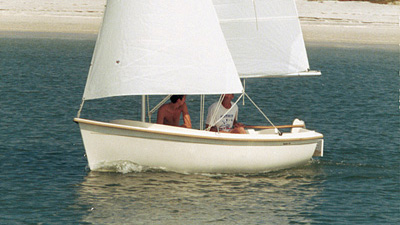
A pair of Ideal 18s.
This could be attributed to the advent of the Laser dinghy and the sudden preoccupation with high performance, meaning planing, speeds. Even coming up through the ranks of lesser dinghies, including the cranky little OK Dinghy, the Laser was a handful the first time I took one out in a breeze. It was a handful, but it was also a blast. On my ear in the water, half in the boat half still trying to get in, I screamed across the bay at a full plane, everything attached vibrating with that high pitched hum produced at super hull speeds. It didn't take long for the experienced sailor to tame the Laser.
Allow me to leave the esoteric Star class out of the picture totally, compress history and jump to the Soling. The Soling was a keelboat and would not capsize, but it carried a big rig with a monster chute and was far from docile in a breeze. Serious dinghy sailors gravitated to Lasers, International 14s, 505s, Stars and Solings; all boats that required well-honed sailing skills. I think these wonderful boats had the effect of providing an intimidating initiation for the neophyte.
The mid-70s saw many beginners starting with boats over 25 feet long. Stable and relatively slow, these were boats that kept you safe and dry regardless of your skill level. Unfortunately, the fact that they kept you dry probably accounts for the fact that these boats helped develop a whole generation of terrible sailors. Having a Laser capsize to weather on you and pinning you under the main was a quick way to learn about sailing by the lee. "What do you mean by sailing by the lee?"
"That's what I mean."
If it's convenient to blame master dinghy designer Bruce Kirby for part of this problem because he was behind the Laser, we also have to give credit to Bruce for his efforts at undoing this problem by giving us the new Ideal 18. Here is a boat that is aimed at simplicity and safety with a dash of performance that you would expect from a Kirby design.
This little keelboat may be just what is needed to get entry-level sailors involved in club racing, a disappearing sport. The idea came from Frank and Skip Shumway of Rochester, New York. Built by Dirk Kneulman Jr. at Ontario yachts, the class now numbers in excess of 40 boats, not a bad start for the first year of production.
In true one-design fashion, the boats are built to be identical. The hull is built around a backbone grid to spread out the rig and keel loads and stiffen the entire hull. No exotics are used in order to keep the cost down. This was a primary goal from the onset. Thirty-six two-liter sealed plastic jugs are bonded to the hull bottom to produce 650 pounds of internal buoyancy. Remember that boats that don't capsize can usually sink. With Ontario's double-overlap-style hull to deck joint detail, the entire boat becomes watertight.
The hull form for the Ideal is a blend of ideas. Rather than produce a planing boat that places a premium on optimum crew weight (Let's see, it's blowing 15 knots today and I need a 142.6-pound crew), Kirby drew a boat with enough rocker to the profile to make planning improbable. Recently, after test sailing an International 14, I was told that for my 220 pounds, I needed a crew that weighed no more than 121 pounds. This eliminated my agile and athletic wife and at the same time any further interest I had in the International 14 class as a family dinghy.
Kirby's approach will keep most husband and wife teams competitive over a wide range of wind speeds. Of course it is inevitable that an optimum skipper-crew weight will emerge eventually. Class rules outlaw hiking, although in the picture I have of the boats competiting in the North American Championship, bot skipper and crew are doing something that appears to be sitting on the rail with attention paid to placement. They are not doing backbends so I guess by today's standards, it is not hiking. Like ooching, this rule is bound to be tested soon. But at this time, the style of sailing is very civilized. The bulk of the boat's stability is provided by a 700-pound cast lead elliptical keel.
The key to the rig is simplicity and cost effectiveness. There is no backstay or runners. The spreaders are swept aft on the tapered spar. The mainsheet rides on a simple transom bridle and leads forward to a mid-cockpit barney post. The spinnaker pole is carried on the boom and all spinnaker handling chores can be easily accomplished without leaving the cockpit. The jib is self-tacking and on a Harken headsail furler. There are no winches. With the headsail self-tacking, the crew is freed to play the mainsheet, leaving the skipper to concentrate on working the boat to weather.
To keep competition focused on skipper-crew skills, the class employs rules to keep the boats identical. There is no hardware substitution or movement allowed. The sail inventory is limited and the sail-away package which, in a brilliant move of diplomacy, offers mainsails from North, jibs from Sobstad and spinnakers from Hood.
The cockpit design of the Ideal makes it comfortable for up to four sailors, but two is the rule for racing. The boat's responsiveness and speed make it an ideal learning platfrom and class racing is the best way I know to develop good sailing skills. You did good, Bruce.
Boat Specifications
| LOA | 17'10" |
| LWL | 14'6" |
| Beam | 6' |
| Draft | 3.25' |
| Displacement | 1200 lbs. |
| Ballast | 675 lbs. |
| Sail Area | 167 sq. ft. |
| SA/D | 23.66 |
| D/L | 175.72 |
| Auxiliary | Evinrude 2 hp |
 This story originally appeared in Sailing Magazine, and is republished here by permission. Subscribe to Sailing.