Perry Design Review: Prout 38
Well-designed cat for family cruising
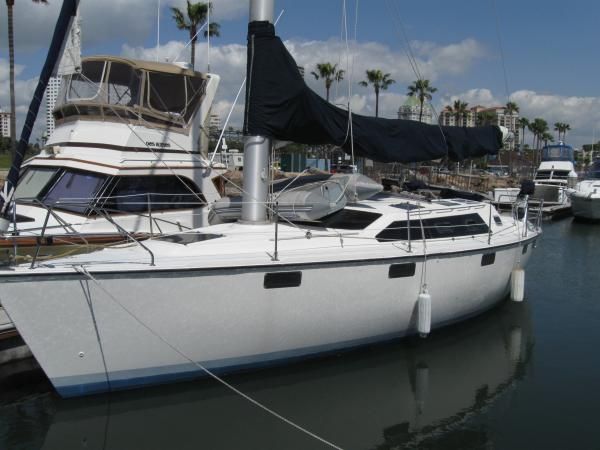
Prout has been in the catamaran business for more than 25 years. This new 38-footer shows the distinctive Prout approach to rig placement and aesthetics. The accommodation plan of this cat fills almost the entire gross dimensional envelope. This means that the Prout 38 will not be light. The sales brochure lists the displacement as "dry" at 14,330 pounds, and the "max recommended weight" at 20,170 pounds. Working with a static waterline length of 34 feet, 6 inches, I come up with a D/L ratio between 156 and 219. Granted, the waterline length will grow as the boat sinks, reducing the D/L ratio. Each hull will sink approximately one inch for every 950 pounds. This means the flotation difference between the dry and max weights will be about 6 inches.
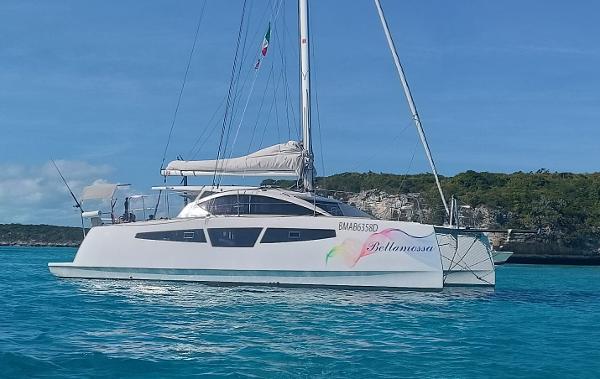
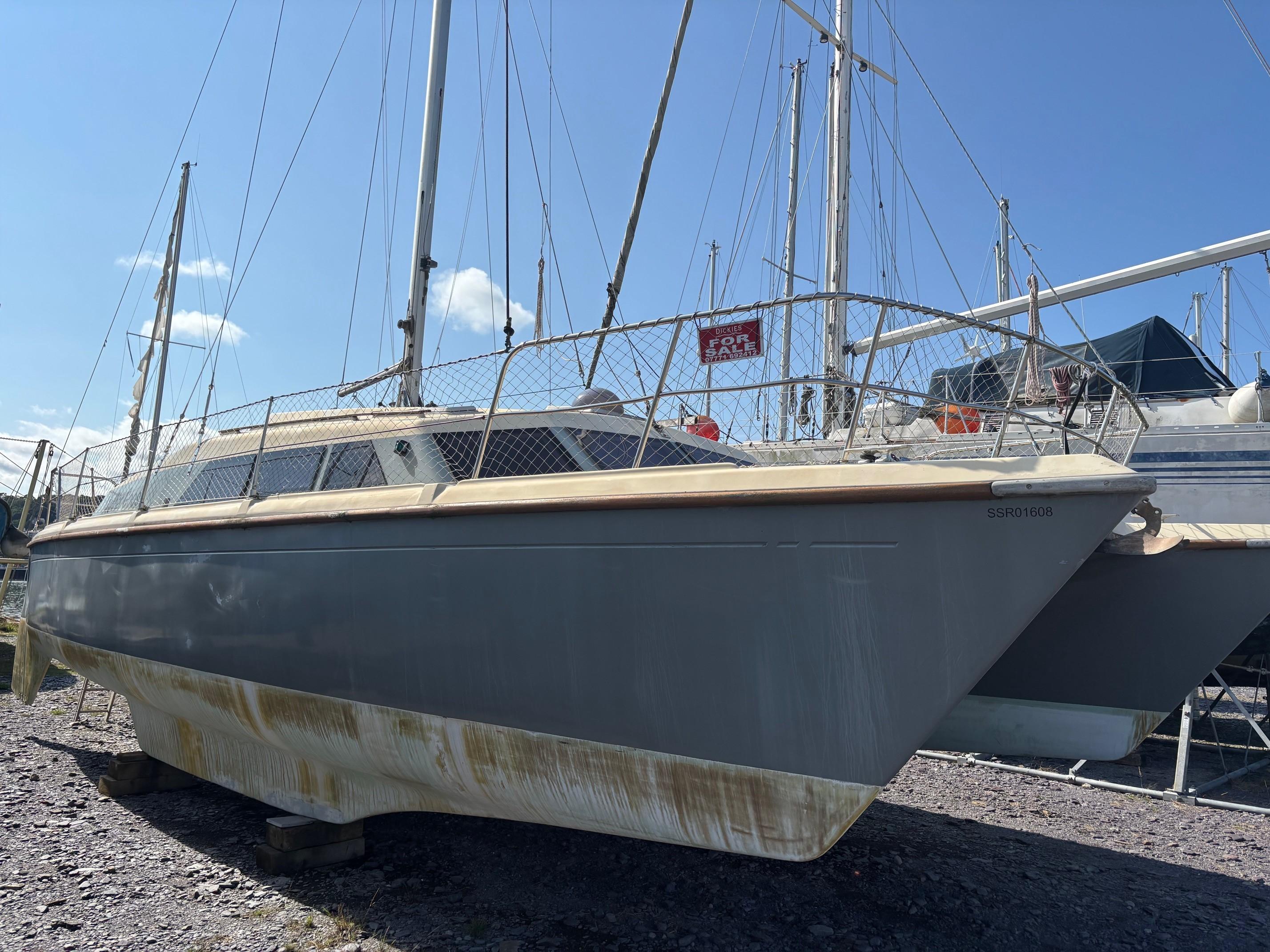
I'm not wild about these types of fixed keels. On the positive side they are durable and serve as good grounding plates that protect the rudder when the cat is beached. On the negative side they contribute to drag, and they create a lack of lift when on the wind. Having said that, the typical cruising family may not want the bother and care it takes to use and maintain high-aspect-ratio lifting foils.
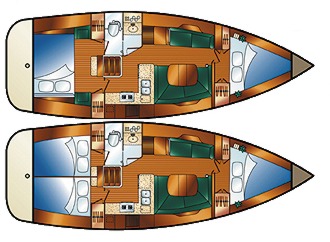
The interior is laid out for three couples. There is one head in the port hull. The galley is sunken in the starboard hull. Note the "cool box" in the forward stateroom.
Without a doubt, cats provide the ultimate cruising platform in terms of cockpit and general deck space. This plethora of deck area is compounded by the fact that the boats do not noticeably heel, so you can sit or lay just about anywhere. Note the large molded foredeck on this model and the lack of forward trampoline.
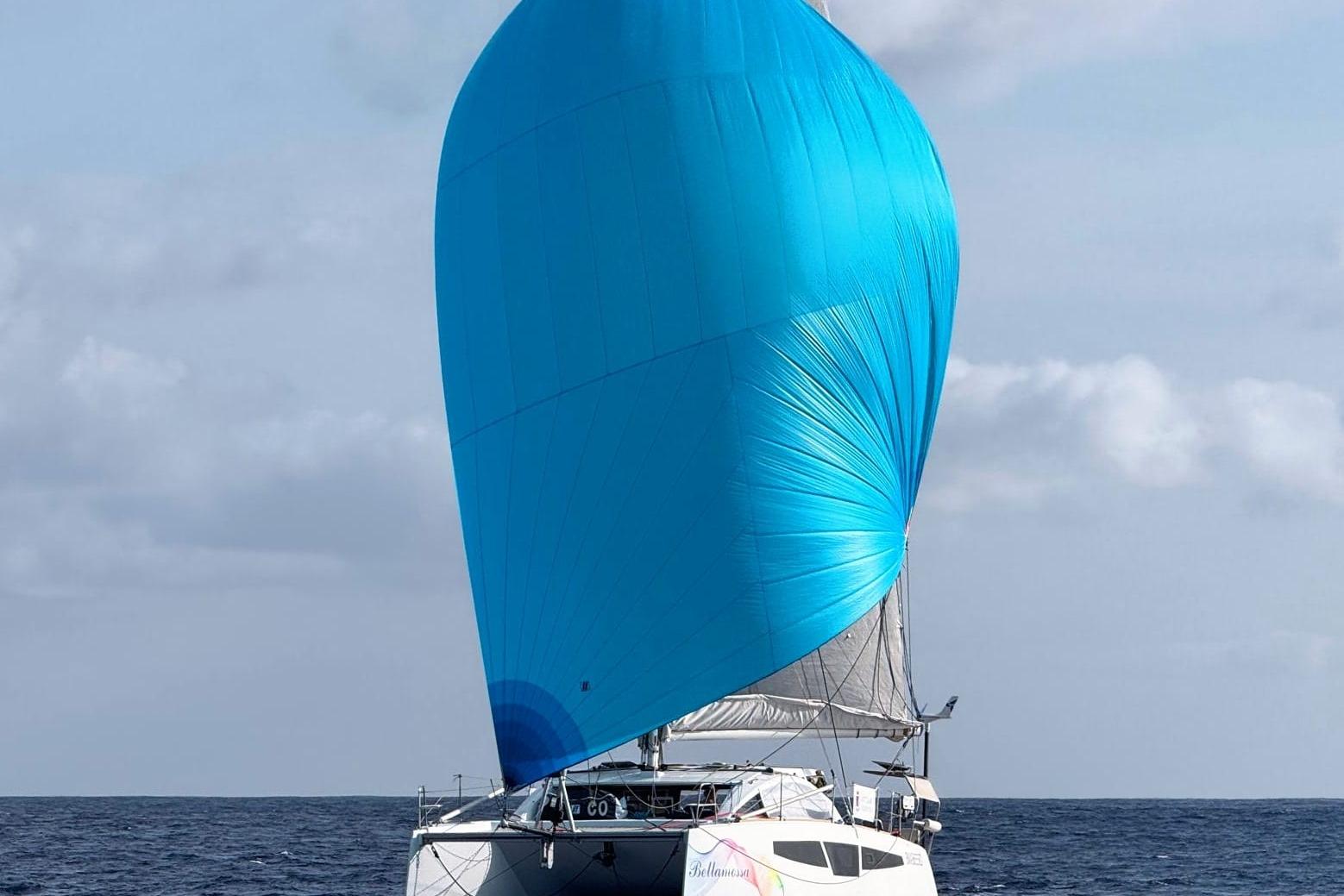
The rig has the mast stepped on the aft bulkhead of the cabin-house. This is a strong and convenient place to spread the compressive loads, and the result is a small, blade-like mainsail and a big foretriangle. We could argue all day about rig proportions and if the big sail should be forward or aft, but the bottom line is that with all the equipment availible today for sail maneuver, it shouldn't really make any difference. Prout has stuck with this basic rig geometry for years, so obviously it is working well for them. Cats don't heel, so the question of helm balance is moot.
Tim Kernan, my right-hand man, has a theory that due to the excessive initial stability of cats, they need huge mast sections. Big mast sections interrupt the air flow over the main. In order to minimize this problem, the bigger sail is moved forward of the mast where it will work unaffected by the turbulence of the mast section. The SA/D ratio for this design at my averaged displacement of 17,250 pounds is 16.95 using 100 percent of the foretriangle. However, the brochure doesn't even list an area for a working jib, it lists a genoa at 481 square feet, which raises the SA/D ratio to 18.2.
Aesthetically, the Prout is a nicely sculpted package and about as good-looking a cruising cat as you will find in this size. This boat would be an excellent way to introduce your family to multihull cruising.
Well-designed cat for family cruising.
Boat Specifications
| LOA | 38' |
| LWL | 34'6" |
| Beam | 17'5" |
| Draft | 3'3" (light) |
| Displacement | 14,330 lbs. (light), 20,170 lbs. (loaded) |
| Sail Area | 707.32 sq. ft. |
| SA/D ratio | 16.95 (based on avg. displacement) |
| D/L ratio | 156 (light), 219 (loaded) |
| Auxiliary | (2) 20-horsepower diesel sail-drives |
| Fuel | 65 gals. |
| Water | 90 gals. |
 This story originally appeared in Sailing Magazine, and is republished here by permission. Subscribe to Sailing.