Fairline Squadron 65 Used Boat Review
A classic 65-footer from Fairline.
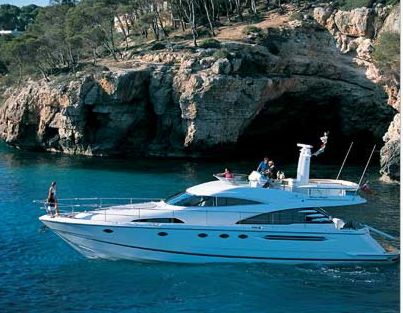
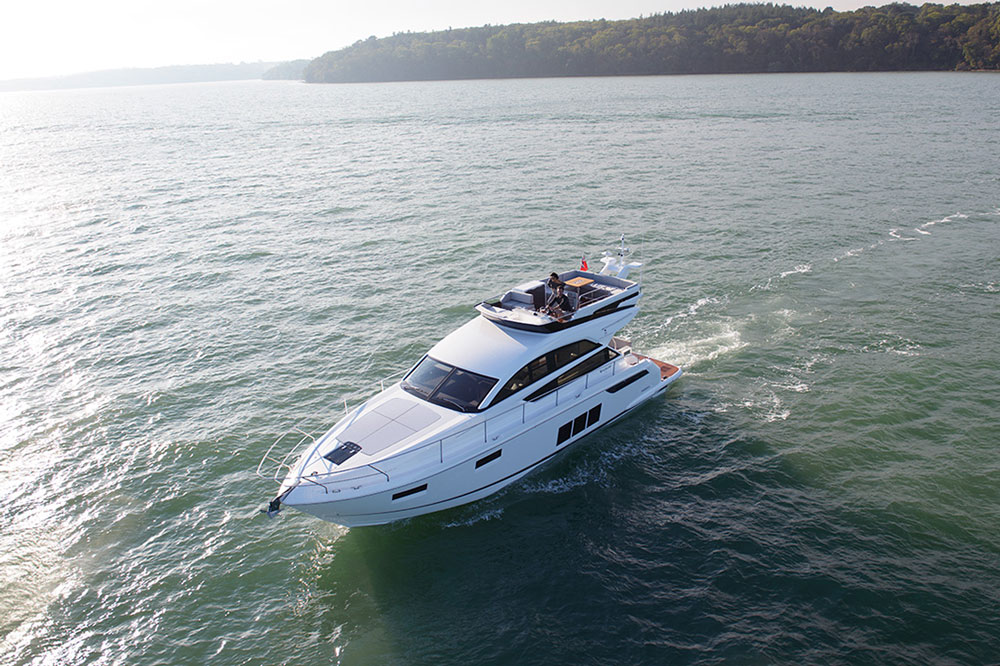
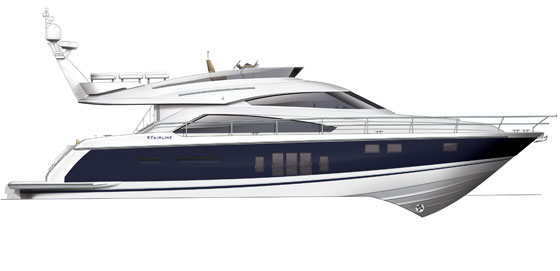
The design of the Fairline Squadron 65 is far more influenced by San Tropez than Southampton, and the lineage seems to have more in common with a blood-red Ferrari Testarossa than a two-tone Humber. Let's just say that if you look up Euro-styling in the dictionary, a photo of the Squadron 65 wouldn't be out of place there. Fairline Marine, one of England's most successful boat builders, introduced the Squadron line of motoryachts in 1991 to fulfill a simple concept: a flybridge yacht that could be operated and enjoyed without requiring a professional crew, yet would have the amenities of a much larger yacht. To that end, they have succeeded admirably, and the level of quality brings a new meaning to the production yacht concept.
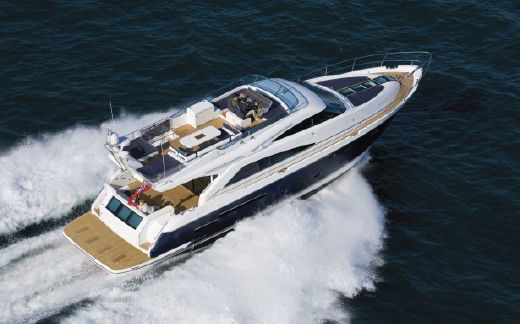
The Fairline 65 Squadron is an English-built yacht with a European flair.
Inside, the 65 interior seems to be that of a custom yacht, with seemingly acres of red cherry and burr elm joinerwork immersed under syrupy layers of glossy varnish. What is probably properly called the salon overlooks the teak-planked cockpit through sliding glass doors, with two deep blue curved sofas to port and starboard and a flawlessly executed combination liquor cabinet and entertainment center in the forward corner. The result is a comfortably social area adjoining the cockpit for alfresco living.
Up three steps is the pilothouse level, with an unusual triangular dining area to port consisting of a pair of two-person lounges and two hassocks around a three-sided table. The galley is bright and airy, with large windows and a pass-through to the helm area just forward. With granite counters, a trio of stainless-stell sinks and full appliances from dishwasher to four-burner electric cooktop, it is compact but well equipped. Two cabinets are fitted to hold Squadron dishes and mugs, a drawer is intended for flatware, but there is a shortage of storage for cooking utensils.
The pilothouse helm is interestingly arranged, with a centerline steering wheel and an outboard companion seat. The skipper has an electric seat with armrests that provides a comfortable position in front of a panel covered with VDO engine gauges. There's plenty of space for flush-mounted electronics, and a chart area is protected by a hinged Lucite panel. Standard equipment includes Hynautic steering, MicroCommander shifters, and a full electrical panel directly behind the helm. Deck access is through a door behind the companion seat, although reaching it is a tight squeeze if the seat is set aft.
Three- and four-cabin layouts are available, differing mainly by reducing the size of the master stateroom to accommodate a fourth guest cabin. The boat reviewed here has the four cabin arrangement, although I suspect the most popular, at least on this side of The Pond, will be the three-cabin version since it creates a spacious master suite with a sitting area and oversized head with bathtub. In the four-stateroom version, the king-sized berth is diagonally positioned, a walk-in closet is to starboard, and a fold-down writing desk combines with a liquor cabinet. The compact head is aft, with a bathtub or optional Jacuzzi.
A VIP stateroom is forward, with an island berth, built-in vanity and access to the shared head with circular shower. The two smaller guest cabins are similarly sized, with the port cabin have bunks and the starboard cabin having a pair of singles as well as a private head with shower. An optional cabin with head and shower can be installed aft, tucked under a bench seat in the cockpit to provide an oversized single berth for children or an occasional crew member.
Another choice for buyers is to fit the fourth cabin as an office, or turn the under-cockpit cabin into either a laundry with washer/dryer, or an oversized freezer compartment.
The deck forward is surrounded by very secure double stainless-steel, waist-high rails, and there is a sunpad built into the sloping coachroof. A pair of gullwing doors open to storage lockers for deck gear, and the Lofrans anchor windlass feeds into a spacious chain locker. Aft, the swim platform is wide enough to handle a personal watercraft, and there is a Besenzoni davit neatly hidden in the transom.
Construction is outstanding, with the solid fiberglass hull handlaid of unidirectional and woven rovings, while isophthalic resins are used to prevent blistering. The entire hull and deck has a double layer of gelcoat to provide extra protection against scrapes and dings, and stainless-steel backing plates are glassed in place under all rails and stanchions for extra strength. While the interior joinerwork was all done inside the Fairline plant, each piece is individually scribed, cut and fitted into place on each yacht to assure a perfect fit. As a final check, every Squadron 65 was fully tested in the water before shipment.
Several power options, all using MAN diesels of 820 to 1200 horsepower, are available and this boat had the 1000 hp. engines that produce a top speed of 32 knots.
The standard equipment list is impressive, including a concealed hydraulic passerelle, electronics package (radar, GPS, VHF, autopilot, plotter, and hailer), bowthruster, vacuum toilets, washer/dryer, anchor windlass, and transom davit.
As for the concept that British powerboats are stodgy, well, one look at the Fairline Squadron 65 and that should sink faster than the Spanish fleet at Trafalgar.
See Fairline Squadron 65 listings.
Boat Specifications
| Length | 66'10" |
| Beam | 17'4" |
| Draft | 4'9" |
| Displacement | 71,680 lb. |
| Fuel | 920 gal. |
| Water | 280 gal. |
Editor's note: this article was updated in August of 2017.