Skater 40: Powerboat Performance Report
Skater 40 from Douglas Marine: Exquisite catamaran delivers stellar performance.
January 22, 2005
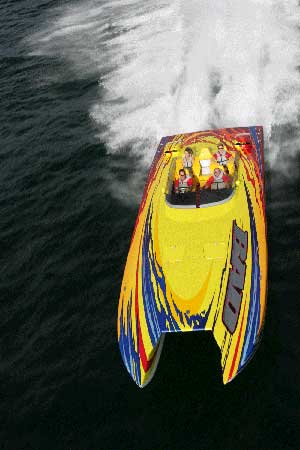
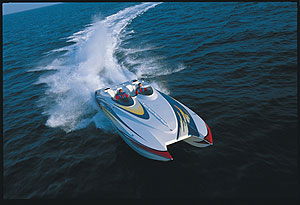
Top speed for the Skater 40 was 147 mph on radar. (Photo by Tom Newby)
As happens in fall, a thick south swell was pushing up from Baja California when we tested the Skater 40 in San Diego. That translated to evenly spaced, for the most part, 3- to 5-footers, with the occasional 6-footer thrown into the mix, just to keep us honest. With the high-back buckets in the cat occupied by our two test drivers, that left our co-pilot to find purchase on the rear bolster bench. As the boat left the docks for offshore testing, he did not look happy.
He returned elated. "The bench really does hold you in place," he said. "I couldn't see over the deck of the boat to brace myself for what was coming, but I could feel the boat leave the water and I kept waiting for a hard landing. I took a couple of kidney punches, but it really wasn't bad back there. I'd do it again."
Extraordinary praise from a guy who usually rides up front. But then, the Skater 40 is an extraordinary boat.
Performance
To power the 40-footer, which ran on a true catamaran hull with two-step sponsons and no center pod, the owner of the boat opted for a pair of supercharged Paul Pfaff engines, each making more than 1,400 hp. Taking no chances with drive reliability, the builder outfitted the boat with dry-sump No. 6 units from Mercury Racing. Gear reductions were 1.26:1, and the propellers were 16 1/2" x 33" five-blade models from Mercury Marine.
Top speed for the Skater 40 was 147 mph on radar. At least that's the top speed we achieved—even with the PSI-blower-equipped engines turning 6,000, there was more left in the throttles. We simply ran out of water on Mission Bay. Without question, given enough space the cat could have run significantly faster.
But it couldn't have been much quicker. After coming on plane in 3.6 seconds, it reached 122 mph in 20 seconds. Electrifying in midrange acceleration tests, the cat ran from 30 to 50 mph in 3.7 seconds, 40 to 60 mph in 3.3 seconds and from 40 to 70 mph in 5 seconds.
Handling scores were strong, especially when it came to full-circle turns at cruising and high speeds. The Skater 40 exhibited a comfortable inward lean throughout turns, and leveled off gently on exit. Straight-line tracking was perfect at all times, even when our driver chopped the throttles.
Like our co-pilot, our test drivers had nothing but praise for the cat's rough-water manners. Quartering, following or head-on, the boat was commanding and comfortable in the big, rolling seas.
Workmanship
Because Skater builder Douglas Marine has no dedicated deck tooling—the builder combines old-school balsa-wood bending with newer-school vacuum-bagging to create its decks—no two Skaters are identical. If a buyer has a specific vision, Douglas usually can accommodate it.
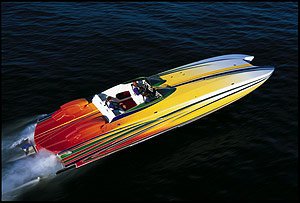
In the case of our test boat, called Risky Business, that meant the hullsides were tapered in more than the "typical" Skater 40, and the aft section of the deck had an extension over the tunnel. In terms of deck lines, the cat was similar to the WHM Motorsports Super Cat race boat, though it had an open-cockpit pleasure configuration with quarter-canopies rather than a fully enclosed race setup.
From mold work to graphics, construction quality was astounding. Handled by The Art of Design in Elkhart, Ind., the graphics incorporated "opalescent" ovals done in photo-sensitive paint. Depending on where you were when you looked at the boat, or the position of the sun, ovals appeared and disappeared. That effect made the paint job, though static by definition, appear animated.
Hardware included six Accon Pop-Up cleats. To keep the deck looking clean, the boat also was equipped with push-pin fender mounts.
Douglas did a bang-up job rigging the boat. Each engine was mounted on a hefty rail system, and not a single wire or cable was left unsupported or unprotected. No detail went unattended. Even the undersides of the hatch covers, which raised and lowered on electric screw jacks, were color-matched to the cat's graphics.
Interior
As our co-pilot can attest, you really don't appreciate a wraparound bolster-style bench until you have to sit on one when you're running in big water. Then, especially when during the seemingly endless moments when the boat is flying and you're weightless, you wonder how anyone does without them. Anything less seems substandard, a serious omission. Rather than installing grab handles between the bolsters, the builder opted for vinyl straps that, though tougher to find than handles in an instant, worked well.
Of course, given the choice, any right-thinking human would choose one of the two high-back buckets seats—the one with the steering wheel in front of it being particularly choice—over the rear seats. In the molded fiberglass podium between the buckets were the Latham throttles and shifters. To give rear passengers an idea of just how fast they're going, a Livorsi GPS speedometer was mounted in the rear-facing section of the podium.
Another Livorsi GPS speedo, as well as a full complement of Auto Meter Pro-Comp Marine GPS instruments, was at the helm station. Of note, each of the two tachometers had a tattletale function. Also at the helm was a Garmin GPS unit and toggle switches for the accessories.
Sturdy and attractive carpet covered the cockpit sole. The interiors of the gunwale trays on each side of the boat also were carpeted. The Skater 40 had no cabin, but it did have lockers under hinged lids in the deck.
Overall
We've never been more impressed with a Skater 40, and we've evaluated a few. Our test boat mastered big water. It also ran close to 150 mph—and would have run past it given the space—with unwavering stability. And it handled precisely. Plus, the catamaran was built to Douglas Marine's high standards. Combine all that, and you have one fabulous performance boat.
Hull and Propulsion Information
| Deadrise at transom | 18 degrees |
| Centerline | 40' |
| Beam | 10'10" |
| Hull weight | 10,155 pounds |
| Engines | (2) Paul Pfaff PPE 1400 |
| Cylinder type | V-8 |
| Cubic-inch displacement/horsepower | 598/1400 |
| Lower-unit gear ratio | 1.26:1 |
| Propellers | Mercury Bravo One 16 1/2" x 33" |
Pricing
| Base retail | $559,589 |
| Price as tested | $898,779 |
Options on Test Boat
Upgrade to Paul Pfaff PPE 1400 engines ($160,000).
Acceleration
| 5 seconds | 40 mph |
| 10 seconds | 67 mph |
| 15 seconds | 78 mph |
| 20 seconds | 122 mph |
| Time to plane | 3.6 seconds |
| Minimum planing speed | 22 mph |
Midrange Acceleration
| 30-50 mph | 3.7 seconds |
| 40-60 mph | 3.3 seconds |
| 40-70 mph | 5 seconds |
Rpm vs. Mph
| 1000 | 9 mph |
| 1500 | 21 mph |
| 2000 | 34 mph |
| 2500 | 54 mph |
| 3000 | 67 mph |
| 3500 | 75 mph |
| 4000 | 88 mph |
| 4500 | 102 mph |
| 5000 | 113 mph |
| 5500 | 127 mph |
| 6000 | 142 mph |
| 6500 | 147 mph |
Top Speed
| Radar | 147 mph at 6500 rpm |
| GPS | 149 mph at 6500 rpm |
Test Conditions
| Site | Mission Bay San Diego | |
| Temperature | 79 degrees | |
| Humidity | 44 percent | |
| Wind speed | Light | variable |
| Sea conditions | 6" chop | |
| Elevation | Sea level |
For More Information
Douglas Marine
Dept. PB
6780 Enterprise Drive
Douglas, MI 49406
269-857-4308
www.skaterpowerboats.com.