Regulator 34 CC: Blaze Your Own Trail
Regulator tips its popular 34-footer with triple outboard power and joystick docking controls.
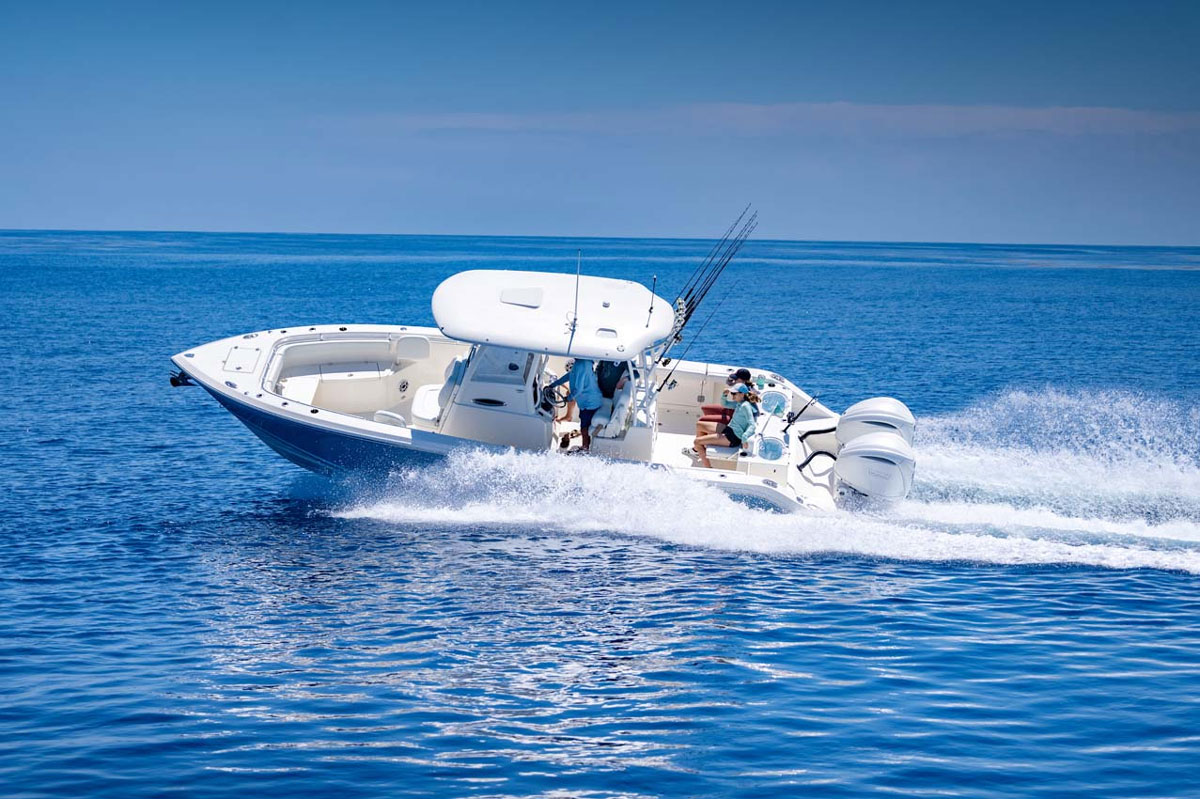
It’s February, and I’m blasting past the Venetian Causeway in Miami’s Biscayne Bay at 60 mph in a center-console boat with 900 ponies worth of Yamaha outboard power racked to the stern. It’s nearly 80 degrees, and the balmy, salt-spiked air is breathing new life into my winter-worn body. So I do what any self-respecting boating journalist does: I snap a photo of the scene with my iPhone and post it on Facebook to taunt my snow-buried friends up north. The response from my across-the-street neighbor back home is almost immediate: “Unfriend.”

If fishing boats were Jedi knights, the Regulator 34 would be Yoda.
Facebook taunting aside—and getting to the point—my neighbor had a right to be envious, and not just because of the fine Southern Florida weather. That’s because I was aboard the Regulator 34 when I snapped that photo. The 34 is a deliciously sweet offshore center-console fishing boat that I’ve run before, but Regulator has upped the ante for 2015, strapping triple Yamaha F300s to the aft end with Helm Master joystick control at the helm. Can an already good boat get better? You bet it can.
Designed by legendary naval architect Lou Codega, who also drew such iconic fishing machines as the Carolina Classic 28 and Regulator 26, the Regulator 34 has a single mission: deliver a crew of anglers quickly, safely, and comfortably to wherever the fish are biting, and in whatever conditions Mother Nature can throw in the way. Take a look at the 34’s whopping 24-degree transom deadrise, generous Carolina flare, and ample freeboard and there’s little doubt that running into a stiff piece of weather is what this boat is all about.
Watch Regulator 34 Video: First Look
The Ultimate Testimonial
Handling that snotty weather is once thing, but building a boat to survive it over and over again without falling apart is an entirely different ball game. Speaking to that theme, Regulator Marine has a reputation for churning out incredibly well-built, long-lasting boats from its factory in Edenton, NC. If you’ve read a Regulator boat review any sort in the last few years you’ve likely heard the story of Queen Bee, a Regulator 26 that was swept by a rogue wave off Natucket, MA, sending her occupants overboard (they survived), leaving the center console to drift and fend for itself in the open Atlantic Ocean. The boat was recovered nearly four years later off the coast of Spain—covered in sea growth, but still afloat—and returned to her owner in the United States. It’s a true testimony to the rugged qualities of Regulator’s construction techniques—the same ones that are baked into every Regulator 34.

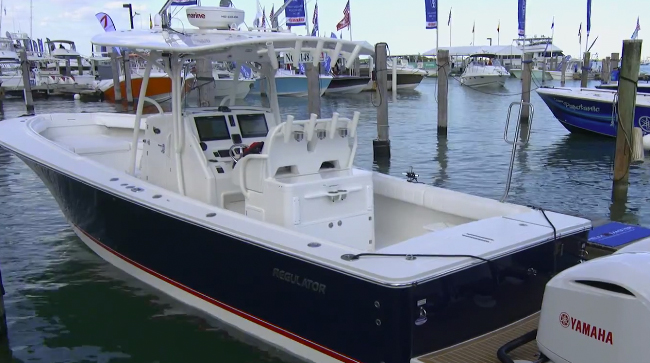
The boat isn't new, but the triple Yamaha outboard power is. Note the Carolina flare in the bow section, part of this boat's North Carolina heritage.
I could feel that ruggedness when I hopped down from the dock onto my test boat, as all of my 250 pounds made a solid “thud” on the expansive, full-width swim platform with faux-teak decking. There’s a large transom door that provides access to the spacious aft cockpit, which is where I found two large hatches in the deck providing bilge and stowage area access. A three-person jump seat flips down at the transom into the aft cockpit, and the gunwale is nicely padded and upholstered for when an angler needs to lean into a big fish while playing it. It’s back here where I got reacquainted with how solid and sturdy everything feels on this boat, almost like a German automobile. Open a hatch and you can feel how smoothly it moves, how substantial it is, and how it closes with precision and purpose. That’s the way almost everything on this boat “works,” from control switches to pop-up cleats.
Moving forward to the bow is where I found a U-shaped casting deck that can be topped with cushions to provide comfy seating for four or five folks. Underneath is a large stowage compartment forward, and two insulated, six-foot-long compartments to each side. These side compartments can be used to keep drinks frosty, or ice down your catch. They can also be used to stow fishing rods. A large hatch in the foredeck provides plenty of space for anchoring tackle, and all of the hardware up there, such as the cleats, rails, and hatch latches, are nicely recessed to avoid becoming line-catching, let-the-big-one-get-away devices. The entire foredeck space is large enough for a large, coffin-type fish box cooler.
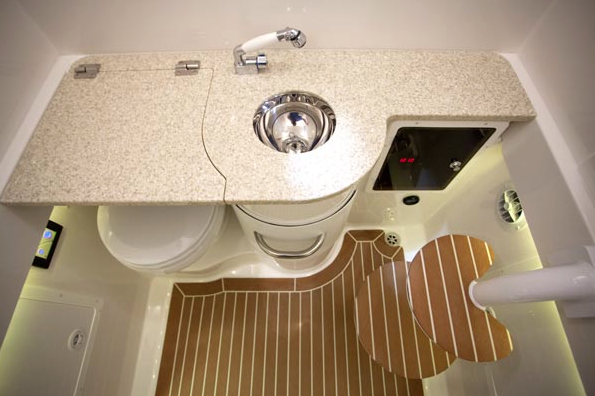
The mini cabin under the center-console unit has not only a berth, but also a washbasin and head.
Sleeping Stowage
Back a few steps from the foredeck, in front of the center-console unit, is an upholstered space with two forward-facing seats where I curled up for a few moments to jot down notes. They’re quite comfy, but a flip-up pair of armrests on either side would be nice, especially for when underway. Back around the port side of the console is a hinged panel that provides access to what I call a “mini cabin” underneath. Under there I found a sleeping area, head, and washbasin, along with some assorted electrical panels and machinery access.
Corian countertops and a faux-teak sole that actually looks like teak add to the richness down here, but I was sort of bummed about the lack of light and ventilation—there’s only one small, oval-shaped portlight. That means it could get stuffy and dark down here. Well, unless you get the optional air conditioning and then flip on all the LED lighting. The cabin is certainly nice enough for quick, Bohemian overnighters, or a nap on the way out to the canyons, but I expect it will get abused more as rod and tackle stowage, the norm on boats like this. And given the fact that there’s an option for rod racks down here that accommodate an additional 11 rods, Regulator seems to understand the trend. That said, it’s nice to have the sleeping option open, when you need it.
Back outside and at the helm-end of the console I found acres of dash space that easily swallowed up the massive fishing electronics package, as well as the Yamaha Command Link Plus display, engine controls, joystick control unit, autopilot, Fusion stereo, and control panel switches. Everything is placed at the hand and nothing is crowded too tightly together. Yes, there’s even room for two air-conditioning vents that can be aimed strategically to cool your brow on those calm, hot days offshore when the fish aren’t biting. Spectacular powder-coated pipework surrounds the whole affair, supporting a huge hardtop with plenty of room for the 4-kW radar array, FLIR night vision camera, VHF antenna, and outriggers. Speaking of outriggers, let’s talk fishing features.
Full-Featured Fishing
Anglers will appreciate the plethora of fishing goodies aboard. The transom is topped with a 25-gallon livewell and a 31-gallon insulated fish box and both are cleverly illuminated for nighttime fishing sorties. You’ll have rods to stow, obviously, and there’s room for 17 of them on deck and around the center-console with further stowage up in two lockers in the bow. A lot of folks might complain about the lack of under-gunwale rod racks, but I’ve broken enough rod guides using that type of arrangement to not be too fussed. Behind my test boat’s helm seating setup was an optional livewell/sink/rigging station setup, which had tons of tackle drawers and pullout stowage units, to boot. One optional feature that I think should be standard is an insulated and macerated aft cockpit fish box. The standard configuration only allows for simple gear stowage in that area.

Regulator's "Offshore Fish" electronics package features a plethora of fish-finding goodies.
You’ll likely want all sorts of electronic fish-finding goodies and Regulator aims to please, making three different electronics packages available for the 34. My test boat came loaded to the gills with Regulator’s “Offshore Fish” package, which includes two Raymarine gS165 15.4-inch multifunction displays, an Airmar B260 broadband 1 kW transducer, CP-300 digital sonar module, Raymarine 55 VHF radio, 4 kW radar, and a Raymarine Evolution EV-200 autopilot. The other two packages, called “Fish” and “Premium Fish” have varying levels of functionality, but if you want two displays, you have to at least opt for the Premium Fish package. Let me tell you, if you can’t catch fish when you own a boat like this… equipped with electronics like this… you might want to pick another hobby.
Power and Control
With a beautifully warm but somewhat stiff easterly sea breeze pressing firmly against our beam, you might expect navigating out of a tight slip to be at least minimally challenging. But with casual inputs to the Yamaha Helm Master joystick docking system, we slipped the confines of our berth, lazily tossing the dock lines up on the pilings as the outboards jostled back and forth with each joystick input. The Helm Master joystick docking system is an option, but if your boating often happens in an area of swift tidal currents or potent sea breezes—or both—it’s one you should consider. It’s not a bad fishing option, either, making swinging and pivoting the boat toward a running fish a real breeze.
| Performance Data | |||
|---|---|---|---|
| Test conditions: calm seas, winds 5 knots, 2 POB. Performance data courtesy of Yamaha. | |||
| RPM | MPH | GPH | MPG |
| 1000 | 7.3 | 3.9 | 1.87 |
| 2000 | 12.3 | 11.2 | 1.10 |
| 3000 | 28.7 | 22.4 | 1.28 |
| 4000 | 42.1 | 37.0 | 1.14 |
| 5000 | 55.1 | 63.2 | 0.87 |
| 5850 | 62.4 | 78.4 | 0.80 |
| Power | Triple Yamaha F300 four-stroke outboards, swinging two 14.75" X 22" (R&L) and one 15" X 21" (C) three-bladed stainless-steel props. | ||
Making our way past the no-wake zone and out into Biscayne Bay, I flipped up the seat bolster behind me to form a leaning post, braced my left foot up against the full-width inset console step, and then put the beans to all 900 horsepower. As the propellers bit in, we quickly passed 30, 40, and then 50 mph, all the way up to around 59 mph. A few taps of outboard and tab trim pushed us past 60 mph and further to 62 mph, which is within four-tenths of a mph of what Yamaha’s testing results, and almost six mph faster than this boat goes with the twin Yamaha F350 power option. Wide-open throttle speeds funnel about 78 gallons per hour (gph) into the three Yamahas. Yamaha’s test results show the most efficient cruise at 28.7 mph and 3,000 rpm, where fuel consumption is 22.4 gph. With the 350-gallon fuel tank, that means you’re talking nearly 450 miles of theoretical range.
Dynamic Handling
As far as handling goes, the Regulator 34 is very well behaved and balanced at all speeds, and her hull skipped right over or through the plentiful—and sizable—wakes provided by the plethora of other boats maneuvering in the area. But this boat isn’t about skipping through boat wakes; it’s about blasting through rough-weather inlets in safety to get out to the big ones. My real-world experience pushing a Regulator 34 through a set of very dynamic three- to five-foot waves at the mouth of the Ocean City Inlet in Ocean City, MD, in 2013 was nothing short of jaw-dropping. With other boats around us cutting speed and swerving to avoid the rollers, we simply pushed the throttles down, nestled the boat into a 20-mph groove, and carved our own path right through the curling waves. And that’s the essence of this boat: blazing your own trail in comfort, safety, and speed.
| Specifications | |
|---|---|
| Length | 33'10" |
| Beam | 10'11" |
| Draft (hull) | 2'3" |
| Deadrise | 24 degrees |
| Displacement | 11,315 lbs |
| Fuel capacity | 350 gal. |
| Water capacity | 31 gal. |
Are there any downsides to this finely crafted fishing machine? Only a few. Standard livewell capacity is only 25 gallons. You can up that with the tick of an option box, and you’ll want to, if live-bait fishing is your ballyhoo (pun intended). The only other area I can fault is the underwhelming amount of standard fish box space. You’ll get 30 gallons or so in the insulated transom fish box, and there are two forward (but sort of shallow) six-foot insulated boxes up front. But to get something big enough for a larger fish, such as big tuna, wahoo, or kings, you’ll probably want to go in for the macerated and insulated cockpit fish box option. Despite these downsides, however, the plethora of overall fishing pluses far outweighs these minor cons.
As we returned to the marina and flipped the Regulator 34 into joystick mode to wiggle her gently back into the slip, I realized I’d made my final test run in the warm Miami sun before being relegated to the air-conditioned convention center displays for the rest of my assignment. Ever get that feeling right before the end of vacation when you realize you have to report to the “office” the next day? It’s sort of how I felt when I stepped off the Regulator 34. Gives you an idea of what a joy this boat is to be on and run, doesn’t it?
Enjoy your own virtual run by watching the boats.com Regulator 34 Video: First Look.
Other Choices: Other rugged offshore center-console boats worth of your consideration include the Everglades 355 T, Cobia 344 CC, and the Boston Whaler 350 Outrage.
View Regulator 34 listings.
For more information, visit Regulator Marine.