Coastal Passagemaker 45: Sea Trial
Coastal passagemaker 45: A rugged coastal knockabout with a slippery hull.
April 20, 2003
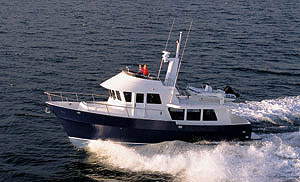
With twin 450 hp Caterpillar diesels and a powerful Wesmar bow thruster, the boat maneuvers easily in tight spaces, and it eats up open water with abandon.
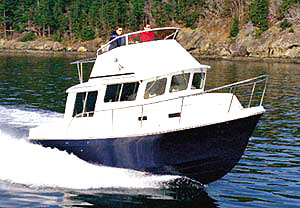
Looking for a new boat that's designed to cruise just about anywhere, with a hull design that has already proven itself on more than 400 commercial vessels? One Washington company has introduced just such a cruiser — and it shouldn't come as a surprise that the firm is headed by a man who has more than two decades of experience with workboats.
Dick Johnson comes to the building of pleasureboats from a 23-year career as a Blaine, Washington commercial fisherman and builder of commercial fishing boats. His pleasurecraft company, Fibercraft, now builds a 38-, a 45- and a 55-footer, all based on the Delta hull — with a no-nonsense workboat profile and a "built to take it" attitude.
The main difference, however, between a Coastal Passagemaker and what we normally think of as a commercial fishboat is that Fibercraft's boats are not displacement-speed cargo carriers, but are boats with an underbody that belies their rugged lines.
The Coastal Passagemaker line is based on the Delta Charter hull, designed by Lynn Senour in the early 1970s and adapted to pleasureboat use recently by John Anderson, a Seattle yacht designer.
It is a proven hull: More than 400 Delta hulls have been in use in the open Pacific out of Westport, Washington and in Alaska's Prince William Sound. This hull, in fact, suggests the fast, rugged hulls of the East Coast lobsterboats, with a fine entry and flat after sections, with 8 degrees of deadrise aft.
The hull is U.S. Coast Guard-certified to 200 miles offshore. The exterior of the boat is low-maintenance fiberglass, and wood trim is an option. In other words, there's no brightwork to keep you busy varnishing when you could be boating.
There are no details of this boat that exist solely for the sake of decoration.
Interior
We boarded a new 45-foot Coastal Passagemaker on a foggy autumn morning off Blaine, Washington. Our test boat was provided by Fibercraft.
From the large swim platform, we entered the aft deck via a gate through a transom that is much deeper than that of most pleasureboats. The dry aft deck was another indication that this is a serious deep-sea vessel.
We entered the saloon via a Dutch-style watertight door, with a serious hatch that has heavy dogs to secure it while under way.
The saloon sole is finished in carpet with teak trim around the hatches. The interior offers traditional nautical elegance, yet it is simple and easy to maintain. This interior was engineered rather than "designed" — and this is an important distinction to make about this boat in general.
Furnishings in the saloon include a settee to starboard, an entertainment center and a small table with flip-up wings, to port. The interior joinery may be simple in design; however, it is considerably finer than what you might find in a workboat.
The teak woodwork is accented with stylish black and stainless steel toggle switches. Windows with blinds and white vinyl-padded panels break up the expanses of teak to brighten the atmosphere.
The Coastal Passagemaker 45's guest stateroom is an unusual multi-use facility that is situated between the engine compartment and the master stateroom. It provides an unexpected but practical use of the space.
Two things make it unexpected. First, the guest head (with a marine toilet and a sink, but no shower) serves the galley and saloon. The idea here is that guests are aboard for a short time and they can make use of the shower in the master stateroom, if need be.
Second, the guest stateroom doubles as an onboard office. In many homes, the office often doubles as a guest room when company arrives — and this boat applies that same concept. In this case, a Murphy bed pulls out to serve as a guest bunk, or folds away to provide a settee for working at the built-in desk.
The master stateroom, with a queen-size walk-around berth, is located in the bow — down four teak-and-holly steps from the wheelhouse. It features a lighted hanging locker, abundant stowage cabinets, drawers and a padded overhead.
Galley
The galley is a compact, seaworthy work area, with everything located close to the cook — including a Force 10 three-burner stove with oven and a pair of deep stainless steel sinks with a Grohe spray head faucet.
The countertops have molded fiddles, for added security if you're preparing food while under way. Food is stored in a NovaKool upright refrigerator/freezer, and cooking odors are vented overboard via an overhead fan.
Engine Room
Despite the boat's high trawler-style profile, the weight has been kept as low as possible to improve stability. A compromise had to be made somewhere, and it was made in the engine compartment's headroom.
There is plenty of room to work on the engines around the sides, but it's a tight fit overhead, unless you remove the hatches. For most routine maintenance, however, the room is more than sufficient.
A Reverso oil changing system serves both the boat's Caterpillar diesels and the Northern Lights generator — and it demonstrate its full worth the first time the owner has to go through the oil change ritual — or pay someone else by the hour to do it.
The boat's 2-inch shafts exit the hull through dripless shaft seals, and connect to the engines via ZF IRM 301 transmissions at a 2:1 reduction. Sound dampening insulation has been used throughout the engine compartment, and waterlift mufflers add another degree of silencing.
Pilothouse
The Diamond Seaglaze windows, looking from the wheelhouse onto the foredeck, are the traditional reversed workboat style, with robust wiper units on the three main panels.
An unusual workboat-style feature is the Coastal Passagemaker 45's free-standing helm, with its stainless steel destroyer-style wheel. A helm seat is optional, but most skippers probably won't want it: You stand to run this baby, because you've got a job to do.
The instrument console ahead of the wheel is an "open-bible pulpit" arrangement, with a conventional compass on top — plus, color radar and a color depth sounder.
Two Caterpillar digital display panels are flush-mounted to starboard, within clear view. This unit sits up off the dash, in keeping with the standing helm.
There's a big bow — and lots of boat to watch. To see what's ahead, you must be on your feet or perched high on an elevated seat. If you're going to make a fast run from the leading edge of a storm to safe harbor, there's no reason to sit down until the boat's safely snugged down.
Close at hand are the controls for the boat's Wesmar bow thruster and Twin Disc GearSelect electronic controls. Abaft the wheel, there's a settee, finished in tan faux leather with teak trim.
The boat's flybridge is topped by a hinged radar mast. The bridge features a complete second helm station and offers seating for several guests.
Under Way
With twin 450 hp Caterpillar diesels and a powerful Wesmar bow thruster, the boat maneuvers easily in tight spaces, and it eats up open water with abandon.
We motored out of the busy channels of the Blaine Civic Marina toward open water, then slowly brought the boat up to speed in 1,000 rpm increments using a GPS to confirm the onboard instruments.
The twin 3126 Cats provide ample power for this hull, lifting the bow onto plane at just under 14 knots.
With the flat 8-degree aft sections, the boat was responsive to its trim tabs. The ride was flat in the light chop, again reminiscent of the Downeast-style lobsterboat hull, which seems to be in the pedigree.
At the end of our test run, Johnson neatly "parallel parked" this 45-footer with ease between a sailboat and a power boat, using the aforementioned bow thruster.
The Coastal Passagemaker 45 is a serious tool for the serious coastal cruiser who has a yearning to explore the far reaches of the continent. There's a lot of coastline between the Aleutians and Tierra del Fuego — and this is a lot of boat to explore it aboard.
Coastal Passagemaker 45 Specifications
| Length | 44'9" |
| Beam | 13'3" |
| Draft | 3'6" |
| Dry weight | 34,000 pounds |
| Fuel capacity | 500 gallons |
| Water capacity | 200 gallons |
| Propellers | Four-blade Nibral 28" x 24" pitch |
| Base price with twin 450-hp Caterpillar 3126B diesel engines | $749,000 |
Performance
| Top speed | 22.3 knots |
| Miles per gallon at 18.6-knot cruising | .6 |
| Estimated fuel cost for 100 miles | $250 |
| Range at 18.6-knot cruising speed | 345 |
| Sound level at cruising speed | 74 dB A |
(Estimated fuel cost based on fuel cost of $1.50 per gallon.)
Standard Features
Onan 5 kw auxiliary generator, 2500 watt invverter/charger with automatic combiner; Reverso oil changing system; Twin Disc electronic engine controls; Force 10 range and oven; microwave oven; NovaKool refrigerator/freezer, Hurricane hydronic heating system.
Options
Nick Jackson davit; washer/dryer; custom dash and built-in electronics.
Construction
Hull is hand-laid solid fiberglass bottom and composite foam core above chine. Deck and cabin are of sandwich foam-cored construction.
For More Information
Fibercraft
(360) 332-4811
www.coastalpassagemaker.com