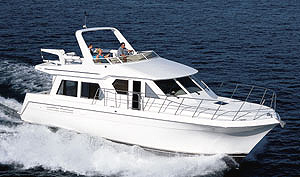
Navigator 57 Rival Pilothouse: Sea Trial
Navigator 57 Rival has Cruising comfort and seaworthy performance in one strong package.
October 10, 2004
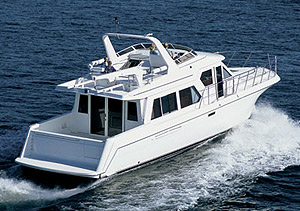
The 57 Rival boasts classic Navigator styling.
A year ago, I was skippering a 56-foot yacht southbound from San Francisco to Southern California. As I was nearing the infamous Point Conception that afternoon, the breeze was blowing about 20 knots — with swells averaging 8 feet. However, I was very pleased with the solid feel of this particular boat, which cruised past Point Conception without hesitation or trepidation.
That yacht just happened to be a 1997 Navigator, so naturally, I was very excited when Sea Magazine asked me to test a brand-new Navigator 57 Rival Pilothouse.
I traveled to San Diego to meet Will MacIntyre, manager of H&S Yachts on Harbor Island. MacIntyre is a pro when it comes to Navigator yachts: so knowledgeable, in fact, that that he was able to answer all our myriad technical and operational questions about the 57 Rival without having to call in a service tech.
In addition, MacIntyre knows the lifestyle of Navigator owners like the back of his hand — these boaters would rather be out cruising the seas, as opposed to their dockside neighbors sitting in their slips, sipping mojitos.
"Navigator has progressively improved the quality, construction and features of its yachts, in order to meet the demanding requirements of offshore cruisers," MacIntyre explained.
Especially popular in the west, the Navigator Yacht signature design is easily recognized on the water. The 57 Rival, in particular, has the classic Navigator styling; however, in addition, it has incorporated many innovations that were derived from paying close attention to the requests of actual Navigator owners.
The heavy-duty design gives this boat superior long-range capability, while the refined, yet practical interiors make cruising with this yacht a pleasure for both crew and guests.
Navigator Yachts is based in Perris, California, where the company designs and builds almost everything that goes aboard the boat. New buyers can visit the site in Perris and meet with the knowledgeable staff to help create semi-custom design for new yachts from 44 to 63 feet in length. Buyers can select their interior colors, fabrics, countertops, flooring, cabinets and more, to accommodate their specific desires.
First Impressions
The 57 Rival was easy to spot as we walked down the gangway to the docks. My first impression was that this boat's lines look similar to those of the seakindly boat I had skippered around Point Conception.
The Rival has a 15-foot beam and a draft of only 4 feet, 7 inches. It tips the scales at 48,000 pounds.
The 57's bow flare is designed for cutting through swells in the sloppiest seas. The boat's leakproof flush-mounted windows — which are sealed in the inner mounting, without any trim on the exterior — give the boat a very clean look, and they easily wash down with a brush.
We headed out on the water to test the 57, and it handled well as we brought the boat up to wide-open throttle. I immediately noticed that there were no sounds of water slapping against the bow or any longitudinal creaking.
The twin 370 hp Volvo Penta diesels are a good match for this boat, and provide very efficient cruising. At 2,600 rpm, the 57 consumed approximately 33 gallons per hour, at 19.1 knots.
While we were coming on plane without lowering the trim tabs, I noticed how the bow angle did not shoot to the moon: I could still see well from the lower pilothouse station.
When we lowered the tabs, the bow angled slightly down. At wide-open throttle, at 2,725 rpm, we went into the swells at 20.1. Going with the swells, we reached 21.2 knots. We had three people aboard and approximately a half-load of fuel in the boat's two 375-gallon tanks.
The boat glided across the water. At approximately 2,500 rpm, the Rival cruised at a comfortable 17.6 knots — which is impressive for a yacht this size, with these efficient engines.
It was time to do some figure eights and circles, to get a feel for the 57 Rival's handling characteristics. I only felt one small thump when we circled back through our wake while cruising at wide-open throttle. The figure-eight turns showed the same results, with little indication that we were hitting our own wakes.
Then, I quickly cut the throttles to neutral — and the boat glided to a stop, with no water coming over the swim step. When you push the throttles, you can hear and feel the boat coming up to plane with the Volvos coming up to higher rpm levels at a smooth pace.
We did not have a bit of spray hit the windshield — and the 57 provided a dry and stable ride, with no noticeable roll. Nothing on the boat's counters shifted while we were under way.
Docking the 57, back at Sunroad Resort Marina, was an eye-opener — exhibiting the good close-quarters handling of this model.
MacIntyre had to back the boat along the last finger between the sea wall and the slips, with no room to spare. He maneuvered the boat onto the finger with only the help of a bow thruster (you can also order an optional stern thruster), with a foot or two to spare from a submerged seawall.
The view from the lower pilothouse was the best for performing this docking maneuver, although boaters on similar boats probably would have opted for the flybridge.
Take the Tour
Sliding glass doors provide entry from the 57 Rival's spacious cockpit into the main saloon. Along the starboard side is an L-shaped settee with a 27-inch television mounted forward in a cabinet that faces the cockpit. Cabinets line the lower half of the port side, including one panel for DC and AC circuit breakers.
When you walk forward, you step up to the galley and pilothouse area, where steps lead up to the flybridge with a ladder leading the flybridge. The galley is nicely equipped with a GE upright refrigerator, a three-burner stove, a microwave oven and a sink with a Moen faucet. Our test boat also had a garbage disposal and a trash compactor.
Under the companionway steps from the main saloon to the galley, you'll find a
a large storage area and a secondary lockable engine room door. This pantry area does have some mechanical units, such as the air conditioner raw water pump, but it is primarily used for storage.
The adjoining engine room space is very well laid out, with room to maneuver around both engines. The engines' big raw water sea strainers look as though they're on steroids, while the fuel filters are located abaft the engines for easy servicing.
Back in the pilothouse, the single helm chair has electronic adjustments — and a dining table is located to port. The table has a pullout wing, so you can pivot the helm chair for use at the table.
The helm has ample space to mount large-screen electronics, and the gauges are mounted up high on the helm, out of the way. One nice touch is that both the water and holding tank gauges are easily visible at the helm.
There is a starboard side door in the pilothouse, so that you can walk up to the foredeck or side to load guests, if you have boarding steps on the dock. You will not have any difficulties walking up to the foredeck, which is protected by stainless steel rails up to the pulpit.
On the flybridge, I found abundant seating, with two forward-facing U-shaped settees under the radar arch, a two-person skipper's bench on the starboard side and a single aft-facing seat next to the steps to the pilothouse. Abaft the radar arch was a davit and a dinghy cradle.
Smaller improvements include mounting the Glendinning Cablemaster toggle switch up near the top of the transom for easier reach and incorporating a wireless remote control for the stereo speakers in the cockpit, on the bridge and in the modern design and stateroom.
Belowdecks accommodations include three staterooms and two heads. Forward is a stateroom, a portside bunkroom and a starboard-side head compartment. A washer and dryer are located at the bottom of the stairs in the companionway, with a hanging locker within arm's reach.
The master stateroom has its own private entrance in the forward starboard corner of the main saloon. Because the master is amidships and is full-beam, it is extraordinarily large. This cabin has its own head and a sit-down vanity.
The two main staterooms offer plenty of storage; with hanging lockers and drawers under the berths. The bunk room has limited storage, however, this cabin looks like it could easily be transformed into onboard office space, for those wanting to work at sea.
Navigator's new 57 Rival handled well throughout our sea trial, turning in a solid performance — and the amenities are comfortable and well thought out in their design. I found the Rival to be a well-built boat that I would gladly take around Point Conception, without fear.
Navigator 57 Rival Specifications
| Length | 58'6" |
| Beam | 15' |
| Draft | 4'7" |
| Weight (w/fuel and water) | 48,000 pounds |
| Fuel capacity | 600 gallons (750 galllons optional) |
| Water capacity | 170 gallons |
| Sleeps | 6 |
| Propellers | 32"- x 31" pitch four-blade bronze |
Standard Features
10 kw auxiliary generator; Racor fuel filters; 15 cu. ft. refrigerator; microwave convection oven; garbage disposal; electric stovetop; Corian countertops; tinted saloon windows; electric heads; mini-blinds; wet bar.
Options
Air conditioning; cherry Interior, 800-pound-capacity davit; VacuFlush heads; Glendinning synchronizer; Glendinning Cablemaster; trash compactor; Raymarine electronics; Ritchie compass.
Construction
Fiberglass hull.
For More Information
Navigator Yachts, Perris, CA
www.navyachts.com
H&S Yacht Sales
San Diego
(619) 291-2600
www.hsyacht.com