Tank Testing Volvo 70 Designs
The Frers design team completed phase three at SSPA in Gothenburg
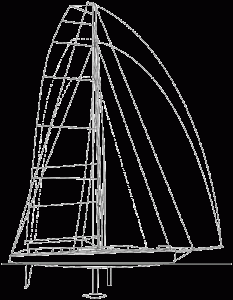
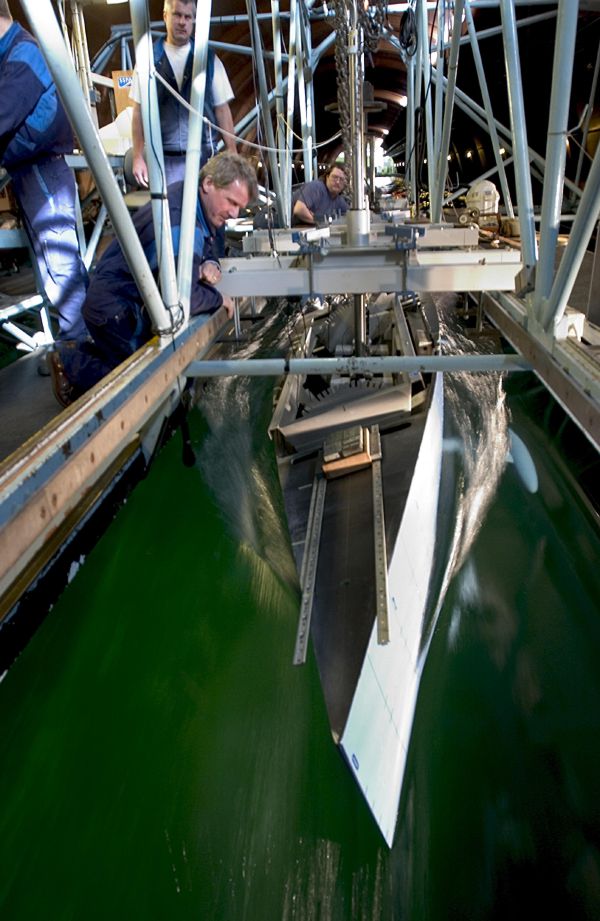 The Frers design team (German Frers Naval Architecture & Engineering) has completed Phase Three of the Volvo Ocean Race design process with a tank testing session at the SSPA towing tank in Gothenburg, Sweden in preparation for the finalisation of details for the D1180-V70 Volvo Ocean Race VOR 70 design. This round of tests validated VPP and CFD (Computational Fluid Dynamics) work that the team, headed by Mani Frers, has been carrying out since June 2003 when the outline of the new Volvo 70 rule was announced.
"Based on the successful design work applied to the 2001 Volvo Ocean Race" said Mani Frers, "we have analysed the boat's performance in that race relative to the profile of the rest of the fleet using a combination of data harvested from the on board systems during the race and extensive de-briefing sessions with the sailors and we have carried some important lessons forward into the new Volvo 70 design."
"That data, coupled with the weather information that German Frers Naval Architecture & Engineers has amassed, and successful round the world design experience spanning nearly 30 years, plus the data that was gathered from other fast swing keel boats we have designed, gave us a strong platform from which to begin our Volvo 70 CFD and tank work."
The Frers team has run more than a hundred CFD VOR 70 designs over the last eight months and iterated the designs to the quarter-scale models that have been tested at SSPA. The six-metre models have allowed to test not just hull form but appendage combinations. By the time the design is finalised four hulls and more than 16 configurations will have been tested at quarter scale.
"There are some key factors that will affect the success of a design for the next Volvo," said Frers at the conclusion of the tank session. "The introduction of inshore racing and the weighting of the overall points between inshore and ocean racing means an entirely new approach is needed to the design solution. And the inclusion of a canting keel with its huge increase in available righting moment into the design process means that characteristics such as planing transition and ballast configurations will be key. The only way to validate our predictions in these areas was to commit to a comprehensive large-scale tank testing programme."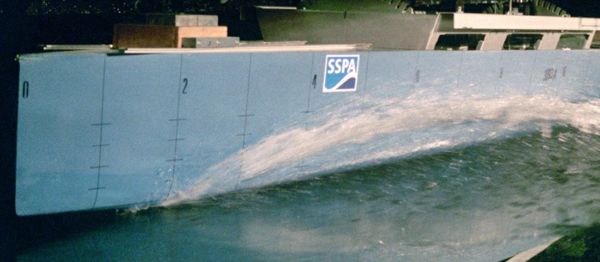 In developments that were pioneered with the Frers' America's Cup work for the Victory Challenge that has led to approaches from key 2007 America's Cup teams, the design team was running CFD and VPP analysis on the towing tank platform concurrent with the towing tests. This allowed instantaneous validation of both the VPP and CFD development work as well as acting as a valuable crosscheck of the towing results. 'We believe our CFD is superior in the transitional planing area of the design process due to CFD development work we have done in tandem with a company in the USA to enhance the flow codes to encompass sea keeping,and the results we have seen throughout the tank session have confirmed our predictions. We are seeing as much as ten per cent drag improvements between base model configurations and the top performers in certain conditions. What we have learned here has given us confidence in our simulation work, particularly with regard to the difficult transitional planing phase."
The D1180-V70 design will be completed and ready for construction by mid July 2004 after a final round of tank tests. "The critical aspect of any racing campaign is time and with a new rule, time is super-critical," said Mani Frers.
"What we want to be able to do is to maximise the post-build sailing time where the critical final few per cent potential of a racing design can be realised. We have design technology, sensors and systems to analyse the performance and the structural behaviour of the boat in the tune-up phase and we therefore feel it is vital to be ready to build as early as possible. We have therefore invested seven months and substantial funds in order to be at that point as early in this race cycle as possible."
"I am happy that our design and technical team is in a position where we can sit down with a Volvo syndicate, outline our findings to them and demonstrate mathematically what we have learned and why, combined with our experience and track record, we can win the Volvo Ocean Race," said Frers. "Naturally we have been approached by several teams planning entries for the next Volvo but we want to be sure that the team we sign with has the resources, infrastructure and drive - as we do - to win the race."
For more information see the Volvo Ocean Race website at www.volvooceanrace.org and www.germanfrers.com
-