Psaros 40: There's one-designs and One-Designs
Sebastien Schmidt describes the first year for his super-slippery Psaros 40 Lake Racer design
 Monohull regattas on Lake Leman are governed by the ACVL rating rule. This is a kind of IR2000, but adapted to the specifics of the numerous prototypes that are sailing there, notably incorporating allowances for 'exotic' solutions: trapezes, canting keels, moveable ballast, rotating carbon wingmasts (on monohulls), and so on. These are not only permitted (unlike in the ORC classes), but the rule also attempts to rate their performance value. In fact, you can have almost everything, you just have to pay for it in rating - and in money.
The only thing that has disappeared from the monohull fleets are the racks. This change, plus a recent requirement for a minimum of 30 per cent of fixed ballast (for safety reasons), has unfortunately condemned the former winged-wonders of the old Libera Class in favour of probably more aesthetic and modern designs.
The fleet is now divided into seven categories of which Class 1 are the biggest and fastest, the boats normally destined to win the annual Bol d'Or in the monohull class. Indeed this was a common requirement when several clients approached us for a new design in late 2001. I say clients because it wasn't the usual order for one or two new prototypes. Two groups of owners contacted us for what began as two identical monohulls (a third has since been launched, with more on the way).
It is interesting to see how the philosophy within the larger Lake classes has changed in recent years. Originally, the owners wanted a large, swift custom design so they could, among other things, show off their financial muscle. Today greater honour falls to the man or woman who can win in a fleet of similar designs. So now we have the Psaros 40 One- Design... Happy times!
The maximum hull length allowed by the rules is 14.2m. Starting with this figure for length we began work using our customised VPP-Courses program, which helps us to match a design to the specific requirements for this type of racing. We first input six typical Bol d'Or weather conditions, then we draw the optimum courses on the map and pick up from the VPP the speeds corresponding to each leg.
The addition of the six total race times helps us arrive at the best possible overall 'compromise' design; for this event - and this category in general - it is too high a risk to centre a design too closely around one particular condition.
However, the next problem is that a length of 14.2m means a fully optimised boat will cost a minimum of 500,000 euros - around twice our clients' budgets!
If we plot hull length against build cost we find that a budget of 130,000 euros corresponds to a boat of 10.2m, 260,000 euros corresponds to a length of 12.2m and 500,000 euros a length of 14.2m; you more or less double the price for each additional 2m of hull length.
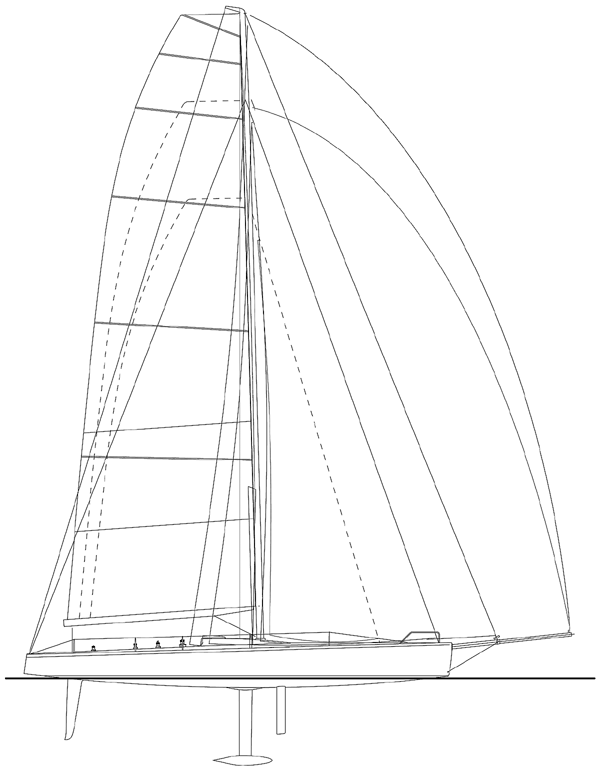
Having now revised our length overall to 12.2m we set about at least matching, if not exceeding, the righting moment of the larger designs, to help compensate for the lack of sailing length. Hence the Psaros 40 has benefited from every conceivable means to increase RM, including water ballast, a canting keel, multiple trapeze and a wide, flared hull. The result is that a boat that displaces just 3.7 tonnes in racing trim generates an RM of 4 tonnes / metre at 20° of heel; this is halfway between monohull and multihull.
So if you 'miss' a tack, or get caught aback, you are immediately in loads of trouble - just like on your Laser, in fact!
Produce your own wind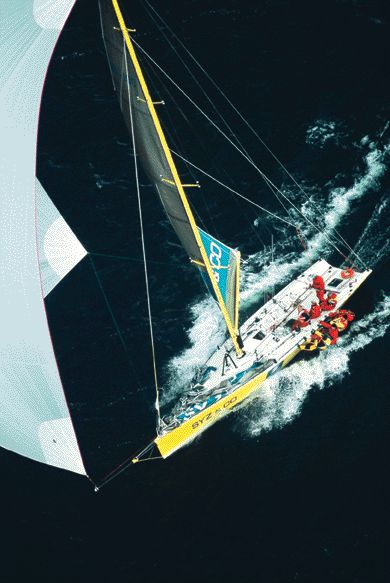 On Lake Leman there is unfortunately a high proportion of 'pétole', local slang for winds of below 6kt. Races regularly start in these conditions, so you have to manage them and try to create your own wind. To accommodate this, we have worked hard at optimising three parameters: a very thin and low wetted area hull shape when heeled; the possibility of sailing with the keel canted to leeward in light air; and a very stiff rig set-up, especially when using the big masthead gennaker (normally a difficult area in terms of luff/headstay management).
In fact, under 7kt of true windspeed these boats are always faster than the wind, just like a multihull!
Appendages and balance
The impression of sailing a dinghy is accentuated by the balance of the side force around the appendages, which places a high emphasis on lift from the rudder - more than a quarter of the total side force. In practice, at low speed, in the pétole, the boat balances nicely using a combination of leeward canted keel and limited use of the daggerboards to offset the leeward pressure of the large genoa.
Structure
The composite structure (except the keel fin which is CNC-machined from a solid steel billet) has been optimised by Clemens Dransfeld at his consultancy, dyne.ch. Priority was given to the hull-beam stiffness, with top and bottom carbon UD straps and longitudinal shear webs generating an efficient I-beam.
However little priority was placed on torsional stiffness, there are no fibres at 45?, no closed bulkheads or webs that could form stiff boxes, no diagonal webs, and yet the runners are still attached to the boat's 'corners'. In fact, everything possible has been done to create a nervous, lively structure in torsion.
An anecdote: the hull panel with the highest scantling is not the forward slamming/grounding area, but the side panels for the ballast tanks, which on each tack receive 450 litres of water from around 1.7m above in just a few seconds. Transfer pipe and valve diameter is a massive 26cm, and the transfer is improved by a 'turbo compressor', in which the air from the leeward tank is forced back up into the windward tank by the force of water flooding down to leeward.
The aim with the structure was to achieve a longitudinally stiff and narrow boat, with well-executed construction, but good longevity in often wild use - partly through allowing some limited movement in the structure. In two seasons nothing has broken on the first two boats, even after some awful manoeuvres, including at least one ? contre capsize!
Transition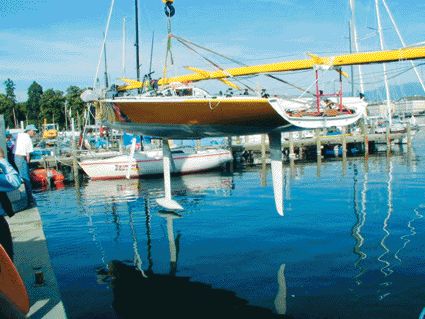 Just as performance lies between that of a mono and multihull, it's the same story with the downwind sail inventory. Spinnakers, reachers, gennakers (whatever you call them), we really have been through the same transition period the multihulls experienced some 15 years before.
The Psaros 40 sails most frequently on apparent wind and its sails seem to get ever closer to multihull designs as a result. Now we are also working on new 'half-and-half' downwind designs with the local sailmakers, somewhere in between asymmetrical spis and reachers. More to follow...
Since the first boat was launched in May 2002 the design has won all the classic lake races at least once. The arrival of the third unit next season will provide more fun and we hope the beginnings of an affordable new one-design Lake Racing class.
Psaros 40 Specifications
| Designer | Sébastien Schmidt |
| Structure | dyne.ch |
| Builders | Chantier Psaros/Maxi Dolphin |
| LOA | 12.28m |
| Beam | 3.38m |
| Displacement | 2600kg |
| Keel | 1040kg |
| Keel mechanism | Hydraulic canting to 40? each side |
| Ballast | 450 litres each side |
| Draught | 2.50m |
| Mast | In M40J carbon by Nordic |
| Main | 71m2 |
| Light genoa | 78m2 |
| Genoa | 49m2 |
| Solent | 38m2 |
| Asymmetric spinnaker | 270m2 |
| Construction | Epoxy glass/carbon sandwich |
Psaros SA
Rte de Thonon 146
1222 Vesnaz/GE
Tel: 022/752 36 95
Fax: 022/752 41 26
Email: [email protected]
www.psaros40.ch
Maxi Dolphin s.r.l.
Via Gandhi, 9 - 25030 Erbusco (Bs) - Italia
Tel. +39/0307718111
Fax +39/0307706433
E-mail: [email protected]
maxidolphin.it