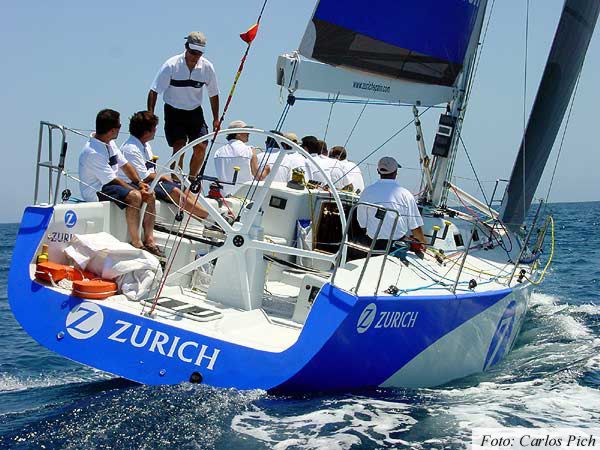
Finot 40: Why Ever Not?
Finot 40: Groupe Finot's new Open 40
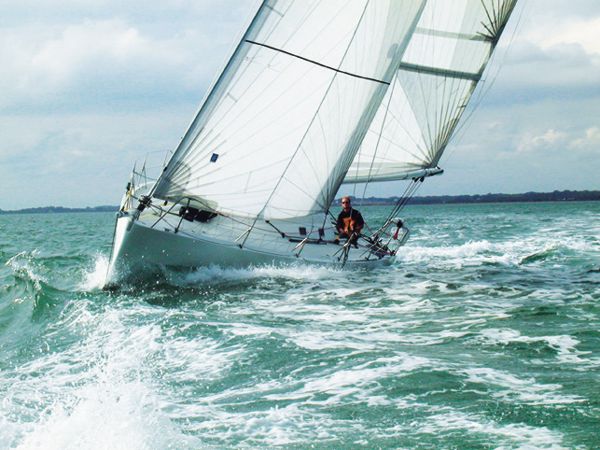 Pascal Conq explains Groupe Finot's solution to the task of creating the perfect blue-water racer-cruiser for a more open-minded next generation...
Design Concept
'This boat must be light, easy to use and very safe. It must offer both exciting offshore racing and perform as a (very) fast cruising boat'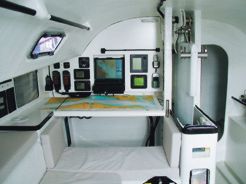 We designed this boat to showcase and make available to the wider public all the knowledge that we have acquired during our Open 50 and Open 60 design work, and after winning six singlehanded around-the-world races in 60-footers and two in 50-footers. We wanted to bring to the market the best of what can be done at this size by using the same technology and design criteria that we apply to our open racing boats. 40ft is a much more appropriate size for a private owner in terms of price, maintenance and use than 50ft and especially 60ft. We also believe that this is a good size for fast long-range cruising - and that boats designed for singlehanded use are generally easier to sail when cruising. While historical convention dictates that a cruising boat must necessarily be a heavy boat, the inescapable fact is that the physical effort required to handle a boat is directly proportionate to its displacement. That's why a 12m boat like this, weighing in at 4-4.5 tonnes (depending upon specification), is so much easier to handle than a traditional 40-footer.
 Extending this same philosophy, everything possible has been done to simplify the use of this boat for a small or even solo crew in both the rigging and the deck layout. As a benefit, by combining racing specification and quality equipment with a light displacement we ensure that the steering is both precise and very light, even with the twin rudders, making it easy and very enjoyable to sail.
In our opinion high achievable speeds reached without stress or strain on the crew mean both pleasure and security. Too fast to be safe, or perhaps even 'sensible' for blue-water cruising? Well, the first example of this Open 40 has already sailed over 40,000 nautical miles without any problems, including the Trans Pacific Race and the last Around Alone Race. She has covered more than 350nm a day many times and reached speeds as high as 28kt. You decide.
Speed, construction, security, simplicity
We believe that all four are closely interdependent. The high average speed capability of this boat is the result of light weight, low centre of gravity and high righting moment through the provision of a sensible amount of water ballast.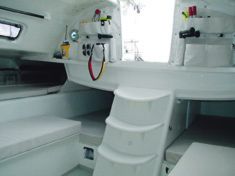 The Finot 40 is built using carbon fibre throughout. For the whole of the hull a monolithic high-temperature prepreg laminate has been specified. We feel this is the only way to ensure very high reliability longterm, with no risk of core-crushing on docks (or even fenders) or other impacts, while also minimising the well-documented risks of high-speed slamming. This is after all a boat designed to travel the oceans of the world without the need for skilled maintenance. There are also some modest cost benefits to the use of a solid hull laminate in what is a semi-production built boat.
The fin for the lifting-bulb keel is constructed in solid carbon, while stability benefits further with the deck and coachroof being built in carbon/Nomex sandwich. The wingmast is also carbon.
Safety
The large draft has allowed us to reduce the lead bulb weight while keeping the centre of gravity low. The result is a boat that is very secure in terms of stability. It has an IMOCA vanishing stability angle of 127?deg; and is re-rightable from an inverted position by filling a ballast tank - which can of course be achieved from inside.
Add to this the three watertight bulkheads (we gave special attention to the trim with two contiguous compartments flooded) and the high strength of the hull and the other parts and we feel this has produced a very secure boat.
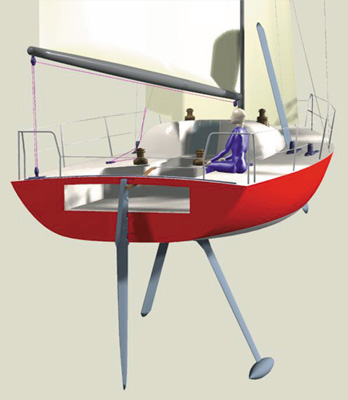
While boat one had a fixed fin, for subsequent boats we have achieved a sliding lifting keel to enable draft to be reduced from 3.2m to 2.05m. This is the only practical way to allow such a boat to access a wide range of moorings without losing
the major asset of its deep draft. With hydraulic lifting and locking rams the keel-lift system is easy to use and very solid.
A canting keel is an obvious alternative for a powerful boat of this type, but early on we decided that with our dual-purpose criteria we should pursue a vertical lifting mechanism in the interests of longterm reliability and ease of mooring.
In the absence of a canting keel the major element of the boat's power is provided by the water ballast, which is divided into two compartments each side, with a total of 1.6 tonnes possible per side. This allows the boat to be some 30 per cent stiffer than a traditional 40-footer for about half the weight.
The resulting power-to-weight ratio is an amazing 260 per cent higher. It begins to be a real sailing boat...
Rig
The carbon wingmast brings us performance and simplicity: no runners and no backstay. Two shrouds and one forestay are all it takes. In the absence of runners, forestay sag under genoa can be minimised by raising the mast with the small internal hydraulic ram that is fitted.
There are three reefs in the standard mainsail, all controlled from the cockpit, while the genoa is permanently mounted on a furler. You can also set a staysail on a babystay, for which there is a second set of lower shrouds on permanent standby, with powerful independent tensioners to ensure adequate inner-headstay tension.
And the Open 40 is equipped with the ultimate 'easy gybing system': no stress, no pole to move, only the asymmetric spinnaker to sheet in and the main traveller to take care of when gybing. There is no permanent vang since we prefer the control provided by a very long transom-mounted mainsheet track.
From the helming position both the mainsheet winch and the main traveller on its tackle sit within reach. Four more winches are mounted behind twin 'pianos' on the coachroof, two for genoa/gennaker sheets and two for the halyards. These are usable from a standing position which is very ergonomic for the back.
The interior is developed for life at sea, with two spacious and comfortable berths under the cockpit aft, and four more berths over the ballast tanks.
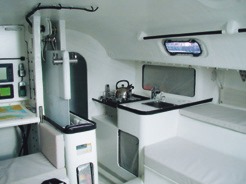
The central cabin area is light and airy, with a well-organised navigation station forward and a proper galley (and drying locker) mounted to starboard. A separate toilet and a Zen-inspired 'owner's' shore cabin lie forward of the main bulkhead, with the asymmetric in its sock and the furled gennaker both concealed under the wide double berth.
Conclusion
We think there is a market for this kind of boat: an affordable and fast blue-water racer and cruiser.
Such boats, built for pleasure, with no limits other than a few sensible restrictions, would also lend themselves to being encompassed within a simple box rule derived from existing IMOCA and Mini Transat regulations.
IMOCA has now dropped its 'official' Open 40 class, which is regrettable. This might have provided an immediate international context to the development of these boats. Maybe it is not too late. In France at least many people are interested in this kind of boat and several are currently under construction.
Whether or not official recognition is forthcoming I believe that this kind of light, easy-to-use and secure design, which offers offshore racing and also a very fast long-range cruising boat, has a bright future.
www.finot.com