Two Walkarounds Examined
The Aquasport 250 Explorer matches up with the Stratos 2500WA.
Nearly every boat with side decks is, in some sense, a "walkaround" but, in sportfishing jargon, the walk-around is a boat that combines the fishability of a center console with the amenities found on boats with cabins.
Like everything, however, there's a wide range in just what a builder means by walkaround and the two walk-arounds examined here are good examples of different approaches to the same problem. The Aquasport 250 Explorer and the Stratos 2500WA are both similar in size (about 25 feet in hull length), but the two builders took different routes to reach the hearts (and pocketbooks) of boat buyers.
Each builder of walkarounds has to decide what his buyers will want, and what they'll be willing to give up because, after all, you can't have everything. If the side decks are wide and deep, then you have to sacrifice room inside the cabin. If the cabin has full standing headroom, then it's going to affect visibility from the cockpit because of that height. And if you want a maximum-sized cockpit for plenty of fighting room, then you have to settle for a smaller cabin. In case you hadn't noticed, life is full of trade-offs.
While both boats are well-designed and built, each had some shortcomings that we found surprising as well as irritating, particularly in this price range.
Design/Construction
Both boats had what we would consider to be conventional but high-quality construction methods. Both stay away from the chopper guns used on less expensive boats, relying on traditional hand lay-up methods with alternating layers of cloth, mat and woven roving, all rolled out by hand. Aquasport uses isophthalic resins to prevent blistering, while Stratos is using polyester resins.
The Aquasport has shifted to a fiberglass stringer system that is first bonded into the hull by vacuum bagging, and then injected with foam. This foam doesn't add strength, although it does act to absorb sound and prevent water from filling the stringers if the hull is holed. The inner liner for the cockpit sole is then bonded to the top of these stringers, creating a monocoque structure that is both light and stiff. Aquasport touts the fact that there is no wood used below water level in this hull.
The Stratos, on the other hand, uses wooden stringers which are completely encapsulated in resin and then bonded into the hull using layers of fiberglass materials. This provides a solid grid to stiffen the hull, although detractors point out that the wood can potentially rot. In truth, the wood acts more as a form for the fiberglass than as the structural member, and the result is a sturdy grid at a slight price in weight over the Aquasport's fiberglass stringers. Stratos injects polyurethane foam flotation into most of the hull cavities, adding an additional layer of security from holing.
Both companies offer five-year limited warranties on the hull and structures, with three years on component parts.
From a design standpoint, both boats are obviously intended to see heavy duty offshore, with vee-bottoms to soften the ride. The Aquasport has a Delta-Conic hull designed by Harry Schoell with 22 degrees of deadrise at the transom. Unlike other Aquasports, the hull of the 250 Explorer is completely smooth and without any strakes. The chine flats are quite wide (8 inches) and start high in the bow and end below the waterline at the stern to provide stability at rest as well as deflecting spray at speed.
The Stratos has two degrees less of deadrise (20 degrees) but the hull shape is quite unusual. The chines become downturned lips or rails at the stern, providing a sort of longitudinal pocket that seems to carry aerated water aft to cushion the ride, or act as roll tabs to steady the boat at low speeds. The Stratos also has molded in recesses for the trim tabs and pumps, making a smoother underwater surface.
One design item to note is that both boats have stepped outside the legal 8-foot-6-inch trailer width limit. In the water, added beam means added stability but added beam on the road means you'll have to deal with permits if you plan to trailer the boat.
As a final design comment, there's no question in our minds that the Aquasport is a prettier boat: lower, leaner, and nicely styled. The Stratos is not only bulkier in appearance with its tall superstructure, but the cabin house is so far forward that it seems out of place.
The construction details on both boats were equally high quality. Both companies use plywood backing plates under the deck hardware, which is throughbolted using stainless-steel aircraft-style locking bolts and nuts.
Both boats have also been paying attention to Powerboat Reports' concerns about fuel tanks. The Aquasport uses a polyurethane tank (180 gal.) mounted neatly under the cockpit sole, which can be removed for regular inspections, while an access port allows visual inspections of the filler connections. The Stratos uses an unpainted aluminum tank (206 gal.) under an easily removable floor panel, and also has an inspection port over the fillers. From what we could see, both were seamanlike installations.
Deck/Cockpit
If you're shopping for a walkaround, you'll be interested in the ease of walking around, so let's start there. Here, the winner is the Aquasport for three reasons. First, the deck width (about 14 inches) is plenty wide enough to walk normally. Second, the cabin leans inward and the bulwarks lean outward to increase the space available for those with size 12 brogans. Last, the combination of high bulwarks (12 inches at the helm and 18 inches forward) combine to put the rail a full 3 feet off the deck for a very secure path forward.
The Stratos, on the other hand, has a 9-inch wide deck next to a more vertical cabin side, so you tend to crab sideways when going forward. The bulwark is 6 inches high and the rail forward is just 24 inches, or a full foot lower than the Aquasport. There's no question that, if you need or want access to the foredeck, the Aquasport provides both better sidedecks and more secure rails.
The foredeck area on the Aquasport also seemed larger, in part because of the lower cabintop but mostly because it is just plain more spacious. Both boats have short bow platforms with built-in anchor rollers, and anchor lockers that hang the anchor by the stock. Each boat also has small seats built into the forward end of the cabin house and opening hatches on the cabin top. The Aquasport has three 8-inch cleats (two on the rail for dock lines and one midships for the anchor), while the Stratos has two 8-inch cleats on the platform.
Both boats have thoughtfully provided steps to reach cockpit level from the deck, although Stratos has utilized the space by providing iceboxes underneath.
Fishermen will want to know about storage for rods as well as fish, and both boats have done a good job in these areas. Rod racks with shelf space is located port and starboard on each boats, holding four rods on the Aquasport and six on the Stratos. Both boats have additional rod storage in the cabin.
The Aquasport has more fish holds, with two 32-inch hatches in the sole opening to fish boxes more than 6 feet, 6 inches long, both of which are insulated with overboard drains. The Stratos has a smallish fish box between the helm seats, and a 5-foot box in the top of the 19-inch wide transom. We'd have to give Aquasport the nod in usable and convenient fishboxes.
Bait is equally important to fishermen, and the Aquasport has a bait station under a hinged panel in the transom coaming with a sink and washdown. Two insulated baitwells on each side can be fitted with optional recirculating systems. The Stratos, on the other hand, has a 32 gallon aerated baitwell in the cockpit floor near the transom, and a bait prep area is atop the transom coaming
In general, both cockpits are deep enough for security, are self-bailing, and have enough room to handle a team of anglers. The Stratos has a walk-through transom door leading to the outboard bracket area, and the sole at the helm is raised 9 inches, providing extra height for the helmsman as well as protection from cockpit water.
Seating in both cases is comfortable, and both boats have helm and companion seats as standard equipment. The Stratos has mounted the seats on platforms which hold large tackle drawers facing into the cockpit, which is a thoughtful use of otherwise wasted space, while the Aquasport achieves a slightly cleaner look by using seats on pedestals.
The helm on the Stratos had the feeling of a bigger boat, in part because there was somewhat more elbow room than on the Aquasport, but it was also the feeling of being above the cockpit level. The level of protection for the helmsman on the Stratos was also much better, with a windshield height of 5 feet 3 inches that deflected wind and spray even while standing. A pair of electrical panels (with lighted toggle switches) are set on each side of the wheel and the engine instruments are in a box set atop the cabin making this a heads up display. There isn't a lot of space for electronics installations without sacrificing the plexiglas covered glove box, but our test boat had the optional hardtop that included an overhead box for electronics as well as rod holders.
The Aquasport, on the other hand, has a much more compact helm, with the Suzuki engine gauges and toggle switches built into a dash panel. Electronics installation space is limited to the cabin top. The windshield was higher (5 feet 7 inches) but raked steeply aft and there was considerable wind turbulence on the helmsman. The inward-angled throttle position was awkward, and forced your wrist to twist if you left your hand on the throttles as you might do if you were running fast or on-offing through seas. We'd definitely remount the controls if this were our boat.
Both boats had nonslip surfaces in the cockpit where you'd expect it, and the texture was above average. But both boats also fell down (hopefully not a play on words) when it came to the rails. The Stratos, for example, had a non-slip surface on the coaming around the cockpit, but it stopped 30 inches forward of the stern cleat where you might step while going ashore. The Aquasport had no nonslip surface at all on their forward cap rail or on the cockpit coaming, both of which are wide enough to be inviting as stepping surfaces. Both boats were surprising in these omissions.
Cabin/Interior
In this area, the Stratos is the hands down winner, both for space and comfort. With 6 feet 1 inch of headroom, it has enough room to spend a night or two without feeling too terribly cramped. A counter top to port has a sink with pressure water and, on our test boat, a Kenyon one-burner stove. Below the counter is an optional front-opening AC/DC Norcold refrigerator. The enclosed head compartment to starboard has 5 feet 7 inches of headroom, molded fiberglass sink and counter, and optional hand shower.
A V-berth is forward, surrounded by a bolstered backrest which turns the area into a dinette when the table is raised between the bunks. The bunks are bit on the short side, with the port berth 6 foot 1 inch and the starboard side only 5 foot 9 inches because the head compartment takes up some bunk space.
The Aquasport, on the other hand, has much more Spartan accommodations and we wouldn't want to spend much time here, particularly with headroom of 5 feet 2 inches. To port is a counter with sink and hand pump, Origo alcohol stove, and icebox. Under the counter is a locker with the plastic water tank.
The V-berths are 6 feet 3 inches long on each centerline and are reversible, with fabric and vinyl on opposite sides. The smallest hanging locker we've ever seen is to starboard, with an opening just 3 1/2-inches wide and 32-inches high, so don't plan to take much finery.
The Aquasport also has an enclosed head compartment, but it might see more use if a portable toilet had been installed between the berths. The head compartment has 4-foot-8-inch headroom, and is finished in white mica with carpeting overhead. The problem area, however, is when one is seated upon the throne. There is just 11" between the vanity counter and the door, so you must sit with your knees jammed tightly together in this narrow space. If you try this at home, you'll quickly see that it is not only uncomfortable but nearly impossible. There is also no ventilation in the head compartment. We weren't impressed, nor can we imagine inviting a spouse to share these quarters for a weekend. Aquasport might simply leave out the sink and counter to make the toilet accessible, or do away with the enclosed head compartment completely.
Engine/Mechanical/Performance
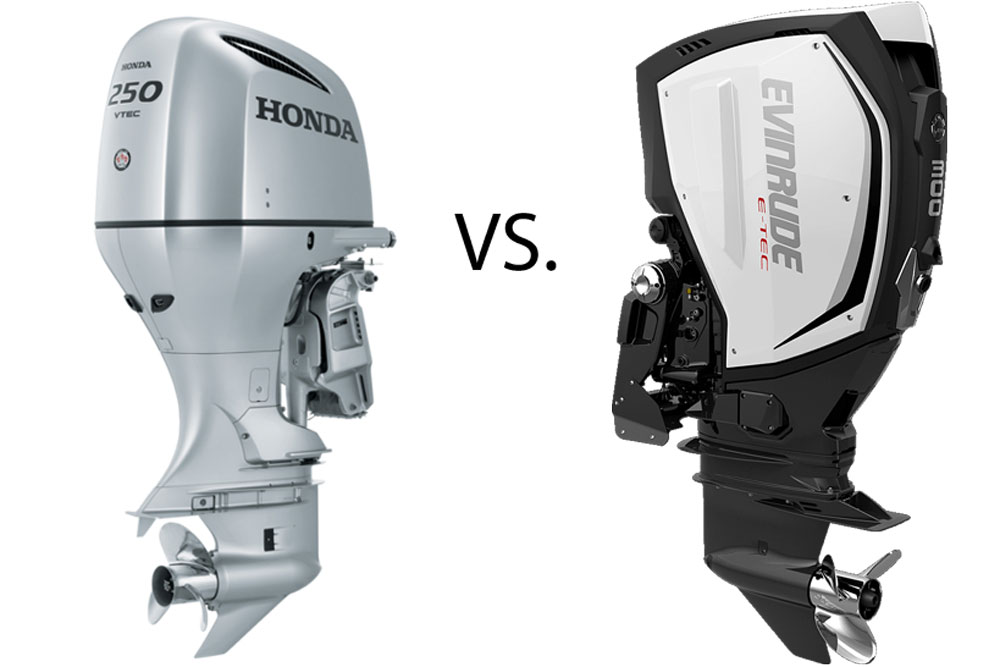
Both boats had twin outboards: the Aquasport with Suzuki 225 horsepower EFIs and the Stratos (as befits an OMC-owned company) with 200 hp. Johnson Ocean Runners. The Aquasport uses an externally mounted transom bracket made by Stainless Marine, while the Stratos has the engines transom mounted. Since both our test boats had been rigged by the respective engine manufacturers, we could find no flaws in the installations.
The Johnson Ocean Runner is a carbureted 3.0 liter 90-degree, V-6 designed for offshore saltwater use, with extensive use of non-corrosive metals, a flushing system, and a high-lift tilt to get the outboard above water when moored. The engine produces 200 shaft hp. at a 5,000-6,000 rpm range. The Suzuki 225 EFI (electronic fuel injection) puts out 225 shaft horsepower from a 60-degree, V-6 of 2.7 liters. Also designed for offshore salt use, the Suzuki has a sophisticated anti-corrosion system.
Hydraulic steering is standard on both boats, and an effort has been made on both boats to make the mechanics fully accessible. On the Stratos, a transom panel hinges upward with pneumatic assists to reveal two batteries bolted in place, the oil reservoir and the master electrical switches (which are a long reach from a kneeling position). The Aquasport relies on three transom panels that hinge downwards, with batteries bolted down outboard on each side and the oil reservoir amidships. One nice touch is that the bait tank pump is mounted on the door itself, making for very easy maintenance of this critical unit.
Access ports on both boats led to the automatic bilge pumps, although there was limited access to the bilges in general. Both boats use only bronze or stainless-steel through-hull fittings, rather than the plastic often found on small boats. In general, the plumbing and electrics were neatly routed and tidily installed, and we found no problems here.
Both boats obviously had enough horsepower to take the curl out of your hair and, in spite of the horsepower and displacement differences, both boats topped out at nearly 47 knots or 54 mph. The Stratos was a little slower off the line, but she was also toting a load of nearly 1700 pounds more. With less beam and displacement, the Aquasport felt more nimble when cranking through medium to high speed turns, but the Stratos had a more solid feel in offshore conditions. The bottom line, however, is that we simply couldn't fault the performance of either boat
Conclusion
As you can see, length alone doesn't determine the product and, in this instance, each boat had areas of compromise. If you want cabin space, the Stratos is your choice. If you want more foredeck and sidedeck room for fishing, go for the Aquasport. As for the cockpits, we'd have to step aside because every angler has his own preferences and both boats had a few features and a few faults.
Price is always a consideration, and the base price for the Aquasport is $28, 495, while the Stratos lists for $33,433. Rigged with 200+ horsepower outboards, both boats would fall into the $50,000 range, and the $4900 base price spread is minimized by the greater list of standard equipment on the Stratos, which includes items such as the washdown system, stereo, cockpit bolsters and seat cushions, trim tabs, full instrumentation and compass, triple bilge pumps and aerated live baitwell.
Perhaps the most important thing to be said about either boat is that, personal preferences aside, you can't go wrong with either one.
| Aquasport 250 Explorer | Stratos 2500WA | |
|---|---|---|
| LOA | 27'4.5" | 26'5" |
| Beam | 9' | 9'10" |
| Draft | 1'7" | 1'8" |
| Displ (no engines/dry) | 4070 | 5800 |
| Fuel | 180 | 206 |
| Water | 5 | 15 |
| Base Price | $28,495. | $33,433. |
Aquasport
1651 Whitfield Ave
Sarasota, FL 34243
(941) 755-5800
Stratos Boats, Inc
880 Butlers Road
Murfreesboro, TN 37127
(615) 895-5190