Gelcoat Care
With proper care, your boat's gelcoat can maintain its shine for many years.
On the day your boat was built, a workman carefully checked the female hull mold for dust, dirt, scratches or imperfections. Then, he began spraying something that looked much like thick paint onto it. More than likely, the mold was upside-down and he was standing inside it spraying over his head.
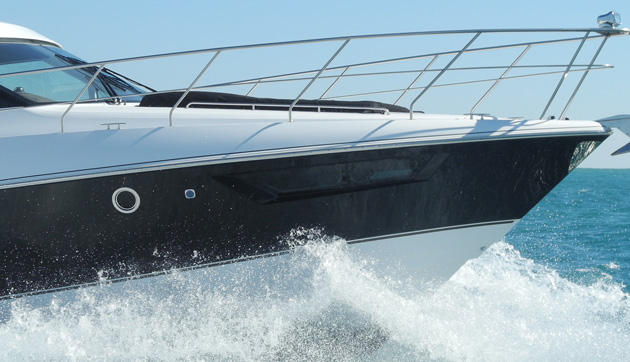
This Cruisers Cantius 48 looks great, but it's brand new. Protecting that gelcoat shine will keep your boat looking good and help it last longer.
The very first part of your boat to be built was the very outside skin, a layer analogous to paint on a wooden boat. This is the part of the boat that must stand up to unexpected bumps against a pier, grit caught in the tread of deck shoes or the ultraviolet light of the sun. Compared against the harsh world in which it functions, that outer skin of your boat seems woefully thin and brittle.
Boat builders call the outer skin of a fiberglass hull (or deck) the "gelcoat." It is actually a layer of pure resin a few thousandths of an inch thick. Contained in it is the pigment which gives your boat's characteristic color. You may think you own a blue boat, but what you actually have is a very thin layer of blue gelcoat.
In a cosmetic sense, gelcoat performs the same function as paint on the sheet metal of a car or on the wood of a table. It provides a glossy, colorful finish that is pleasing to the eye. But, the gelcoat does more than just look good. It also seals the fiberglass layers beneath it against water or moisture.
The structural importance of a good, sound gelcoat cannot be over stressed. A poorly made, worn or badly scratched gelcoat can allow water to permeate the underlying fiberglass. Over time, the result could be serious damage.
Modern gelcoats are amazingly successful at both looking good and providing protection. They're so good that they make it difficult to lay to rest the old half-truth that fiberglass boats are no maintenance. The fact is, gelcoats require maintenance, even though it's a lot less work than maintaining brightly varnished mahogany.
The goal of gelcoat maintenance is to protect it against sunlight, water and abrasion. Not even the best gelcoat will last the whole lifetime of a boat (which may be double your lifetime). But, with proper care, the outer skin on one of today's fiberglass boats should last a decade or longer and still look good.
Those fenders you carefully hang in place before docking are really a form of maintenance. The protect the gelcoat against major scuffs, scrapes and gouges. Because gelcoat is brittle, it's no match for a concrete and steel pier or even a wooden dock riser.

Fenders protect your boat from big damage, but they will eventually remove the shine on the topsides unless you add protective covers like this Hunt 44 has.
Even as those fenders prevent big damage, they can be causing almost microscopic wear and tear. Dirt on the surface of the fender can be ground into the gelcoat. At first, you can't even see the damage. But, after a couple of years, the area rubbed by the fenders begins to look dull. That's a sure indication that the high gloss of the gelcoat has been worn away by the fenders.
Slipping terry cloth "boots" over the fenders helps to prevent this type of damage. These fabric can be removed and washed when they get dirty. As an added bonus, the terry cloth can be purchased in a variety of colors to complement the rest of the boat's color scheme.
Keeping your boat under cover ... either under canvas or in a boathouse...will protect its finish from the sun. Ultraviolet light is the real culprit here. It bleaches the pigment and causes the outer surface to turn "chalky."
Other than only taking your boat out at midnight, there's really no way to completely avoid ultraviolet light. A boathouse is a great help in protecting large craft, although hardly practical for most of us.
Canvas covers to shield flat horizontal surfaces are another possible means of protection. In the days of wooden boats, it wasn't uncommon to see overall canvas covers just to protect the varnished wood from sun. Anyone who has had to manhandle a wet cover, though, knows how impractical this solution can be on a large boat.
Wax seems to be the only practical way to protect your boat's gelcoat from ultraviolet light. Virtually every expert recommends applying wax, although none of them say specifically how much protection it affords. All that can be said for certain is that the gelcoats of boats protected by wax tend to retain their original color and lustre longer than boats that have not been waxed.
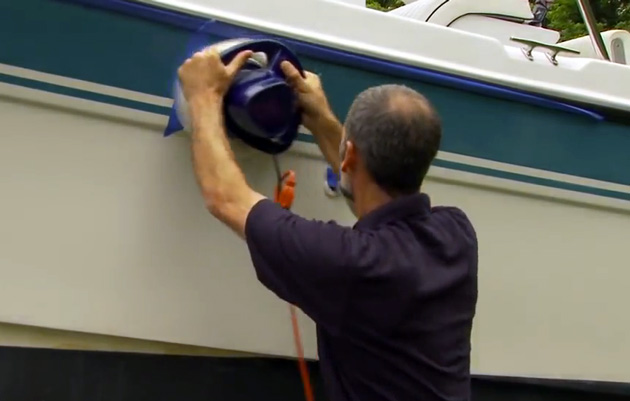
Wax seems to be the only practical way to protect your boat's gelcoat from ultraviolet light.
Most fiberglass boat waxes are based on a blend of old- fashioned carnauba wax and modern silicones. Many also contain chemicals designed to absorb some of the ultraviolet rays. Also available on the market are pure chemical polishes. These, too, depend upon silicones to protect the gelcoat.
Dirt and mild stains can be removed with one of the many fiberglass cleaners available on boat store shelves. Most of these preparations depend upon chemical action combined with very gentle abrasives to do the work. Some cleaners leave wax protection behind. Others are designed as the first in a two-step cleaning and waxing procedure.
You should have waxed or polished the hull and topsides of your boat last spring during fitting out. They may still look great, but August is a good month to think about applying a new coat. If the gelcoat is in good condition, it will continue to shine long after the last wax has worn off. There's no really way of telling whether your boat has enough protection other than applying another coat.
Horizontal surfaces have the most exposure to sunlight. Unfortunately, they are also the surfaces upon which we must walk. Wax should never be applied to any walking surface for obvious reasons. It will make the surface slippery and could lead to a nasty fall or a man overboard.
Instead, scrub decks and other walking surfaces often to remove airborne dust and dirt that inevitably collects. Even though your boat looks clean, this dirt can be ground into the gelcoat even by soft deck shoes. Although it would take a long time to do any damage this way, scrubbing the deck costs virtually nothing. It's cheap insurance.
Avoid using household cleansers! The "grit" in kitchen scouring powder is harder than the gelcoat. So, as it cleans it scratches. You can literally clean the shine right off your boat in a few washings. Be sure you use a cleaner that is specifically designed for fiberglass.
The gelcoat represents only the smallest fraction of the money you have invested in your boat. But, the appearance of your boat is almost totally determined by the condition of the gelcoat. A badly maintained gelcoat can knock thousands of dollars in value off an otherwise seaworthy boat. It makes good economic sense to
The joy of owning a beautiful boat is another reason for taking care of the gelcoat. Pride of ownership may be the best reason. Seeing yourself in the gelcoat is a nice reflection upon you.