Is the Hull on my Fiberglass Boat Too Thin?
Don't let a little daylight shining through the hull fool you -- boats are built mighty tough.
September 26, 2014
Question: The picture I sent in is from the inside of my fiberglass boat looking outboard through the hull on a bright sunny day. You can actually see some daylight shining through the hull near the top of the photo .
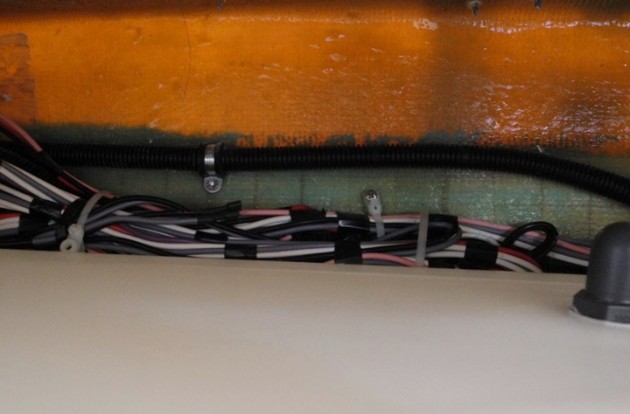
The fiberglass laminate in the hull above the water tank transmits some light from outside, but it's no cause for worry. Boatbuilders these days are very good at maximizing strength-to-weight ratios.
Toward the middle you can also see some white squares that I guess are pieces of core material. My friends and I are debating whether or not this is a defect in the hull that may cause me a lot of grief later on. What’s your take?
Answer: I look at a lot of different boats in a year’s time and I can assure you this is not necessarily a problem at all. I see this on just about all boats and at different places in both hull and deck laminates. Some manufacturers will actually coat the inside of laminates with white or grey gelcoat to hide this sort of thing and to give the impression of a more finished-off laminate.
The bottom line is that there really is nothing wrong either way. Core materials are used to stiffen composite laminates, and in many cases enhance overall rigidity. That said, this stiffness is not needed at all points in the overall structure of either a hull or deck. The fiberglass and resin are much stronger than most folks realize, and builders have learned how to work most effectively with these materials over the years.
As a basis for comparison, fiberglass boats built during the 1960s and 1970s were generally overbuilt in terms of the amount of fiberglass and resin used. They were also quite a bit heavier than they actually needed to be. During those years we basically had 90-degree fiberglass roving and polyester resin to work with.
Today, by using biaxial fiberglass cloth and more sophisticated vinylester and epoxy resins, strength-to-weight ratios can really be maximized. I wouldn’t worry one bit about what you are seeing in this picture.