Everglades 273cc Review
Bigger can be better, even when it comes to a bay boat like the 2017 Everglades 273cc.
If you were to ask an avid angler his or her top five picks for a capable bay boat, chances are pretty good that the Everglades 243cc would be on that list. It’s not just Everglades’ most popular model, it’s also one of the most respected fishing hulls on the market. The 243cc garners that sort of reputation for lots of good reasons. It’s fast, efficient, seaworthy, infinitely fishable, and is one heck of a sweet ride in a nasty chop. So when Everglades expanded its bay boat presence in 2016 by introducing two larger bay boats—the 253cc and 273cc—we decided to ask the question, “Is bigger better?” by running the 273cc. The answer? Start by taking a peek at the boat for yourself.
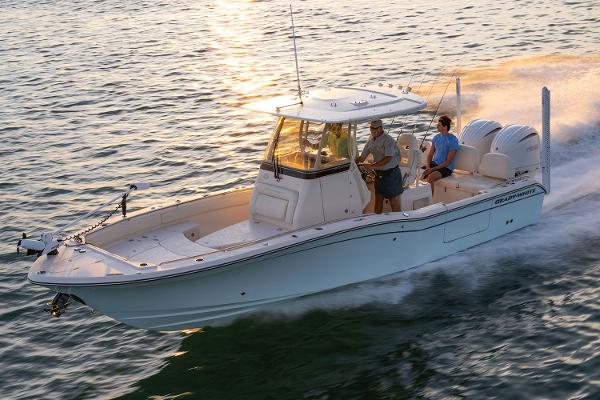
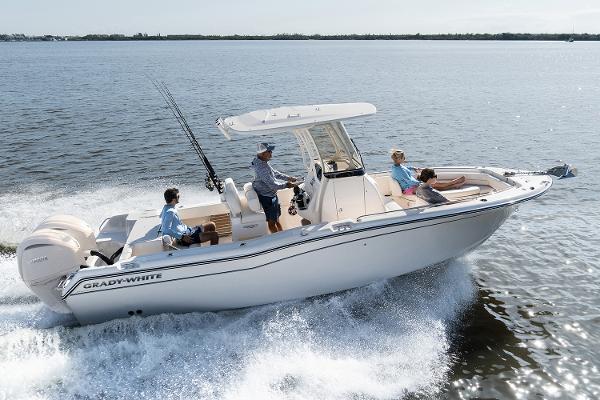
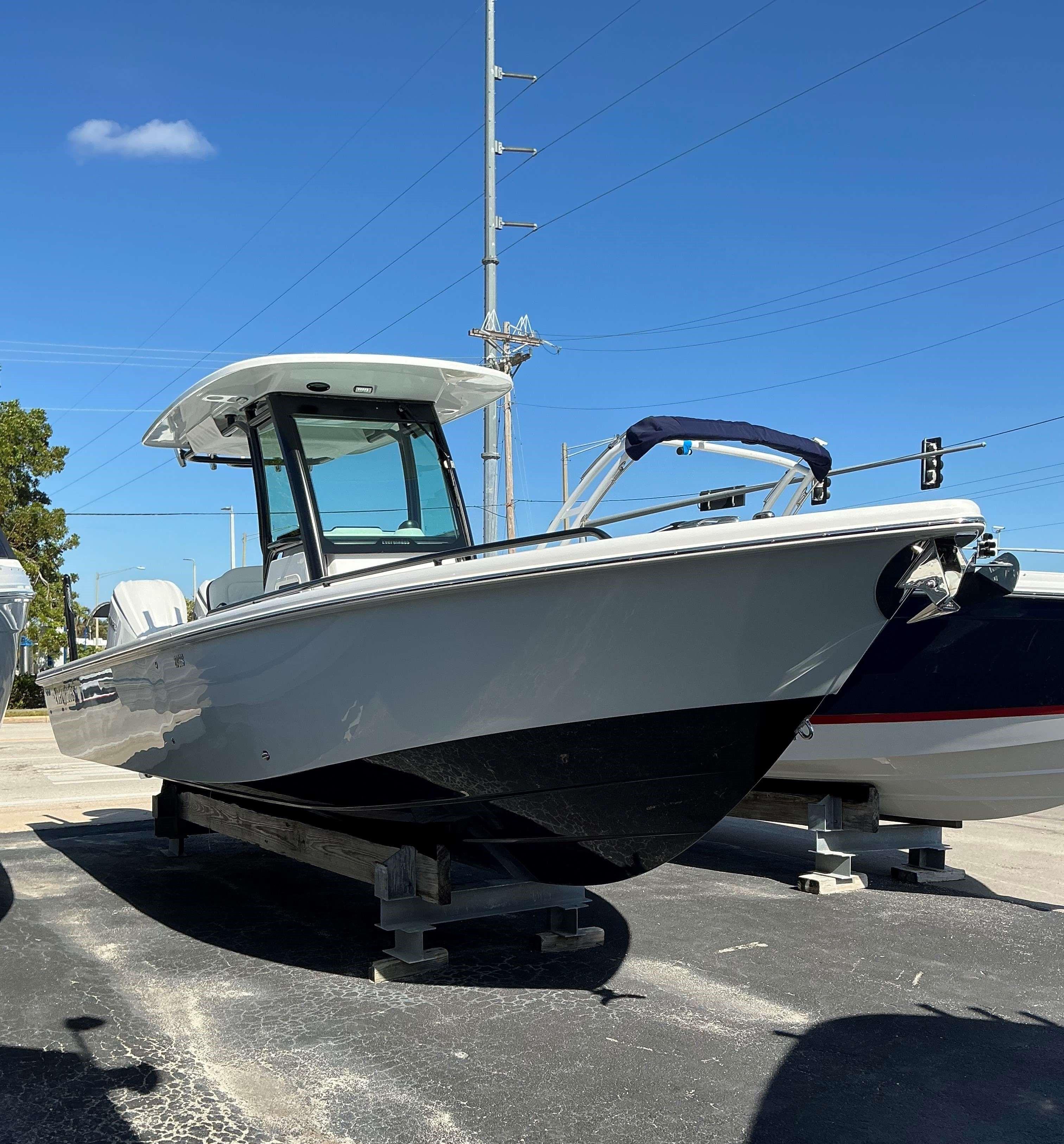
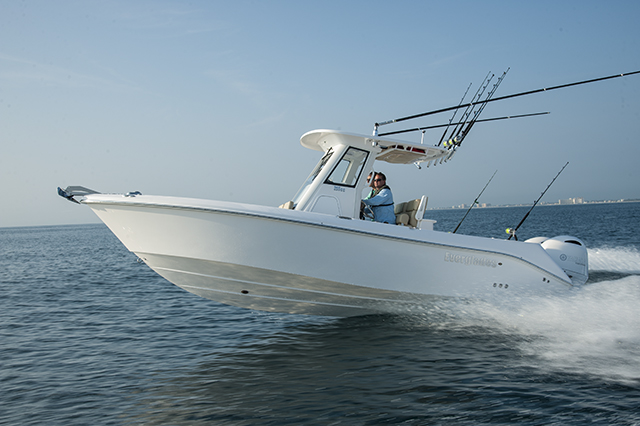
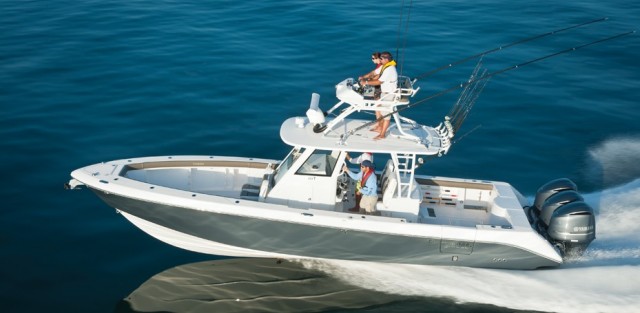
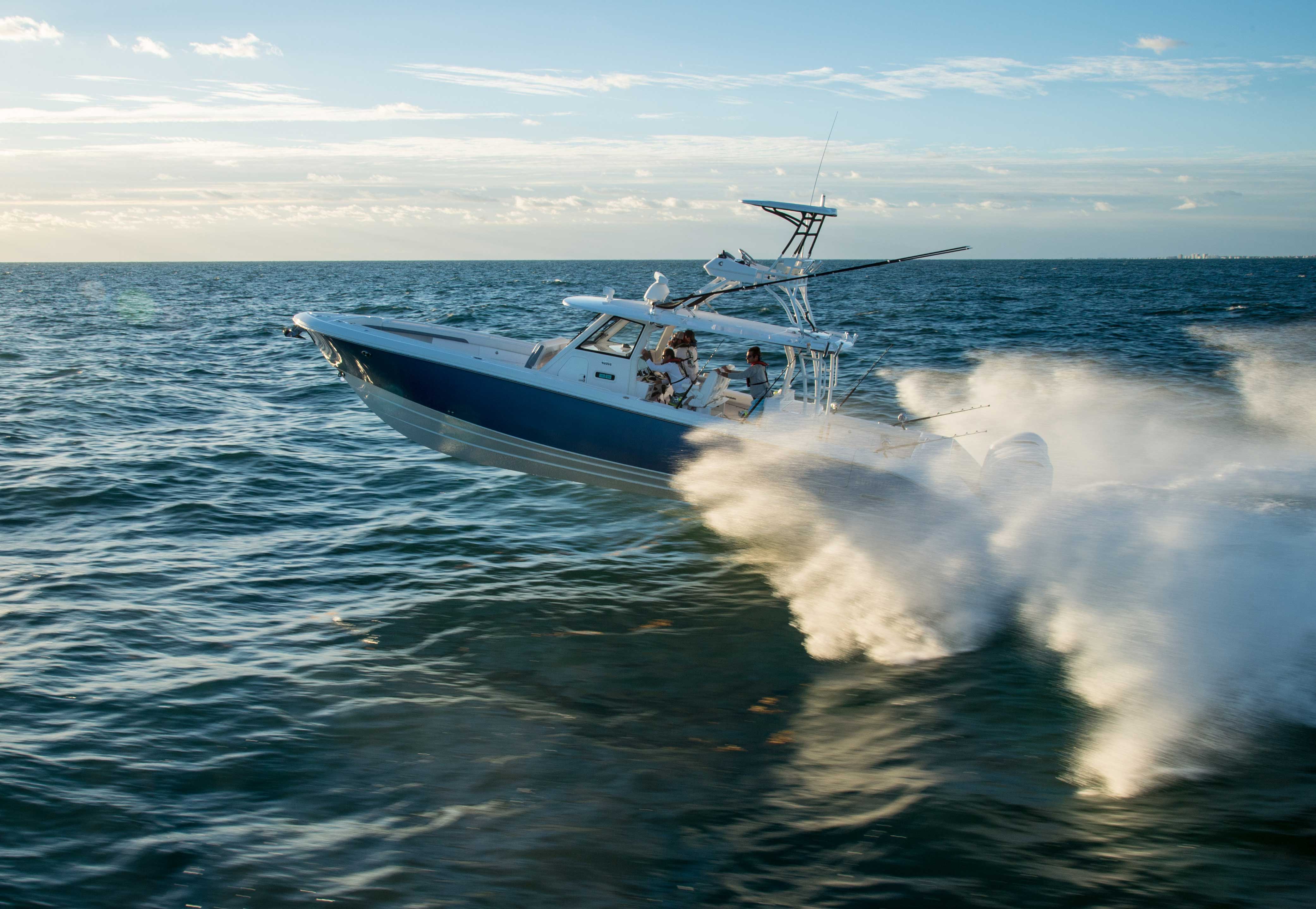
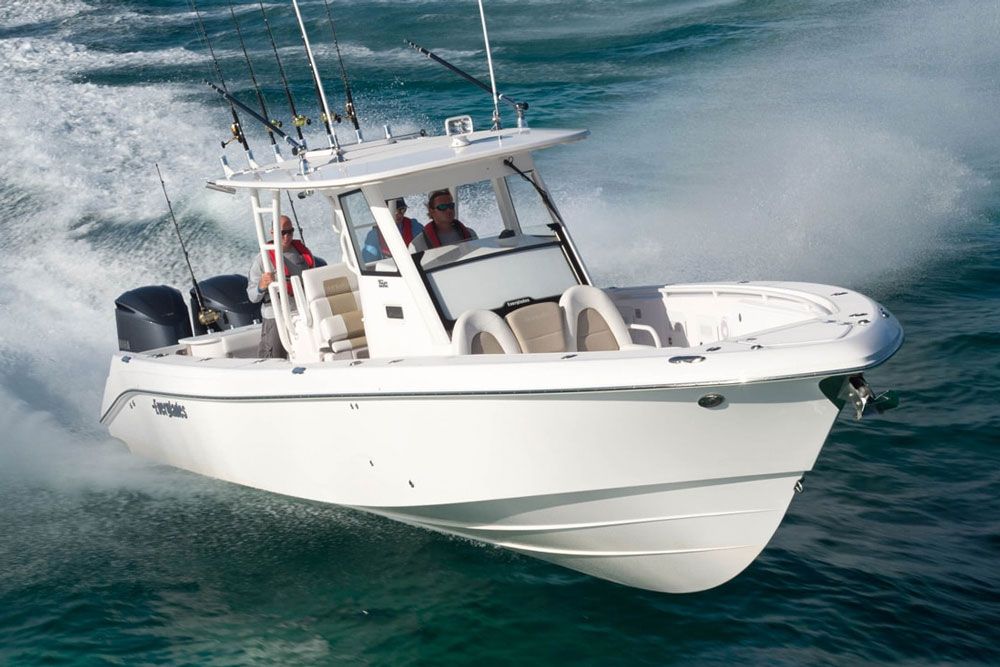
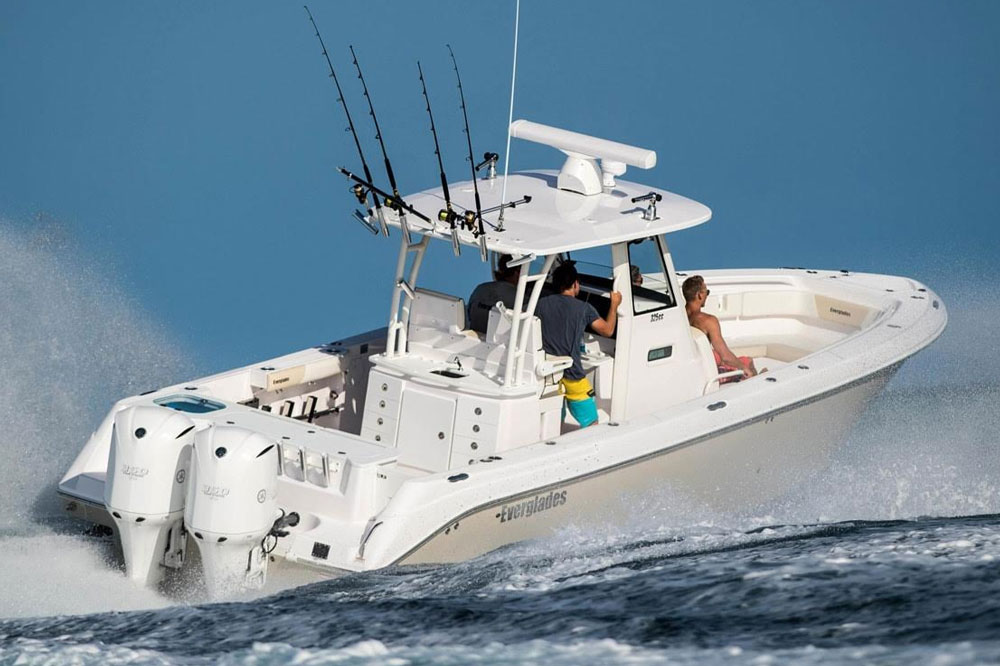
From the dock, the 273cc truly does look as if it’s just a blown-up version of the 243cc. It’s got the same low freeboard, large forward and aft casting platforms, a sprawling center console unit with tempered glass side panels and windshield, and plenty of flare at the bow. Like its smaller sister, the 273cc is a good-looking rig. Look at the stern, behind the center console, and at the foredeck, however, and you’ll start to see subtle—and not so subtle—differences. Perhaps the biggest departure from the 243cc norm you’ll see on the 273cc is its twin outboard powerplants, five hundred ponies worth.
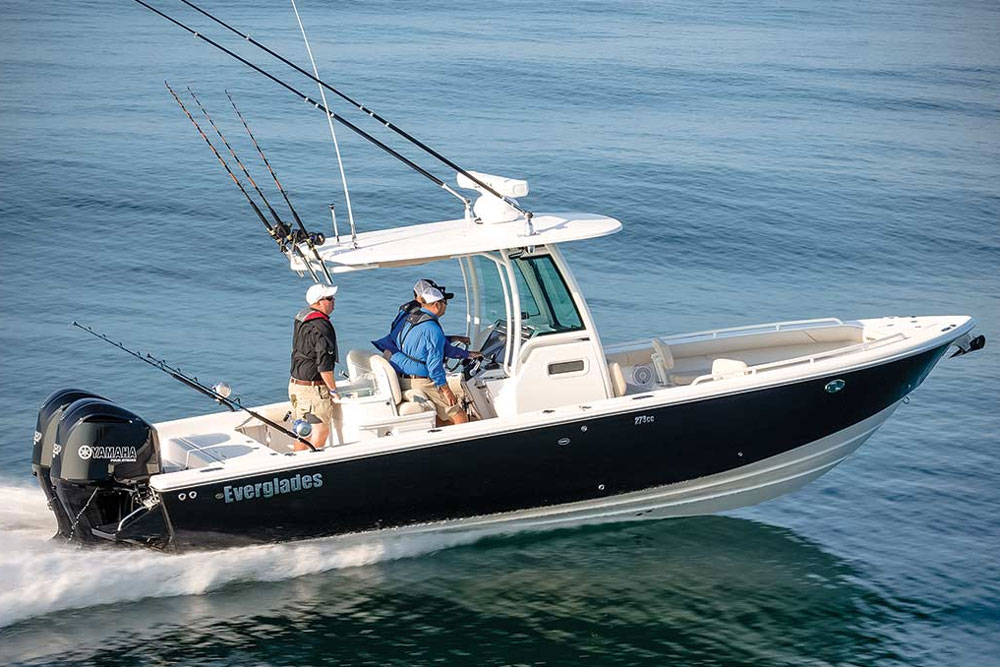
The 273cc can handle up to 500 HP, versus the 243cc’s maximum of 300 HP.
While 500 horses may seem like a lot of power for only three additional feet of length, the 273cc weighs in at 2,400 pounds more than the 243cc. The 273cc also carries 13” more beam, which means there’s room at the transom for twins. In many states this may also mean you can’t legally tow it without a permit, though.
With a pair of 250 HP Yamaha four-stroke outboards loaded in the chamber, the 273cc can shoot up to 30 MPH in only 4.25 seconds. Keep the hammer down and the big-bore Yamahas will rocket the 273cc all the way up to a top end of 54.9 MPH. For the sake of comparison, the 243cc has a top end of 50.1 MPH with its maximum rated power plant—a 300 HP Yamaha four-stroke.
If you’re headed for the canyons—which this boat is certainly capable of on the right weather days—you’ll want to cruise the 273cc at around 28 MPH, which will get you a little over two miles per gallon. That nets a theoretical range of around 322 miles, with no reserve. You can obviously go slower and extend your range, when needed.
Despite its longer length and greater beam, the 273cc doesn’t have nearly the “wide-open” deck feel that the 243cc does, and we couldn’t decide whether that was a good or bad thing. The 243cc’s deck plan is pushed out at the ends, with its casting platforms and seating pressed far into the bow and stern. Deck space is made a priority in that design. The 273cc, on the other hand, has a larger helm bench seat with livewell and rigging station, a more spacious aft casting platform, and bigger forward-facing lounge seats in the bow. The center console is also bigger, as is the two-person bench that sits in front of it. An enclosed head is hidden inside the center console unit, just like the 243cc.
All that additional seating gives the feeling of far more comfortable accommodations. And that can be a good thing on a long ride, or when entertaining friends and family. But some of the 243cc’s charms are its near-perfect blend of utility, comfort, and fishable deck space. That makes us wonder what the enhanced comfort features—and a little less open deck space feel—will do to the 273cc’s overall fishability. Still, Everglades knows its stuff when it comes to angling, so our guess is the 273cc will be a joy to fish from.
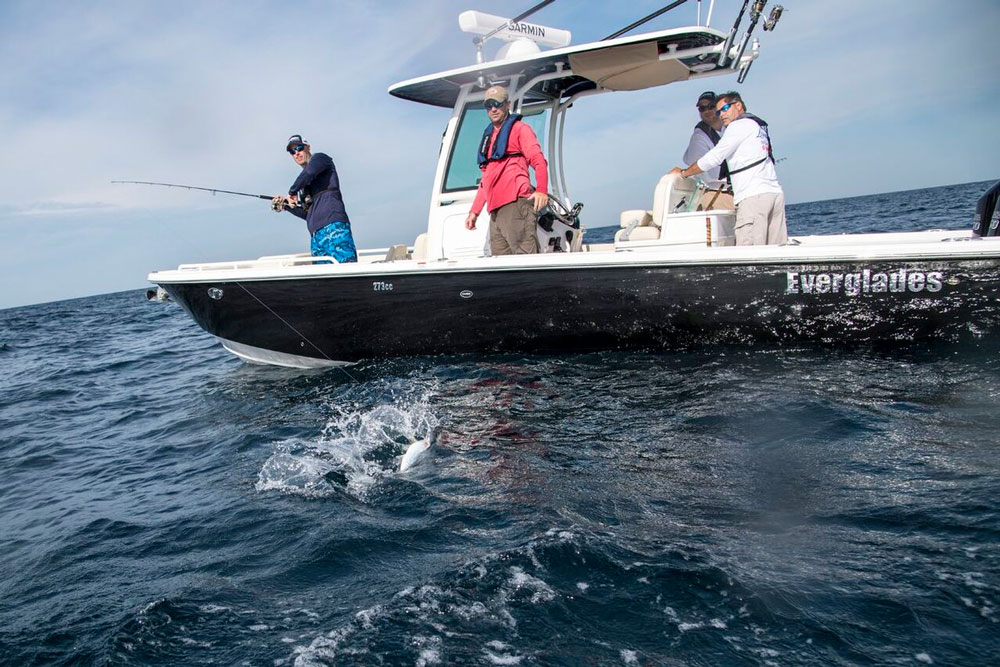
You need look no further than the live wells, fish lockers, rod stowage, and casting platforms for evidence of an Everglade’s fishability.
Looking deeper, the 273cc of course benefits from Everglades’ build quality and hull design. That includes its patented RAMCAP construction process, which mates pre-formed foam to the hull and deck as preassembled parts, instead of the foam being pumped in under pressure. The result is a hull and deck that behave as a single piece, greatly reducing vibration and flexing. That’s part of what gives any Everglades a great ride. The other part of the equation is a graceful but purposeful transition from a sharp forward entry back to a 20-degree deadrise at the transom. That’s a degree steeper than the 243cc.
So, is bigger better? In the case of the 273cc versus the 243cc, well… kind of. If you’re looking to go farther offshore in bigger weather but still enjoy the inshore and near-shore fishability of a bay boat, the 273cc is going to be hard to beat. But, if you live in an area where bluewater fishing is closer to shore and you’ve got a bend toward a boat with a bit more utility, the 243cc might be an overall better boat for you. Can’t make up your mind? Sea trial them both.
Other Choices: If you’re looking for a capable bay boat in this size range, also consider the Pathfinder 2600 TRS, or the SeaVee 270Z. Slightly smaller but still quite competent are the Ranger 2510 Bay Ranger, and the Grady-White 251 Coastal Explorer.
See Everglades 273cc listings.
For more information, visit Everglades Boats.
| Specifications | |
|---|---|
| Length | 27'3" |
| Beam | 9'3" |
| Draft | 1'6" |
| Deadrise | 20 degrees |
| Displacement | 6,400 lbs. |
| Fuel capacity | 157 gal. |
| Water capacity | 20 gal. |
| Performance Data | |||
|---|---|---|---|
| Test conditions: 15–20 MPH winds, two POB, two-thirds fuel. Performance data courtesy of Yamaha. | |||
| RPM | MPH | GPH | MPG |
| 1000 | 6.2 | 3.0 | 2.1 |
| 2000 | 9.2 | 7.5 | 1.2 |
| 3000 | 28.2 | 14.0 | 2.0 |
| 4000 | 39.3 | 23.1 | 1.7 |
| 5000 | 48.1 | 41.3 | 1.2 |
| 5850 | 54.9 | 50.1 | 1.1 |
| Power | Twin Yamaha F250 four-stroke outboards, swinging 15.25” x 18” three-bladed stainless-steel props. | ||