GPS for Offshore Sailors
Hot picks for built-in receivers
There is no question that GPS has revolutionized navigation. Many of the boats cruising our coasts, not to mention those sailing offshore, have some sort of GPS receiver onboard and some have made the leap to systems with differential receivers. An accuracy of 100 meters on average is common when the Department of Defense has selective availability (SA) switch on (most of the time). With land-based differential GPS added in, it is possible to reduce that to 10 meters or less.
But which of the receivers on the market today are right for real offshore sailing? We took a hard look at the best receivers generally available and discovered that what you see is not always whet you get ... although sometimes, what you get is better than you bargained for.
Several basic parameters should be laid out before we enter into the evaluations. First, we have used both built-in and hand-held receivers extensively and do not consider hand-helds to be primary, long-term offshore tools but great back up receivers. Second, chart plotters and GPS are separate and quite different technologies and should be treated individually, even though the two are now joined hip and thigh in many interesting, new navigational devices. Here, we review GPS alone.
Thirdly, there are only a handful of companies that actually build recreational GPS receivers, the actual chipsets or mother-boards that go inside the antenna and box. Among the leaders are: Trimble, Rockwell, Canadian Marconi, Leica-Philipps, Magellan and Garmin. If you are buying a GPS as part of an instrument "system," check out who made the GPS receiver. It was probably one of the above, which leads us to our conviction that it is wiser to buy a receiver with the manufacturer's name on it than one that is being resold under another name.
Lastly, having sailed many thousands of miles with sextant, time signal and tables and then many more miles with GPS, we appreciate the significance of the GPS revolution. GPS is no panacea. Its accuracy lies somewhere between wonderful and miraculous, but it still is regularly off by 100 meters, although often less. GPS should be added to the chart table as a part of the whole navigational solution that includes, charts, compasses, chronometer, sextant and the ability to navigate. Given those requirements, the system then can be considered the primary navigational tool.
What GPS Does
Most readers know the basics of how GPS works. But to review, an onboard receiver acquires a signal from the first clear satellite it sees, downloads an almanac of where the other birds are in orbit, and then begins to search for them. Once three have been found the receiver triangulates the readings from the satellites to establish a position. Add a fourth, fifth and six satellite and consistent accuracy improves dramatically.
The signals from the satellites are read by the receiver, either on a dedicated channel or on a channel (or channels) that shift rapidly from signal to signal reading several almost simultaneously. The first is a hardware solution: one channel one signal, more or less. The second is a software solution, called multiplexing, which permits less hardware to do more work.
Although multiplex receivers have worked well to keep performance reasonable and costs low, multi-channel, parallel receivers have proven time and again to be more reliable and more accurate. In this case, it appears that throwing hardware at the problem actually works. Garmin, in particular, has been a leader in multiplex technology. Yet, the company is developing multi-channel technology for the future. To generalize, multiplex is the technology of hand-held devices while multi-channel is the chosen technology for commercial and offshore systems.
As the GPS gathers information from the satellites, the GPS translates it into a number of different functions, including position, course-made-good, speed-made-good, cross-track error, position plot and so forth. Simpler devices, such as the Magellan 1200XL, have a number of screens that can be paged through. More sophisticated receivers will have a number of pages, behind which may be a number of other, more detailed screens, plus useful navigation databases. How easily and intuitively the screens are laid out and accessed will be the measure of how "friendly" and useful the GPS can be. Part of this is the legibility — the size-of the characters and numbers on the screen — an issue for those of us whose eyes are not as good as they once were.
Lastly, how well the device fits into the onboard navigation scheme of things is an important consideration. Does the GPS have the output capabilities to work with the radar, the autopilot and the sailing instruments? Does it have sufficient NMEA-compatible connections and the software to read the necessary NMEA protocols for most companion devices? Networking GPS into other systems may not be a high priority, but it can be extremely useful, particularly for shorthanded sailors.
Cost is an issue for everyone, particularly because GPS is not an insignificant purchase. But it is good to remember that GPS is a primary navigational device, right up there with the depth sounder, speedo/log and radar in the Pantheon of marine electronics. If you're going to spend money on electronics, spend it here before you go out and drop a bundle on a daisy chain of sailing instruments.
The eight devices we review below have been chosen for their quality and value to blue water sailors.
Trimble NT200
A pioneer in GPS technology, Trimble manufacturers a full range receivers for both the commercial and recreational markets. A leader in chipset technology, Trimble also has supplied receivers to several other name-brand manufacturers. The NT series, which was been created for the civilian marine audience, has also found its way into numerous governmental applications. For example, the NT200D is a standard aboard U.S. Coast Guard vessels and buoy tenders. Moreover, when the captains of the two recently-launched US submarines Wyoming and Louisiana specified GPS receivers for their boats, both called for the NT200D.
The NT200 and 200D (D signifying built-in differential capability) have six-channel parallel receivers (12 channels are optional) that will track eight satellites (or 12) simultaneously. Equipped with sophisticated P-DOP and angle-of-height filters, the receiver can weed out low (thus refracted) signals and discard anomalous signals formed during satellite switches. The resulting position fix is superior.
The user interface created by Trimble has become a sort of industry standard, including the course-over-ground screen — the "turtle-on-the-highway" image — which is now copied by all the major manufacturers. Shifting from the menu to the various function screens and then paging through data pages using the menu and toggle buttons is straightforward and logical. The screen itself is the largest on the market and easy to read from a distance. This is useful if the helmsman is using the "course over ground" function to compliment the cockpit compass. At night, the screen is very legible; however, in direct daylight, like most backlit LCDs, the image tends to fade.
Among its unique features, the NT200 will accept input from outside speed and log readers for data comparisons and DR purposes. Should the receiver's GPS function fail, it will continue to calculate DR positions using the actual data input.
The NT200 is ready to accept differential with the addition of the Acutis Differential receiver. The NT200D comes with the differential circuits built-in. Trimble's optional "Smart Card" reader allows the 200 and 200D to download waypoint and leg data and upload electronic chart data.
Finally, the Coast Guard awarded Trimble a contract to install coastal differential GPS broadcast stations, so the company will continue to lead the way as the new differential technology expands. We highly recommend the NT200 for offshore sailing and world cruising.
Northstar 941X
Northstar has never been a company to seek the broad segment of the market and its receivers, Loran and GPS, have long been considered "big boat" or commercial systems. There is no doubt that commercial fishermen, in particular, have chosen Northstar as one of their favorite GPS receivers, in no small part because the 941X will translate GPS positions into Loran TD positions. But, while "top of the line," the Northstar 941X and XD (with differential built in) are receivers that compare in price to other top-end receivers and offer as much or more. It is worth noting that this year and for the second year running, the Northstar 941 won the NMEA annual award for "best GPS."
The 12-channel receiver, tracking 12 satellites simultaneously, is built by Northstar's parent company Canadian Marconi, which supplies advanced navigational equipment to the aircraft industry and builds dedicated GPS receivers for Boeing. With excellent P-DOP, signal-to-noise and angle-of-altitude filers, the position fixes derived the by receiver are consistently excellent.
The screen on the unit is a backlit LCD with what is called "transflective graphics" — meaning that light and dark images are sharply delineated and therefore easier to read, particularly in sunlight. The unit functions via main screens and supplementary pages. A feature we like a lot is the on-screen directions that always locate the user among the many screens and pages. While a little study of the owner's manual will help, a competent navigator can operate the unit intuitively.
The 941X is differential ready, while the 941XD has the differential receiver built in to the main box. A single, combination antenna is available for those who go with the XD model. Both units come with tidal information (supplied by Marisystems) for 3,000 NOAA locations.
Northstar has brought the sophistication of aircraft technology together with the rugged demands of working offshore fishermen to produce a GPS receiver that is a pleasure to use, as accurate and reliable as any unit on the market and as durable as any offshore sailor would need. Although pricey at $1,675, this is a great GPS; We highly recommend it for offshore sailing and world cruising.
Leica MX400
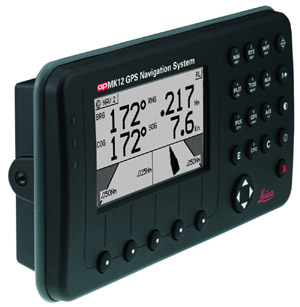
Most GPS receivers are aimed at a market segment — in other words, a price point. One that isn't is the Leica MX400, which was introduced in 1995 and is both the most expensive unit in this survey and the most elaborately equipped. Leica purchased the GPS division of Magnavox in 1994, thereby combining two high-tech giants under one brand. The MX400 is built around a chipset that was designed by Leica and built by Phillips in Denmark. Using highly tuned filters and circuitry, the receiver provides extremely high-quality reception and consistent accuracy.
The back-lit, black and white LCD screen is the best in the field; images are sharp, large and easy to read, even from a distance. The face of the unit is laid out similarly to the Trimble NT200, but in a smaller, more compact design. Toggling through screens requires a bit of practice and memorization, but once the software's logic is clear, the MX400 becomes a pleasure to use. We rate the screen's clarity and the ease of using the system very highly.
With four in/out ports that will handle all NMEA protocols and can be interfaced with RS232 connectors, theMX400 is meant to be the brains of a navigational set up. Linked to a daisy chain of sailing instruments, the radar and autopilot, and a laptop computer, the GPS will integrate a wide variety of on-board electronic functions. Moreover, internal software provides tide tables, sun and moon almanacs, wind calculations and much more.
Those who enjoy sophisticated instruments with multiple functions and elaborate databases will covet the MX400. At over $2,000 (through the catalogues), the unit is expensive, but not out of this world — particularly if you recall that only seven years ago, a single-channel hand-held receiver cost almost $3,000! As noted, there are several top-of the line GPSs from which to choose but none match the quality, the abundant features and the ease of use of the Leica MX400. We highly recommend it for all applications.
Micrologic ML250
Micrologic ... Doomsday. Strange how those words remain associated even two years after the day when all Micrologic GPS receivers then in use simultaneously came up with an error message ... unreliable fix. The nightmare of the information age: you can't trust either the satellites or the computers! But it was all smoke and no fire. The positions being calculated were not in error. The error message was in error. The errant chip in each unit had to be replaced (factory recall) and on the units went crunching numbers with a high degree of accuracy.
In some quarters, the smoke still hangs over Micrologic. But it shouldn't. The company, now owned by Vikay Industries of Singapore, which manufacturers the chipsets for the receivers, produces fine receivers at fair prices. The new MLS 250 is a sophisticated and complete receiver. With a 12-channel parallel receiver, high speed processing and multiple search correlators (24), the ML250 provides consistently accurate readings.
Mircologic devices have always been "brainy" — a nice way of saying "complex." The new ML250 has overcome this tendency by offering a simple "menu-point-enter" process that allows the user to go straight to the needed function and then underlying pages. Along the way, functions and pages are clearly road-mapped and the way home to the menu only a button-push away.
Several interesting databases have been installed as standard equipment, including a world map, a light list with 16,000 entries, sun and moon almanac and PC interface software. Additional databases are available as options.
While not the most sophisticated or most advanced GPS on the market, the MLS 250 is an excellent receiver. At under $600, we highly recommend it as both a good offshore, world-cruising GPS and a great value.
Furuno GP50
An eight-channel parallel receiver that has been designed to work in close interface with Furuno radar, chart plotters and differential receiver, the GP50 is a workhorse GPS. It does what it needs to do without bells and whistles. The receiver has been equipped with standard filters, and an "all-in-view" computing algorithm so the quality of the calculated positions will always be high.
The no-frills software and screen set-up, work on a dedicated push-button approach that opens function screens and then allows the user to page through sub-screen data. While not the easiest screen to read, the 5 1/2-inch backlit LCD has good contrast and large, legible characters.
Furuno is a world-wide company that has a loyal following in the commercial and fishing fleets of the world. Those planning to equip a boat with a Furuno radar would do well to mate the GP50 with it. Although not a first choice among GPS receivers for offshore sailing, the Furuno GP560 is a solid, reliable receiver and that will provide good service.
Raytheon NAV398
Ratheon Marine, like Furuno, is a marine electronics company that offers a whole range of devices and systems. Thus, the NAV 398 is both a stand-alone unit and one that can be interfaced easily into the company's existing line of products.
The receiver in the NAV398 is the Raystar 108, which appears in various forms through the company's Raytheon, Autohelm and Apelco products. An active GPS receiver, the 108 is manufactured by Rockwell International for resale to equipment manufacturers. The Rockwell receiver is a solid eight-channel parallel, continuous-tracking antenna that tracks up to eight satellites. While Raytheon only claims a "time to fix" after initialization of 3 minutes, in practice the receiver operates much faster than that, providing boot-up fixes in less than a minute.
Using an LCD screen with automatic contrast control, the screen should adapt to light and dark and direct sun conditions. In fact, in direct sunlight the screen reflects light and obscures parts of the display, which in turn seems to fade slightly in density and contrast.
Like the Furuno receiver, the 398 is a no-frills device that provides reasonable performance with excellent Raytheon system integration. The 398 has only one NMEA port but it does also support Autohelm's SeaTalk software. If the Autohelm system is going in on deck, with a Raytheon radar and an Autohelm autopilot, then the 398 would be a logical choice for a fix-mounted GPS at the chart table. This is particularly the case if Loran is to be interfaced to the system. We recommend the NAV 389 as a good mid-range GPS at a fair price.
Magellan 1200XL
Magellan is one of the pioneers of GPS for everyman. The introduction of the 1000 series receivers in the late 1980s brought the cost of owning GPS to under $3,000 — amazing at the time. Relying on simple multi-phase receivers that scanned and located satellites slowly and often lost contact at odd moment, the early systems were wondrous if less than perfect. Since then, the 1000 series hand-held has been refined and new receiver technology incorporated, offering 10-channel parallel accuracy and reliability in their hand-held DLX 10 and NAV 650 chart plotter.
The 1200LX is a kind of hybrid, being half old multiphase and half new multi-channel. In fact, it uses a two-channel receiver that scans up to 12 satellites. This is the technology developed in the successful hand-held 3000 series and Meridian receivers, adapted to a fix-mount application.
The 1200 offers simplicity and low cost over sophistication and expense. Six simple screens, well road-mapped with signs, provide the basic navigational functions. In fact, the screen protocols in this series of Magellans is far easier to use than in earlier generations.
With one NMEA in/out port, the receiver may be interfaced with other instruments or the autopilot, providing the NMEA codes and protocols match. This should be checked prior to making a purchasing decision.
We have sailed many miles with older Magellan technology and always marvel at its cranky consistency. The new mid-range units, like the NAV 1200XL, work even better and provide GPS accuracy at low cost. For those with limited budgets, smaller boats, or in the market for a small back-up GPS, the 1200 XL comes warmly recommended.
Garmin GPS 120
On the highly competitive edge of the mass market in GPS, Garmin and Magellan have been slugging it out for years. Garmin's new GPS 120 is designed to counter Magellan's 1200 XL ... or is it the other way around. Both are basically hand-held, multiplex receivers adapted to fixed-mount applications. The 120 uses Garmin's MultiTrac8 receiver, which scans eight satellites for best triangulation.
The edge that Garmin may have earned in the small hand-held market (we do not know sales numbers) may be due to the software developed for the GPS 40 an 45. Using a simple menu and "go to page" function that makes finding the desired information and then moving on a cinch.
The 45 series uses a high contrast black and white LCD screen, which is easy to read. The new 120 has gone to a plain, gray-scale LCD which does not offer the same contrast and sharpness. That said, the screen is large and readable when out of direct sunlight.
The Garmin receiver technology has proven to be remarkably reliable and accurate, while the software in the box makes using their systems intuitive and easy. Like the Magellan 1200 XL, the new Garmin 120 makes a good budget GPS and a great backup or second receiver for offshore sailors. Most of all, it is a great value at well under $400.
Conclusion
In the three levels of the GPS market, three receivers stand out as the best for long term use in a blue water environemnt. At the top of the range we recommend the Trimble NT200 as both a great receiver at a good price. In the mid-range, the Mircologic ML-250 stands alone as the best receiver at the best price. And, between the budget receivers, the Magellan 1200LX is our choice — as a back-up to our Trimble or Micrologic.
For More Information
Trimble Marine Products, 2800 Wells Branch Parkway, Austin, TX 78728. phone: (800) 827-2424;
Leica, 32868 Hawthorne Blvd., Torrance, CA 90505;
Micrologic, 9610 DeSoto Ave., Chatsworth, CA 91311, phone: (818) 998-1216;
Raytheon Marine Co., 676 Island Pond Rd., Manchester, NH 03109-5420, phone: (603) 647-7530;
Magellan, 960 Overland Ct., San Dimas, CA 91773, phone: (909) 394-5000;
Garmi, Olathe, KS, phone: (913) 397-8200.