Mystic Building 40-Foot Catamaran Series for 2014
The smallest model in the exotic Mystic catamaran line will become a reality next year.
Almost four years ago, I stood next to John Cosker, owner and founder of Mystic Powerboats in DeLand, Fla., during the drivers’ meeting before the 2010 Desert Storm Poker Run on Arizona’s Lake Havasu. Like most custom high-performance powerboat builders, Cosker was looking for something to spark his business in what were the darkest of economic times.

Almost four years in the making, the C4000 Series of 40-foot Mystic catamarans will start production in March 2014.
He told me that as soon as he got his first order he would start building a new catamaran in the 36- to 42-foot range. It would join his immensely successful 50-foot offshore racing model, and it would be available in a few different versions.
Since then, I’ve spoken to Cosker just about every month for various news stories on his projects—Mystic is a notable player in the go-fast powerboat game, and that’s my beat to cover. At the end of every interview, I always asked him about the smaller cat project. And I always got the same answer.
“Just not ready to pull the trigger on that yet—still waiting for the first buyer to step up and order one.”
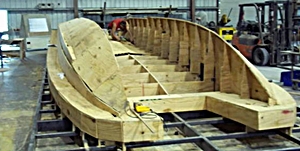
This image of the developing hull plug for the 40-footer in its early stages was taken at Vectorworks Marine.
In the dry pits during the Super Boat International Offshore National Championships this year in Clearwater, Fla., Cosker pulled me aside. I thought he might want to give me some inside information on the Qatar’s new turbine-powered 50-foot Mystic cat. Not so.
“You have to keep this to yourself until I call you in a few weeks,” he told me with a giant smile across his typically tough-to-read face. “We’re building the 40. I have orders for three of them. We’re getting started on the tooling next month.”
Called the C4000 Series, the catamaran will be available in an open-cockpit version called the C4000S, a high-performance canopied pleasure version called the C4000RS, and a pure offshore racing version—called the C4000R—aimed at the growing Super Boat International Supercat class. New plugs for the tooling are being CNC-milled at Vectorworks Marine in Titusville Fla., and Mystic will build the molds in house. Production on the new C4000 series will begin March 2014.
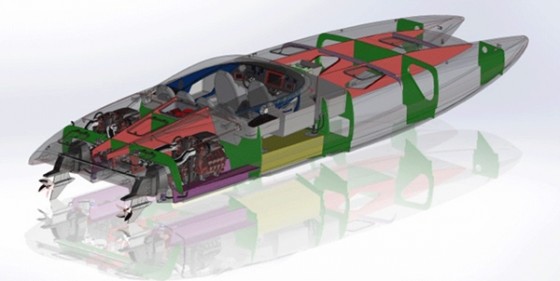
A CAD-generated cutaway view of the new Mystic C4000S, which will be offered in Pleasure, Race/Pleasure and Offshore Race versions.
"A lot of people were interested in having us build a 40-foot cat, but no one was able to commit to it," said Cosker. "I didn't want to make the investment in hundreds of thousands of dollars of tooling without having orders. Now, we have three buyers, one for each model, so we're moving ahead."
Two of the buyers currently own 50-foot Mystic cats and are well known in the go-fast boat community. Ron Szolack of "Flight Club" go-fast boat fame is getting the first open-canopied 4000S, which likely will be powered by twin 700-hp engines from Mercury Racing.
"I have the 50-foot Mystic now and it's just such a big boat to trailer around," said Szolack. "I just wanted a smaller model. I love the way the 50 rides and handles, so I'm going to try the pleasure version of the 40 with a pair of Mercury Racing 700s. John said it should run around 140 mph with those."
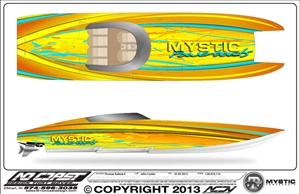
Using graphics created by Thomas Kulesia, III of No Coast Design, Mystic will paint Szolack’s Mystic C4000S in-house.
Tom Borisch, who sold his old piston-powered Mystic 50-footer to Szolack before buying the former JBS Racing turbine-powered 50-foot Mystic for poker runs, has ordered the first canopied 4000RS. Twin supercharged or turbocharged engines from Sterling Performance will power Borisch's new cat.
"I'm either going to put in a pair of Sterling 1550s I have now—I'm a big Sterling fan—or a pair of their new 1700s with the new turbocharger housing castings they have for them," Borisch said. "This is a great opportunity. I've had a lot of experiences with people in marine industry, and I trust John Cosker. There are no surprises with him—he does what he says he's going to do. I talked to my wife about it, and it's almost a no-brainer."
Borisch said he doesn't know if his new Mystic will replace the one he currently owns. "I may sell the 50, I may end up keeping both," he said. "I'm not sure what I'm going to do."
While Chris Mills of Boat Customs will handle graphics for Borisch's 40-footer called Game Changer, Mystic will take care of the graphics—based on a design from Thomas Kulesia, III, of No Coast Design—for Szolack's cat.
Likely to make an immediate impact on the offshore racing circuit, the first 4000R will go to a well-known team that—right now, at least—wants to keep its name out of the media. The team currently plans to campaign the 40-footer in SBI's Superboat class next year.
Cosker originally planned to modify the tooling of his existing 50-footer to create a smaller version of it. Shortly into the project, he decided to scrap that strategy and create a new design.
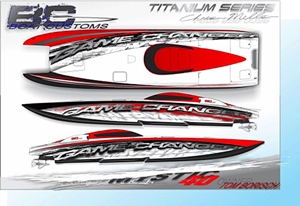
Chris Mills of Boat Customs created the “Game Changer” graphics for Borisch’s 40-footer.
"I couldn't do what I wanted to do with the 50 to make it a 40 without some compromises I wasn't willing to make," he explained. "So I started from scratch with a clean computer screen and designed an all-new model. Because I did that, I was able to do a lot of things with the 40 that I had wanted to with the 50.
"The stepped bottom of the 40 is a bit more aggressive than that of the 50," he continued. "The goal in that more-aggressive bottom configuration is to carry the boat better at lower speeds so the racing version can get out of corners quicker, as well as carry the heavier pleasure version better at lower speeds with the added weight in appointments that poker run boats tend to have in them. The design will be the next evolution of Mystic, incorporating everything we've learned during almost 10 years of building the 50-footer."
The R and RS models will have the same canopy as the 200-plus-mph Mystic C5000R with a full carbon fiber and Kevlar roll cage and inch-thick laminated windshields.
All C4000 catamarans will be built the same way, which means with carbon infused with epoxy. Mark Bishop of Waterfront Composite Solutions in Davidson, Md., which handles structural engineering for Mystic, currently is working on a final lamination schedule. Bishop performed the engineering work on all of the Mystic models including the C5000, the SL700 express yacht, the C62 express cruiser, and the Silverhook Mystic V-bottom raceboat built for Nigel Hook and Michael Silfverburg.
Mystic will work with Composites Consulting Group in DeSoto, Texas, to set up the infusion process—that company will handle all of the flow models and setup specifications to infuse the hulls, decks, and the liners on the pleasure boats.
According to Cosker, the C4000 will be a highly engineered boat created using Solidworks CAD software. From the hull and deck to the engine to the bow and stern eyes, every element used in the model will be fully assembled in the computer file before production for precisely built boats and fast deliveries, he said.
While the final price has yet to be released, buyers can expect it to be in the high six-figure range, depending on power and options.