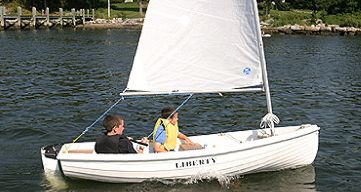
Hunter Xcite and Hunter 146: Two New Dinghies Debut
Hunter Xcite and Hunter 146 debut this fall
September 14, 2002
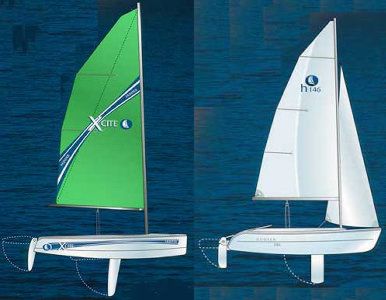 Hunter Marine Corporation of Alachua, FL USA will debut two new dinghy models for 2002. These new models are being built at the new Hunter Composite Technologies facility, formerly JY Sailboats, in East Lyme, CT. Both boats will feature the patented Advanced Composite Process that combines a thermoformed UV protected plastic, fiberglass mat and injected foam into a rigid, sturdy hull that is five times more impact resistant than conventional fiberglass.
HUNTER XCITE
The Xcite is clearly targeted at the entry level market, carrying a price tag of just $1995 in the base model. There are two sail rig sizes for varying sailor weights, skills and windspeeds. Color selection and graphics likewise runs the gamut from plain vanilla to combinations that will please your wildest child.
At 95 pounds, the Xcite is easily cartopped, and lightweight enough for kids to launch and pull up on the beach. Parents will be pleased to find that the boat is completely unsinkable.
ACP description
ACP is the most modern production boat building method being used today. It starts on the outside with a tough outer shell that is both weather and scratch resistant. The outer layer is then backed up with a high density urethane foam to add stiffness and impact resistance. The entire structure is strengthened by a layer of knitted biaxial fiberglass bonded inside the foam.
Finish
The outer layer of ACP is a BASF plastic called LURAN-S. This plastic is specially formulated to provide a beautiful glossy finish that is very easy to maintain. Dirt and grime is easily removed without the use of harsh chemicals. The finish will never develop the crazing associated with gel-coat and since the color goes so deep into the outer layer, scratches can be sanded out and buffed back to nearly new finish. This makes most minor damage easy to repair without using special techniques, resins, or paints. Since you can do this quickly and easily yourself, you'll save money. But since the ACP structure is so much stronger than fiberglass, you're much less likely to have to repair it to begin with.
Impact resistant
 The outer plastic surface of the structure works in combination with urethane foam backing to provide nearly 5 times the impact resistance of traditional fiberglass. Instead of thin brittle coating on the outside, the ABS backed Luran-S plastic is both thick and flexible. When an ACP boat is struck by an impact, the outer skin will flex slightly to absorb the energy. Flexing is much better than breaking. Next, the urethane foam backing supports the skin and diffuses the impact energy through a large area. Finally, the fiberglass backing holds the structure intact, thus preventing significant damage. Where a fiberglass boat might have a large crack or hole, an ACP boat will suffer no more than a surface scratch.
Positive Flotation
Aside from it's beautiful and durable finish, ACP construction provides yet another benefit. Safety. The foam backing that provides the structural rigidity, also makes the boat unsinkable. In the unlikely event an ACP boat is completely filled with water, it will still stay afloat. The material itself provides the positive flotation, eliminating the need for airbags or foam blocks inside the hull.
HUNTER 146
 The 146 is targeted at the niche between the Laser and a traditional Daysailor.
Families and new sailors will love the New Hunter 146. Higher sides and a wider beam create more confidence and the unsinkabilty provides peace of mind for the parents. The 146 is easy to trailer, rig and launch and it will carry the entire crew. A versatile boat for the family on the go! The new Hunter 146 is built utilizing the patented Advanced Composite Process which combines thermoformed UV protected plastic, fiberglass mat and injected foam that is conformed into a rigid, sturdy hull that is five times more impact resistant than conventional fiberglass..
Wide beam gives spacious cockpit and stability
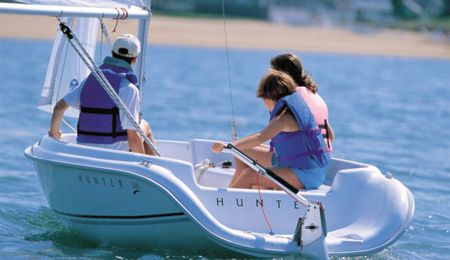 The 140 has a beam of nearly 6 feet. The wide beam combined with a low center of gravity and a large centerboard helps keep the boat very stable when sailing. As the wind tries to tip the boat over, the weight of the crew is aided by the hull form in counteracting the force of the wind. The beam is like a lever arm increasing the stabilizing force of the crew as it gets further away from the center of the boat. The lever force of the weight is also aided by the buoyancy of the boat on the low side. The upward force of the boat bottom trying to float counteracts the wind's efforts to tip the boat over. Since a wide hull has more area for buoyancy, it has more upward force on the low side to counteract the heeling force of the wind. The third element working to keep the 140 stable is the centerboard. Imagine making your hand perfectly flat and moving it through the water. Naturally, it's much easier to move it edge first then palm or back first. A centerboard works on a similar concept. As it projects below the boat, it's easily driven forward on the leading edge. The force of the wind trying to tip the boat pushes the face of the board against the water. This is a lot like moving your hand through the water palm first. The foil shape of the board also helps convert the sideward force into forward motion
High boom clearance
The 140 boom is set 31" above the sitting position. This means that most kids, or anyone under 5"4", won't ever have to duck to clear the boom during a tack or jibe. Some boats have extremely low booms that require all kinds of bodily contorsions to clear the boom. Even a taller person need only duck a few inches on the Hunter 140.
Kick up centerboard vs. daggerboard
A centerboard is much easier to operate than a daggerboard. First, it stays in the boat all the time. Since it can't come out, it can't get lost. Raising and lowering is a simple matter of pulling or easing out a line. Lifting up a daggerboard under load can require a great deal of upward force. If you run aground with a centerboard it simply pivots back and rides over the object. If you hit bottom with a daggerboard, the first thing that will happen is that your boat will come to a sudden stop. Since it will now be under great load, raising it up to get free of the obstruction will be much harder. The 140 uses a bunjee cord to draw it's pivoting centerboard into the down position. If you hit an object or run the boat onto the beach, the upward force of the object overcomes the downward force of the bunjee cord and the board simply retracts into the trunk.
Self bailing cockpit
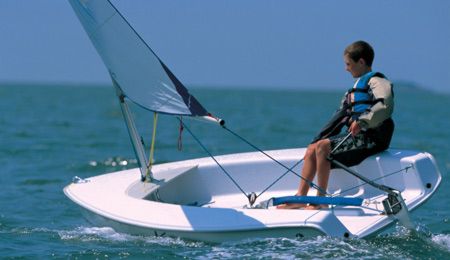 The Hunter 140 cockpit is designed to drain completely on it's own. No bailing required! The floor of the cockpit is slightly above the waterline of the boat and sloped aft to direct all water out. This eliminates the need for below the waterline "automatic" bailers which can leak water into the boat. This is also safer since you can never "swamp" the boat like a bathtub full of water. Any water that comes into the boat simply drains out the back. This is also great when the 140 is out of the water. If you store it level or with the bow slightly up, all the rain water will drain right out.
Jib
Sailing should be fun for everyone on board. This is one reason the 140 is equipped with a jib. Rather than just sit there, your passenger can be part of sailing the boat and learn by doing rather than watching. The telltales on the jib show the flow of wind on the sail, helping to guide in steering and trimming. The jib also functions to help generate airflow across the mainsail, enhancing performance. Boats with jibs generally sail better towards the wind than boats without jibs. This means your 140 will naturally "point" better than a boat with a single sail. The jib sheets are controlled through pivoting "cam" cleats making trimming easy from any position, even the helm.
Specifications
Hunter Xcite Specifications
| LOA | 9'11" | 3.02m |
| Beam | 4'8" | 1.425m |
| Draft (board up) | 6" | 0.15m |
| Draft (board down) | 3'6" | 1.07m |
| Dry Weight | 115 lbs. | 56 kg |
| Mast Height | 16'6" | 5.03m |
| Sail Area (Standard) | 46 sq. ft. | 4.26m2 |
| Sail Area (Turbo) | 54 sq. ft. | 5.00 m2 |
Hunter 146 Specifications
| LOA | 14'9" | 4.5m |
| Beam | 6'4" | 1.93m |
| Draft (board up) | 9" | 0.23m |
| Draft (board down) | 3'0" | .91m |
| Dry Weight | 255 lbs. | 115.77kg |
| Mast Height | 16'7" | 5.06m |
| Sail Area | 110 sq. ft. | 10.22 sq. m |
Hunter Marine Corporation
Route 441, Post Office Box 1030
Alachua, Florida USA 32615
Phone: 386-462-3077
Fax: 386-462-4077
e-mail: [email protected]
Customer Service Hotline
(8am to 5pm EST)
1-800-771-5556
www.huntermarine.com