Perry Design Review: Freedom 45
Cruising innovation in center and aft cockpit.
Gary Mull is responsible for all the current Freedom yachts as well some classics. Both the Ranger 26 and 29 were rockets in their day and retained their race course vitality for a long time. The sleek Ranger 37 won the SORC. Gary's one-off Improbable was a dinghy-like approach at an offshore yacht and compiled a very impressive race record. Improbable is now berthed in Seattle and has been converted to a cruising yacht with a very ugly paint job. Gary is on of those designers who you can call at any time with a question. You have to be prepared for a dose of Mull-ian wit and sarcasm, but it is always well worth it. Gary's current work load includes a good deal of composite construction engineering for both the yachting and aerospace industries.
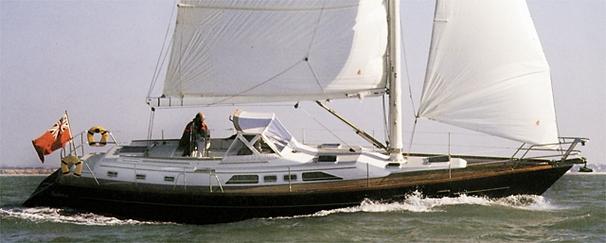
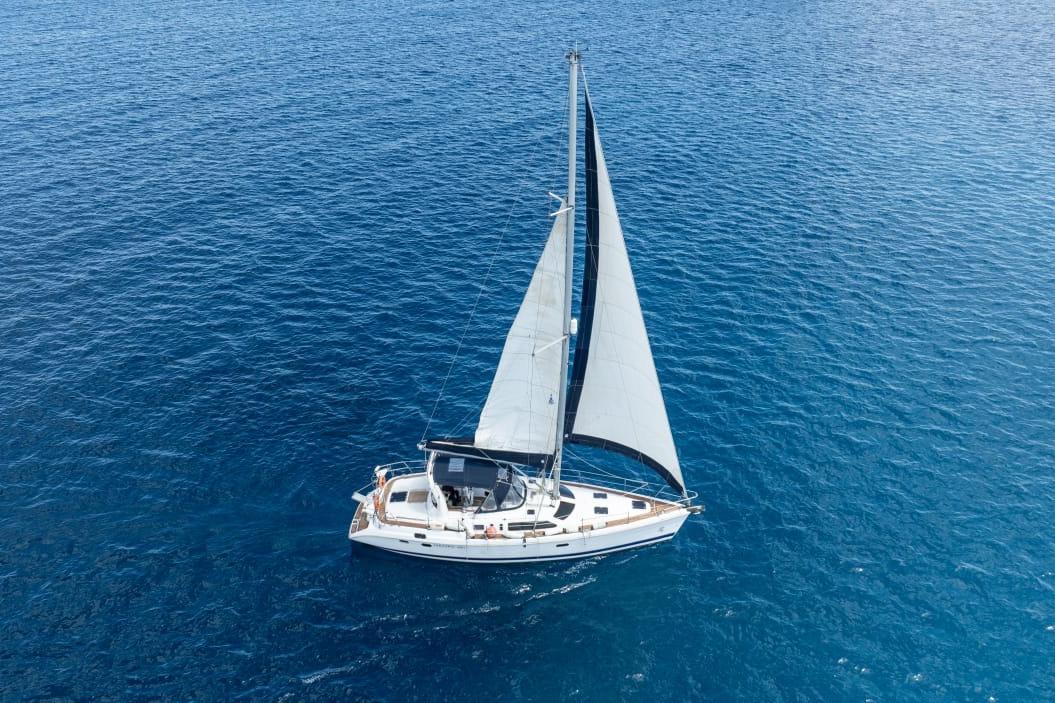
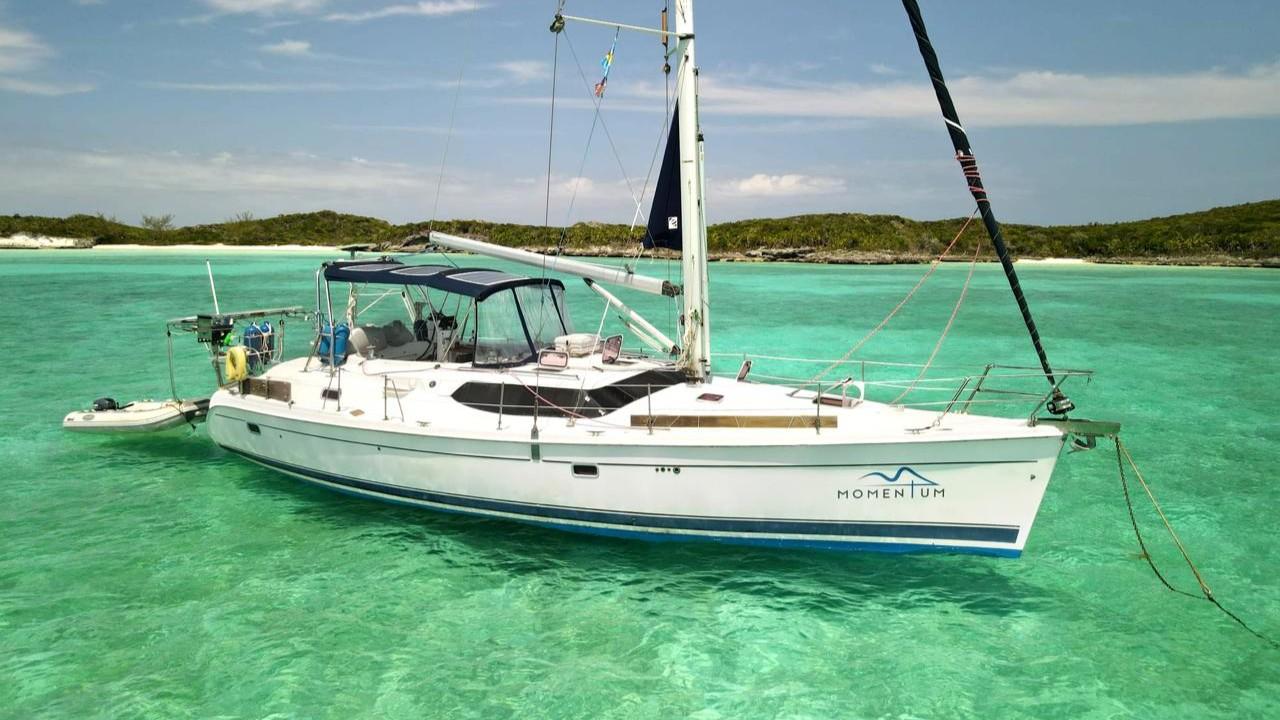
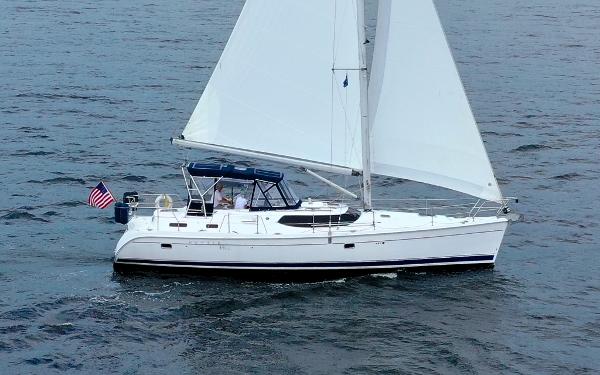
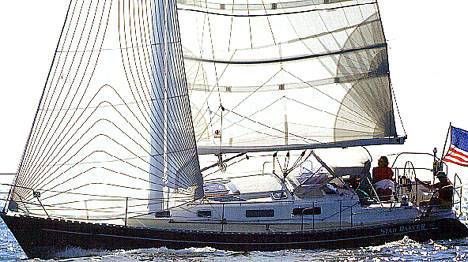
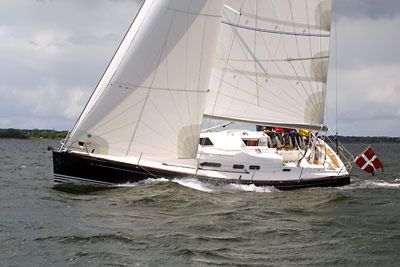
The Freedom 45 CC under sail.
The newest Freedom is this center cockpit version of the 45. Consider the origins of this line. Several designers were involved with the early efforts as the concept went through a slow evolution. When Mull came on the scene with Freedom he took the concept and used the technology developed for the free standing rig to do a rig that in the case of the 45 is definitely a sloop. The boats share other characteristics as well as rig design. All the current Freedoms are volume-oriented designs aimed at cruising comfort.
The race boat designer can work from a hull shape and rig size leaving the interior until last. The cruising yacht designer must start with the accommodations and then do his best to wrap a good hull around the volume requirements. Does this sound like compromise? Perhaps, but keep in mind that while a tenth of a knot may be a breakthrough on a racing yacht the cruiser loses far more than a tenth paying more attention to this sandwich than his genoa trim. That's OK. The racer wants to win. The cruiser wants to have fun. If the racer can't find that extra tenth of boat speed that he had last week his day will be ruined. The cruiser's day is ruined if someone leaves the sandwiches sitting on the dock box.
The designer must seek a balance of characteristics. The ability to point to 28 degrees apparent wind may be traded off for a wider toe in the V-berths. Where you want to go has far more effect on keel design than how fast you want to get there. The only formula I know of to assist in the balancing of cruising considerations is Ted Brewer's tongue in cheek comfort formula — displacement in pounds divided by .65 times .7 DWL plus .3 LOA multiplied by the beam to the 1.333 power.
There are two factors that make the interior of the aft cockpit 45 worth extra study. The location of the mast frees up the center of the boat. The high freeboard of the 45 allows the cabin sole to come up increasing usable volume. Unfortunately, both the companionway ladder and dining table are missing from the drawing I reviewd and this exaggerates the open space somewhat. But we can adjust for that. From my experience this is a typical cruising layout for this size.
Gary Mull Comments
It is great fun to share the page with Bob and to be asked to provide a few comments on the basic technical aspects of the Freedom 45 and the new aft cockpit version of this design.
When Freedom asked me to design a larger and more spacious boat to follow our four previous designs for Freedom, I knew the basic design concepts we used on those other Freedoms had served well. While designing racing boats I have never seen any reason to be particularly conservative, and had no qualms about designing the double ruddered keel-less 12-Meter USA, but for cruising boats, intended to go wherever their crews want to take them, moderation is the watchword.
The hull of the F-45 is of moderate displacement/length ratio, 253 at DWL, but with a hull shaped to allow it to be loaded well below that with the equipment, stores, etc., most want to take on long-distance voyages. Hull volume and good form stability are achieved with a fairly fine entry so as not to sacrifice good motion in a seaway.
The sloop rig is based on a freestanding mast together with self-tending jib. While certainly not traditional, a properly designed and fabricated carbon-fiber spar is quite functional and in overall design terms makes good sense for the cruising owner. It is axiomatic that more parts mean more possible problems. When asked if a lack of rigging isn't dangerous, we note that Orville and Wilbur used wires but Boeing doesn't.
Two sizes of rig are available. The short rig, shown in the mid-cockpit sail plan, is sized to accommodate bridge clearances on the inland waterway, while the larger rig, shown in the aft cockpit sail plan, is more suited for light air areas.
Ease of handling, especially short-handed, is where we spend most of our rig and sail plan design efforts. Main and jib are self-tacking. All running rigging is led aft to the cockpit through stoppers to large winches so that sail can be made and handled easily by one person without leaving the cockpit. An electric-powered winch for the main halyard ensures that anyone aboard can hoist sail with ease.
Sailors new to a Freedom need only tack up a narrow harbor entrance simply turning the wheel, while normal boats fight their way with much winching and grunting or go through one all-standing gybe, waiting for the boom to crash into the lee shrouds (which aren't there), to understand one of the advantages of our rig.
While we offer a straight fin keel, most owners now opt for the winglet keel. This reduces the draft from 6 feet 6 inches to 4 feet 11 inches. Performance of the two versions is virtually identical.
Naturally, as the F-45 is designed to cruise offshore, stability and safety are prime considerations. Overall center of gravity, and therefore stability, is the same with either keel, being achieved with a somewhat heavier wing keel. All aspects of the F-45 are designed to comply with existing USCG, NMMA, and NFPA codes, as well as ORC safety regulations.
As with all Freedoms, the F-45 structural design uses knit unidirectional E-glass reinforcements over a balsa core.
This new aft-cockpit version has a somewhat smaller owner's cabin than the mid-cockpit version, but adds tremendous flexibility in the variety of arrangements offered to prospective F-45 owners. The arrangement shown here is one of three we have developed for Freedom.
Forward is a V-berth cabin with separate owner's head, including shower. This cabin can also be fitted out with a double berth to one side and sit-down dresser opposite if desired.
Coming aft, the main saloon provides seating for six at a table that folds out to starboard for full dinning. An entertainment center with TV, CD player and AM/FM cassette stereo, is one of the most popular options offered by Freedom.
The chart table, which is nowadays more of an electronics station, faces aft at the aft end of the starboard settee. It may be fitted with enough electronics to satisfy NASA, including satnav, GPS, etc. I am now working with an electronics manufacturer to provide a system that will display a computer chart of the area you're sailing, GPS position, and radar display on one screen.
The galley, with huge sink, three- or four-burner stove with oven and larger freezer/refrigerator is C-shaped to provide the cook with full support on either tack under sail but allowing the cook to be braced without being in direct line of the stove in case of hot spills. The sink is on centerline providing good draining on either tack. Below is the engine, up to 90 horsepower, in an engine box giving complete access but treated with soundproofing material discovered when I did some work on submarine sound dampening systems.
To starboard is another head with shower serving the two double berths aft cabins. These cabins, with full headroom, each have large hanging lockers, a set of drawers and gobs of stowage under.
 This story originally appeared in Sailing Magazine, and is republished here by permission. Subscribe to Sailing.